
Medically Reviewed By: Dr. SHABBIR HUSSAIN BPT
Last Updated: May 20, 2026
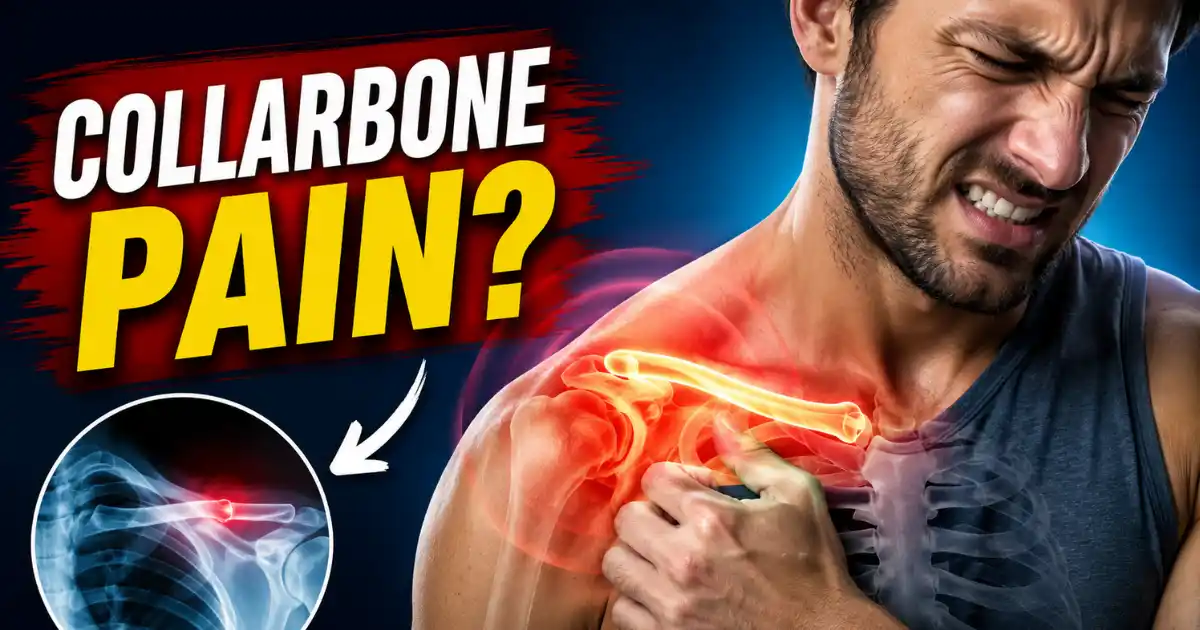
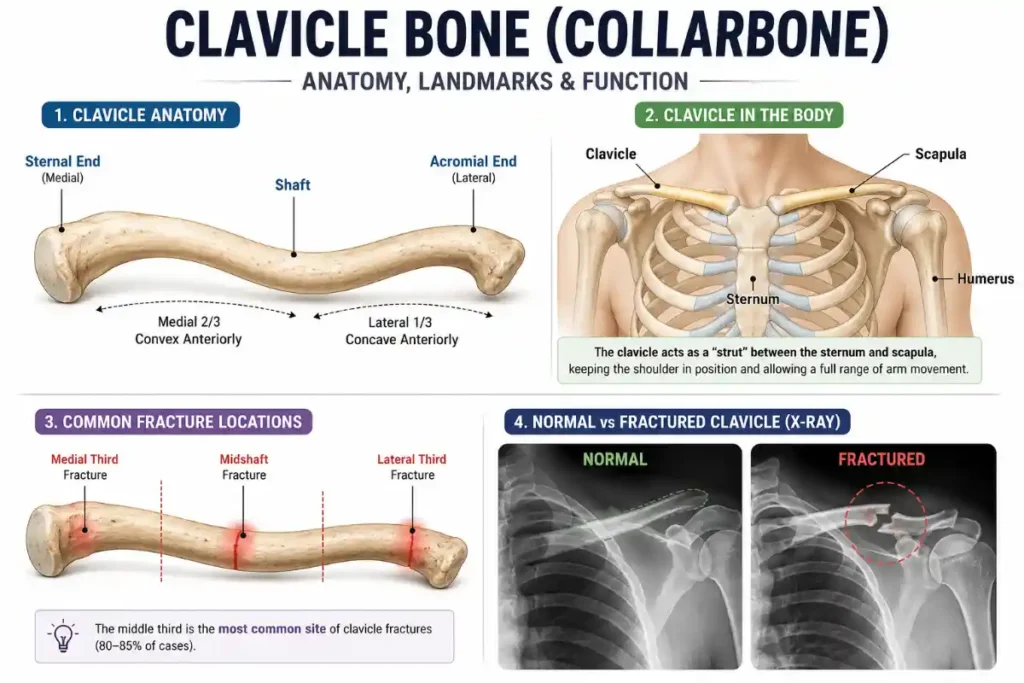
What is Clavicle Bone – The clavicle, commonly known as the collarbone, is a long, S-shaped bone located horizontally in the upper part of the chest.
It serves as a crucial structural component of the shoulder girdle, connecting the arm to the trunk of the body.
Each clavicle is position horizontally, extending from the sternum (breastbone) in the middle of the chest to the acromion, a bony process of the scapula (shoulder blade).
The clavicle lies above several important structures, such as major blood vessels and nerves.
Quick Clavicle Facts
- The clavicle is also called the collarbone.
- It connects the arm to the chest.
- It is one of the most commonly fractured bones.
- A clavicle fracture often happens during sports or falls.
- Most fractures heal without surgery.
Clavicle Bone important functions – clavicle facts
The clavicle bone has several important functions.
It provides support and stability to the shoulder joint, helping to keep the arm away from the midline of the body.
This allows for a greater range of motion and helps to prevent shoulder dislocations.
Additionally, the clavicle acts as a protective shield for underlying structures and helps transmit forces from the upper limb to the axial skeleton.
Clavicle Bone Fractures
Fractures of the clavicle are relatively common due to its exposed position and vulnerability to direct blows or falls onto the shoulder.
Treatment for clavicle fractures typically involves immobilization with a sling, though severe cases may require surgical intervention.
Overall, the clavicle plays a vital role in the functioning and stability of the shoulder joint, facilitating a wide range of upper body movements.
A clavicle fracture, also known as a broken collarbone, occurs when the clavicle bone is fractured or broken.
Clavicle fractures are relatively common and often result from falls onto the shoulder or direct blows to the collarbone.
Medical Disclaimer
The information provided on this website is for educational and informational purposes only and should not be considered medical advice, diagnosis, or treatment. Always consult a qualified healthcare professional or physician regarding any medical condition, symptoms, or treatment decisions. Never ignore professional medical advice because of something you read on this website.
Content reviewed by – Dr SHABBIR HUSSAIN BPT.
Signs and symptoms of a clavicle bone fracture may include:
- Pain: There is usually immediate pain at the site of the fracture, which may worsen with movement or pressure on the collarbone.
- Swelling and bruising: Swelling and bruising may develop around the fractured area.
- Visible deformity: In some cases, the fractured clavicle may cause a visible deformity or a bump at the site of the break.
- Difficulty moving the arm: A clavicle fracture may make it challenging to move the affected arm due to pain and instability.
If you suspect a clavicle fracture, it is important to seek medical attention for proper diagnosis and treatment.
Diagnosis is typically confirm through a physical examination, medical history review, and imaging tests, such as X-rays.
| Condition | Main Symptom |
|---|---|
| Clavicle Fracture | Sharp pain after fall |
| Shoulder Strain | Muscle tightness |
| AC Joint Injury | Pain at top of shoulder |
Clavicle Bone Fracture Treatment
The treatment for a clavicle fracture depends on several factors, including the location and severity of the fracture, as well as the individual’s age and activity level.
The two main treatment options for clavicle fractures are non-surgical and surgical approaches.
Non-surgical treatment:
Immobilization:
The most common non-surgical approach involves immobilizing the arm and shoulder with a sling, figure-of-eight brace, or clavicle strap.
This helps support the fractured bone and allows it to heal naturally. It will helps in reducing the pain and discomfort.
Pain management:
Over-the-counter pain medications, such as acetaminophen or non-steroidal anti-inflammatory drugs (NSAIDs), may be recommend to manage pain and reduce inflammation.
Physical therapy:
Physiotherapy plays a crucial role in the rehabilitation and recovery process following a clavicle fracture.
The goal of physiotherapy treatment for a clavicle fracture is to –
promote healing, restore shoulder function, improve range of motion, and regain strength in the affected arm and shoulder.
The specific physiotherapy treatments may vary depending on the individual’s condition and the stage of healing.
Here are some common physiotherapy interventions use for clavicle fracture:
Early stage (immobilization phase):
Pain management:
Techniques such as ice or heat therapy, transcutaneous electrical nerve stimulation (TENS), or ultrasound may be use to manage pain and reduce inflammation.
Passive range of motion exercises:
The physiotherapist may guide you through gentle movements of the shoulder joint
To prevent stiffness and maintain mobility while the clavicle is immobilized.
Education:
You will receive guidance on how to protect the healing clavicle.
Proper use of the sling or brace, and any activity modifications necessary during this phase.
Mid-stage (early mobilization phase):
Active range of motion exercises:
As the fracture begins to heal, you will be gradually introduced to active shoulder movements
To improve flexibility and restore the joint range of motion.
Strengthening exercises:
Specific exercises targeting the muscles around the shoulder
including the rotator cuff muscles and scapular stabilizers, will be prescribed to regain strength and stability.
Proprioceptive and balance training:
Activities that challenge balance and coordination, such as standing on one leg or using a balance board, can help improve proprioception and restore functional stability.
Late stage (advanced strengthening and functional training):
Progressive resistance exercises:
The physiotherapist will introduce resistance training using weights, resistance bands, or exercise machines to further enhance muscle strength and endurance.
Functional training:
Activities that simulate real-life movements and tasks, such as reaching, lifting, and pushing, will be incorporated to improve functional capacity and restore full shoulder function.
Return to sports or activities:
If you participate in sports or specific activities, the physiotherapist will guide you through a gradual return-to-sport program.
Ensuring you regain the necessary strength, stability, and range of motion before resuming full activity.
During the rehabilitation process, your Qualified physiotherapist will closely monitor your progress and provide guidance on proper exercise technique.
And make any necessary modification to the treatment plan.
It is important to follow the physiotherapy program consistently and communicate any concerns or difficulties you may experience to your physiotherapist.
Surgical treatment:
Open reduction and internal fixation (ORIF):
In cases where the fracture is significantly displaced, unstable, or involves multiple fragments, surgery may be recommended.
During ORIF, the surgeon repositions the fractured bone fragments and secures them in place using metal plates, screws, or wires.
This procedure helps maintain proper alignment and stability during the healing process.
Intramedullary fixation:
Another surgical technique involves inserting a specially designed metal rod or pin inside the clavicle to stabilize the fracture and promote healing.
The choice between non-surgical and surgical treatment depends on various factors, including the individual’s age, occupation, activity level and the specific characteristics of the fracture.
Your healthcare provider will evaluate these factors and recommend the most suitable treatment approach for your specific case.
Following any treatment method, regular follow-up visits will be necessary to monitor the healing progress and make any necessary adjustments to the treatment plan.
Rehabilitation exercises and physical therapy are often an essential part of the recovery process to regain strength, range of motion and functionality in the shoulder.
Did You Know?
The clavicle is the first bone in the body to start developing before birth — and one of the last to fully mature.
FAQ’s
Q: What is a clavicle fracture?
A: A clavicle fracture is a break in the collarbone, the long bone that connects your shoulder blade to your chest. It’s one of the most common bone fractures, often caused by falls, sports injuries, or direct blows to the shoulder. The clavicle bone can break in the middle (most common), near the shoulder, or near the chest.
Q: How long does it take for a clavicle fracture to heal?
A: Most clavicle fractures heal within 6 to 12 weeks with proper treatment. Adults typically need 8-12 weeks, while children may heal faster in 3-6 weeks. Complete recovery and return to full activities may take 3-4 months. Healing time depends on fracture severity, age, overall health, and treatment method used.
Q: What are the symptoms of a broken clavicle bone?
A: Common symptoms of a clavicle fracture include immediate sharp pain in the collarbone area, visible deformity or bump, swelling and bruising, inability to lift the arm, grinding sensation when trying to raise the arm, shoulder sagging forward and downward, and tenderness to touch. Seek immediate medical attention if you experience these symptoms.
Q: Can a clavicle fracture heal without surgery?
A: Yes, most clavicle fractures (about 80-85%) can heal successfully without surgery using conservative treatment. This includes wearing a sling or figure-of-eight bandage, pain management, ice therapy, and gentle rehabilitation exercises. Surgery is typically recommended for severely displaced fractures, open fractures, multiple bone fragments, or fractures that break through the skin.
Q: What causes a clavicle fracture?
A: Clavicle fractures are commonly caused by direct impact to the shoulder from falls onto the shoulder or outstretched arm, car accidents, sports collisions (especially in contact sports like football, hockey, or rugby), bicycle accidents, and birth injuries in newborns. Athletes and active individuals are at higher risk for this type of injury.
Q: When should I see a doctor for a clavicle injury?
A: Seek immediate medical attention if you experience severe pain in your collarbone area, visible deformity, inability to move your arm, numbness or tingling in your arm or hand, swelling or bruising, or if the injury was caused by high-impact trauma. Early diagnosis and proper treatment are crucial for optimal healing and preventing complications.
Q: What are the best exercises for clavicle fracture recovery?
A: Recovery exercises should be done under medical supervision and include pendulum exercises (gentle arm swinging), passive range-of-motion exercises, shoulder blade squeezes, wall walks, and progressive strengthening with resistance bands. Start exercises only after your doctor approves, typically 4-6 weeks post-injury. Avoid heavy lifting and contact sports until fully healed.
Q: Can you move your arm with a broken clavicle?
A: While it’s technically possible to move your arm with a broken clavicle, it will be extremely painful and is not recommended. The pain and instability usually make arm movement very limited. Movement can worsen the fracture and delay healing. A sling or immobilization device should be worn to restrict movement and protect the healing bone.
Q: What is the difference between clavicle fracture surgery and conservative treatment?
A: Conservative treatment involves immobilization with a sling or brace, allowing natural bone healing over 6-12 weeks. Surgery involves plate and screw fixation or intramedullary pinning to realign and stabilize the bone. Surgery offers faster stability and better alignment for severe fractures but carries surgical risks. Most simple fractures heal well with conservative treatment.
Q: How can I prevent clavicle fractures?
A: Prevent clavicle fractures by wearing proper protective gear during sports (shoulder pads, helmets), maintaining strong bones through calcium and vitamin D intake, practicing fall prevention at home, using proper techniques in sports and physical activities, strengthening shoulder muscles through exercise, and avoiding risky behaviors. Athletes should undergo proper training and conditioning.
Q: What are the complications of an untreated clavicle fracture?
A: Untreated or improperly treated clavicle fractures can lead to malunion (improper healing), nonunion (failure to heal), nerve or blood vessel damage, chronic pain, shoulder weakness, reduced range of motion, visible deformity, and increased risk of arthritis. Proper medical treatment significantly reduces these risks and ensures optimal recovery.
Q: Is clavicle fracture surgery painful?
A: Clavicle fracture surgery is performed under general or regional anesthesia, so you won’t feel pain during the procedure. Post-operative pain is managed with prescribed pain medications and typically decreases significantly within the first week. Most patients experience manageable discomfort that improves daily. Modern pain management techniques make recovery much more comfortable than in the past.

Dr. Shabbir Hussain, BPT Licensed Physiotherapist | Clinical Rehabilitation SpecialistMaharashtra OTPT Council Reg. No. PR-2021/08/PT/009532Society of Onco Physiotherapists Reg. No. SOP/00033/LM
He is a licensed physiotherapist with over 8 years of experience in physiotherapy, kidney rehabilitation, oncological rehabilitation, and lymphedema management. He specializes in balance disorders, pain management, musculoskeletal rehabilitation, strengthening programs, and VR-based rehabilitation.
Dr. Shabbir Hussain (BPT)