

Confused When You Look at Your Blood Test Report?
Seeing an H or L next to a blood test result can be alarming—but an abnormal number does not automatically mean you have a disease.
Then the Google searches begin:
“What does high CRP mean?”
“What happens if Vitamin D is low?”
“Is high TSH dangerous?”
This is where one of the most common mistakes happens: people often assume that one abnormal number automatically means they have a disease.
But understanding a blood test report is about much more than looking at a single number. The test name, units, laboratory reference range, symptoms, medications, age, and overall clinical picture all matter.
In my clinical experience, patients often become unnecessarily worried after seeing one result outside the laboratory’s reference range. At the same time, an apparently “normal” result does not automatically rule out every health problem.
So, let’s understand how to read a blood test report correctly—and what those high, low, and normal results actually mean.
What Is a Blood Test Report?
A blood test report is a laboratory document showing measurements obtained from a blood sample.
Blood tests may be used to:
- look for possible health problems
- monitor an existing condition
- assess treatment response
- evaluate nutritional status
- investigate symptoms
- monitor changes over time
Laboratory results are generally interpreted against a reference range, but “normal” is not one universal number. Reference ranges can differ according to the laboratory, testing method and characteristics of the population.
That is why your report’s own reference range is usually more useful than a random range found on the internet.
What Does “High” or “Low” Actually Mean?
Suppose your report shows:
CRP: High
That does not automatically mean:
“I have a serious disease.”
Similarly:
Vitamin D: Low
doesn’t tell us the entire story without considering the actual value, units, laboratory range and clinical context.
A laboratory result is one piece of information, not the complete diagnosis.
Clinically, many patients make the mistake of treating the report like a final answer. Doctors instead combine the laboratory findings with history, examination and, when necessary, other investigations.
How to Read a Blood Test Report Step by Step
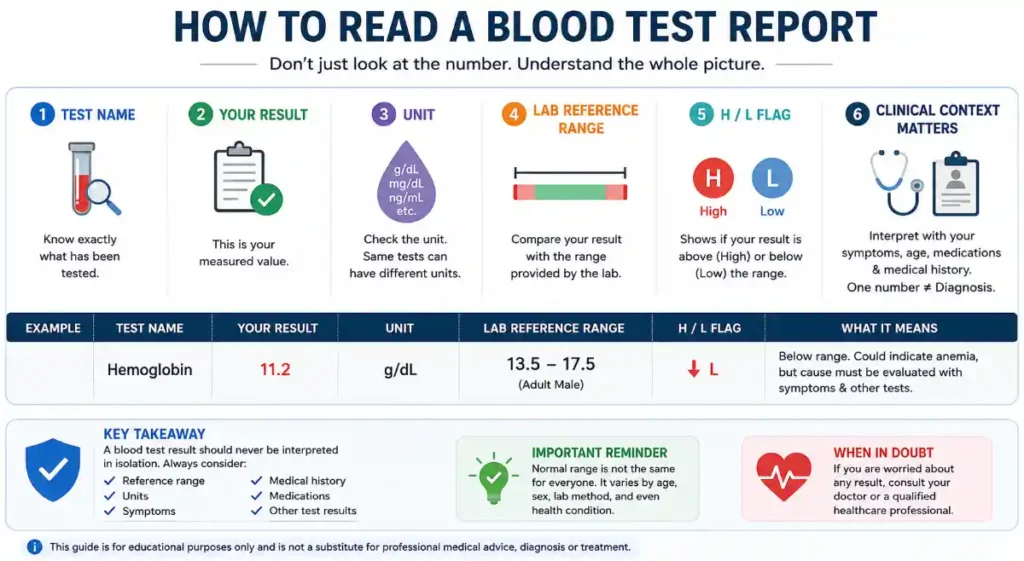
1. Start With the Test Name
First identify exactly what has been tested.
For example:
- CBC
- Hemoglobin
- WBC
- Platelets
- CRP
- ESR
- Vitamin D
- Vitamin B12
- TSH
- Blood glucose
- Creatinine
- SGOT/AST
- SGPT/ALT
- Lipid profile
Do not interpret a number before knowing what the test measures.
2. Look at Your Actual Result
The next column is generally your measured value.
For example:
Hemoglobin: 11.2 g/dL
The number alone isn’t enough.
You need to check the unit and the reference range printed on the same report.
3. Check the Laboratory’s Reference Range
This is one of the most important steps.
Different laboratories can use different testing methods and reference ranges. MedlinePlus specifically advises patients to use the reference range printed on their own report rather than comparing the result with a range found elsewhere online.
So don’t panic simply because Google says your number “should” be different.
4. Check the Units
The same type of test can be reported using different units.
For example, you may see:
- mg/dL
- g/dL
- ng/mL
- pg/mL
- mIU/L
- mmol/L
A number without its unit can be misleading.
CBC Report Explained
A Complete Blood Count (CBC) commonly includes measurements related to red blood cells, white blood cells and platelets.
Common components include:
Hemoglobin
Hemoglobin helps carry oxygen through the blood.
A low result may occur in different types of anemia, but the cause cannot be determined from hemoglobin alone.
WBC
White blood cells are involved in the body’s immune response.
An abnormal WBC count can have several causes, including infections, medications and other medical conditions.
Platelets
Platelets play an important role in blood clotting.
A platelet result that is significantly abnormal deserves appropriate medical evaluation, especially if accompanied by unusual bleeding or bruising.
Important: CBC interpretation usually requires looking at several values together rather than focusing on one number.
CRP: What Does a High CRP Mean?
C-reactive protein (CRP) is a marker associated with inflammation.
A raised CRP can occur with various inflammatory or infectious conditions, but CRP itself generally does not identify the exact cause.
This is why a high CRP should not automatically be interpreted as a specific disease.
The result needs to be considered alongside symptoms, examination and other investigations.
Vitamin D Report: What Should You Look For?
Vitamin D testing commonly measures 25-hydroxyvitamin D [25(OH)D], which is generally the main blood measurement used to assess vitamin D status.
Vitamin D has important roles in bone health, calcium absorption and normal muscle and nerve function.
If your report shows a low result, don’t immediately start taking very high-dose supplements without appropriate medical guidance.
The appropriate approach depends on the degree of deficiency, your health status and your clinician’s recommendation.
Vitamin B12 Report
Vitamin B12 is important for normal blood formation and neurological function.
A low B12 result may require further evaluation depending on the patient’s symptoms, diet, medications and other laboratory findings.
For example, someone with fatigue and someone with neurological symptoms may require a different clinical assessment even if their laboratory value appears similar.
TSH Report: Why Is It Important?
TSH is commonly used when evaluating thyroid function.
A TSH result can be interpreted differently depending on other thyroid tests, symptoms, medications and clinical circumstances.
Therefore:
High TSH ≠ automatically “thyroid disease confirmed.”
Likewise, a result within a laboratory reference range does not always explain every symptom a person may have.
Why Reference Ranges Can Be Confusing
One of the biggest misunderstandings is thinking that there is one universal “normal” number for every blood test.
In reality, reference ranges can vary.
Factors that may influence laboratory results include:
- age
- sex
- food and drink
- medicines
- preparation before the test
- laboratory methodology
- previous results
Want a Simpler Explanation of Your Own Report?
If you have a laboratory report and are struggling to understand the medical terminology, you can use our educational AI tool to help organize the information in simpler language.
AI Health Report Checker
Paste your report or upload a JPG/PNG image. The AI explains the values in simple language.
Maximum 10 MB. For scanned PDF reports, save/screenshot each page as JPG or PNG and upload the image.
This AI Health Report Checker helps you understand laboratory test results in simple, easy-to-read language. It provides general educational information based on the values and reference ranges provided in your report.
The tool is intended for educational purposes only and does not provide a medical diagnosis, prescribe treatment, or replace evaluation by a qualified healthcare professional. Always review your laboratory results with your doctor, especially if you have symptoms or abnormal results.
Important: AI-generated information may contain errors or may not account for your complete medical history. Do not make treatment decisions based solely on this tool.
Common Mistakes People Make
1. Panicking Over One Abnormal Value
One value outside the reference range does not necessarily mean something dangerous is happening.
2. Comparing With Someone Else’s Report
Your friend’s “normal” result may not be directly comparable with yours.
3. Using Random Internet Reference Ranges
Always start with the range printed by your laboratory.
4. Starting Supplements Automatically
A low vitamin result may require evaluation of the underlying cause and appropriate dosing.
5. Ignoring Symptoms Because the Report Is “Normal”
Laboratory tests are only one part of medical assessment.
6. Assuming AI Can Diagnose the Report
AI can help explain information, but an automated explanation should not replace clinical judgment.
The FDA’s current guidance highlights that medical software can involve important considerations around clinical decision support, safety and how patient-specific information is interpreted.
What AI Means for Medical Reports
AI can help explain and organize medical report information, but explaining a result is not the same as making a clinical diagnosis.
AI-generated information can have limitations, including errors, uncertainty and incomplete clinical context.
Use AI as an educational assistant—not as your doctor.
If your report is significantly abnormal or you have concerning symptoms, speak with a qualified healthcare professional.
When a Blood Report Creates Unnecessary Anxiety
Illustrative example — not a real patient case:
Imagine a 34-year-old office worker receives a routine blood report and notices that one inflammatory marker is flagged as high.
He searches the number online and becomes convinced that he has a serious disease.
However, the clinician reviews his symptoms, medical history, medications and the rest of his laboratory findings before deciding what the result actually means.
This is an important lesson:
A flagged result is a reason to understand the result — not automatically a reason to panic.
Expert Clinical Insight
In my clinical experience, one of the most common problems is not the laboratory report itself — it is how people interpret it.
Patients often come to a healthcare professional with screenshots of isolated values from their reports.
I usually encourage them to bring the complete report, because the relationship between several findings can be much more informative than one isolated number.
Another common pattern is checking old and new reports from different laboratories and comparing the numbers directly. That can be misleading because testing methods and reference ranges may differ.
For monitoring trends, using the same laboratory where practical can make comparisons easier.
Why Misreading Blood Tests Can Be a Problem
Misinterpretation can lead to two opposite problems.
Unnecessary Fear
A person may become anxious about a mildly abnormal result that requires routine follow-up rather than an emergency response.
False Reassurance
The opposite can also happen.
Someone may see a “normal” value and assume that everything is definitely fine, even when significant symptoms are present.
Both situations can delay appropriate medical care.
When Should You Contact a Doctor?
You should seek medical advice when:
- several laboratory results are significantly abnormal
- you have persistent or worsening symptoms
- you have unexplained bleeding
- you develop severe weakness or fainting
- you have difficulty breathing
- you have severe chest pain
- you develop confusion or a sudden neurological problem
- your clinician has specifically advised urgent follow-up
A blood report should always be interpreted in the context of your health.
Who Should Be Especially Careful With Self-Interpretation?
Extra caution is appropriate if you:
- are pregnant
- are a child or older adult
- have kidney or liver disease
- take multiple medications
- have a known chronic disease
- recently underwent surgery
- have significant neurological symptoms
- have severe or rapidly worsening symptoms
These situations can make interpretation more complex.
Myth vs Fact
| Myth | Fact |
|---|---|
| High result means disease confirmed | An abnormal result may have several explanations |
| Normal result means everything is fine | Normal laboratory values don’t rule out every health problem |
| Internet reference ranges are enough | Your laboratory’s own reference range should be considered |
| AI can diagnose my report | AI tools can explain information but shouldn’t replace clinical assessment |
| One blood test tells everything | Diagnosis often requires history, examination and multiple pieces of evidence |
Final Word
Understanding a blood test report doesn’t mean memorizing hundreds of medical values.
It means knowing what the test measures, what your actual result is, what units are being used, what reference range your laboratory provides, and how that result fits into the bigger clinical picture.
If you have a report that looks confusing, don’t immediately assume the worst.
Understand first. Verify next. Take medical action when appropriate.
And if you’re using an AI report-explanation tool, remember the most important rule:
AI can help you understand your report. A qualified healthcare professional decides what it means for your health.
✅ Key Takeaways
- Always check the test name, result, unit and laboratory reference range.
- Don’t diagnose yourself from one abnormal number.
- Reference ranges can differ between laboratories and patient groups.
- Compare trends carefully, preferably using the same laboratory when possible.
- Consider symptoms and medical history alongside laboratory findings.
- Use AI tools for education and explanation—not as a replacement for medical assessment.
Frequently Asked Questions
Is a blood test report easy to understand?
Some basic values are relatively straightforward, but proper interpretation can require knowledge of symptoms, medical history, medications and laboratory reference ranges.
What does H mean on a blood test?
“H” generally indicates that the reported value is above that laboratory’s reference range. It does not automatically mean that you have a disease.
What does L mean on a blood test?
“L” generally indicates that the result is below the laboratory’s reference range.
Can I compare my report with an older report?
Yes, trends can be useful, but comparisons should consider the laboratory, test method, units and reference ranges. Using the same laboratory when practical can make trends easier to interpret.
Can AI explain my blood test report?
AI can help translate technical terminology and organize information into simpler language. However, AI-generated explanations should not be treated as a diagnosis or treatment plan.
Is a high CRP always dangerous?
No. CRP is associated with inflammation, but the result alone generally cannot identify the exact cause or severity of a condition.
Does low Vitamin D always require supplements?
Low vitamin D may require treatment, but the appropriate dose and duration depend on the individual situation. Discuss supplementation with a qualified healthcare professional.
Should I worry if one result is slightly outside the range?
Not necessarily. Healthy people can sometimes have results outside a reference range, and clinicians interpret the result together with the rest of the clinical picture.
References
- MedlinePlus. Laboratory Tests. U.S. National Library of Medicine.
- MedlinePlus. How to Understand Your Lab Results. U.S. National Library of Medicine.
- MedlinePlus. Vitamin D Test. U.S. National Library of Medicine.
- U.S. FDA. Clinical Decision Support Software Guidance for Industry and FDA Staff.
- U.S. FDA. Clinical Decision Support Software FAQs.
- U.S. FDA. Artificial Intelligence Program: Research on AI/ML-Based Medical Devices.

Dr. Shabbir Hussain, BPT
Registered Physiotherapist | Clinical Rehabilitation Specialist
Maharashtra OTPT Council Reg. No.: PR-2021/08/PT/009532
Society of Onco Physiotherapists Reg. No.: SOP/00033/LM
Dr. Shabbir Hussain, BPT, Registered Physiotherapist with over 8 years of experience in physiotherapy, kidney rehabilitation, oncological rehabilitation, and lymphedema management. He specializes in balance disorders, pain management, musculoskeletal rehabilitation, strengthening programs, and VR-based rehabilitation.