

Dr. SHABBIR HUSSAIN (BPT)
🔄 Last Updated: August 8, 2026
🩺 Evidence-Based Review
⏱️ Reading Time: 8 minutes
There is a moment many women know too well: you look at the calendar, count the days again, and wonder whether you should take a pregnancy test today—or wait a little longer.
One of the most common mistakes is testing too early. A negative result can feel reassuring, but if the test was taken before enough pregnancy hormone had accumulated, it may simply be too soon to detect the pregnancy.
A home pregnancy test detects human chorionic gonadotropin (hCG). This hormone begins to rise after implantation, and its concentration generally increases during early pregnancy.
The most reliable practical rule is straightforward: most home pregnancy tests can be used from the first day of a missed period. If you do not know when your next period is due, the NHS advises testing at least 21 days after the last unprotected sex.
⚡ Pregnancy Test Calculator — Quick Summary
🎯 Main Risk: Testing too early can produce a false-negative result.
🔎 Key Sign: A missed period is one of the earliest and most reliable signs of pregnancy when cycles are usually regular.
✅ Best Solution: Take a home pregnancy test from the first day of your missed period. If you don’t know when your period is due, test at least 21 days after the last unprotected sex.
🛡️ Prevention Tip: Follow the kit instructions carefully and avoid drinking excessive fluids immediately before testing.
🧪 Pregnancy Test Calculator
Find your estimated next period and the most appropriate time to take a home pregnancy test.
📅 Your Pregnancy Test Timing
What should you do?
- If your period is already late, you can generally take a home pregnancy test now.
- If the test is negative but your period still does not come, consider repeating the test after several days.
- If you do not know when your period is due, testing at least 21 days after the last unprotected sex is a useful practical guide.
- Follow the instructions supplied with your pregnancy-test kit.
This calculator provides an estimate of when pregnancy testing may be appropriate. It does not diagnose pregnancy and cannot determine the exact date of ovulation, fertilization or implantation. Menstrual cycles vary between individuals. If you have severe abdominal/pelvic pain, heavy bleeding, fainting or severe dizziness, seek urgent medical care rather than relying on this calculator.
🧮 How Our Pregnancy Test Calculator Works
This calculator estimates an appropriate time to take a home pregnancy test using your menstrual-cycle information and, when provided, the date of your last unprotected sex. It is designed to help you understand when testing is more likely to provide a useful result—it does not diagnose pregnancy.
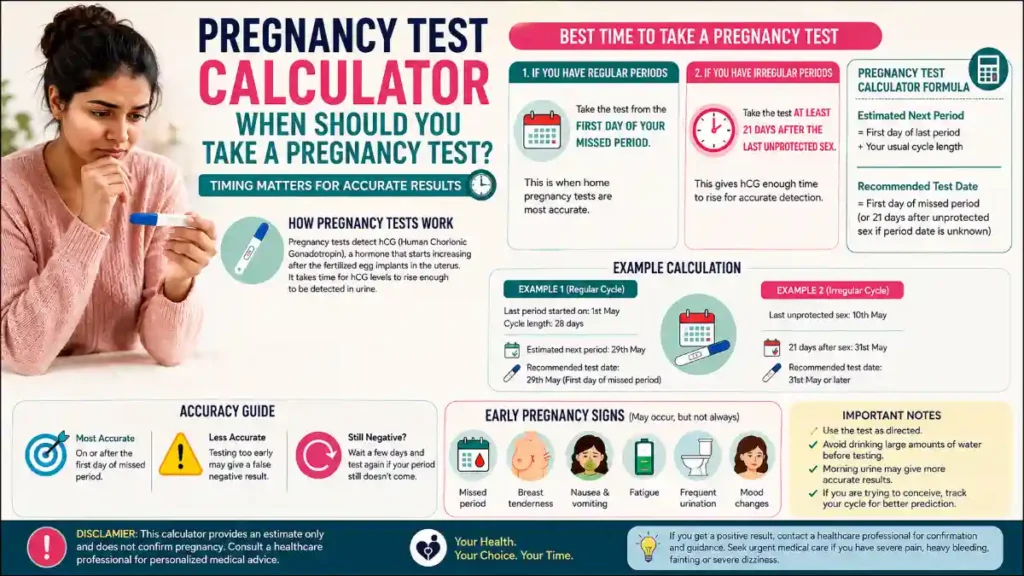
The calculator adds your usual cycle length to the first day of your last period to estimate when your next period is expected.
First day of last period + usual cycle length
For people with predictable cycles, the calculator uses the estimated first day of the missed period as the primary testing date.
First day of the expected/missed period
If you enter the date of your last unprotected sex, the calculator also calculates the date that is 21 days afterward. When this date is later than the estimated period-based testing date, the calculator uses the later date as the more conservative testing recommendation.
Date of last unprotected sex + 21 days
Menstrual cycles can vary from month to month. This calculator cannot determine the exact date of ovulation, fertilization or implantation and cannot confirm or exclude pregnancy. The result is an estimated testing window, not a medical diagnosis.
Evidence basis: The methodology follows the practical principle that home pregnancy testing is generally most useful from the first day of a missed period, while people who cannot reliably determine when their period is due can use the 21-days-after-last-unprotected-sex approach as a practical testing guide.
Pregnancy Test Calculator: How It Works
The calculator is designed around three useful pieces of information:
- First day of your last menstrual period
- Your usual menstrual-cycle length
- Date of the last unprotected sex, particularly if your periods are irregular
For someone with a predictable cycle, the estimated next-period date can be calculated by adding the usual cycle length to the first day of the last menstrual period.
Example:
If your last period began on August 1 and your usual cycle is 28 days, your next period would be expected around August 29. If it does not arrive, testing from around August 29 onward is reasonable.
However, this is an estimate, not a diagnosis. Ovulation and implantation do not occur on exactly the same day in every cycle. Research has demonstrated substantial biological variation in implantation timing, which is one reason a pregnancy may not be detectable exactly when someone expects it to be.
What Is a Pregnancy Test?
A pregnancy test checks for hCG, a hormone associated with pregnancy.
Urine pregnancy tests are available as home testing kits, while blood tests are performed through a healthcare provider or laboratory. Blood testing can detect smaller amounts of hCG, but a home urine test is usually the simplest first step for someone wondering whether they are pregnant.
After a fertilized egg implants, hCG starts appearing and rises during early pregnancy. The amount present in urine depends on several factors, including how far along the pregnancy is and how concentrated the urine sample is.
This explains something that surprises many people:
A negative test does not always mean “definitely not pregnant.”
If testing is performed too early, hCG may simply not have reached the level the particular test can detect.
Why Timing Matters More Than Many People Realize
The temptation is understandable: you had unprotected sex, you are worried, and you want an answer immediately.
But biology does not work according to the clock on your smartphone.
Studies have shown that pregnancy-test performance can vary depending on the test’s analytical sensitivity and the form of hCG being detected. Different commercial tests may therefore perform differently very early in pregnancy.
A systematic review also found that home-test performance can be affected by how the test is used in real-world settings.
That is why a calculator based on expected period date + time since unprotected sex is more useful than simply asking, “How many days after sex can I test?
Why Testing Too Early Can Give a False-Negative
The main danger isn’t usually the pregnancy test itself. It is misinterpreting the result.
A false-negative result may lead someone to assume pregnancy has been ruled out when the test was simply taken too early.
Another problem is relying on symptoms alone. A missed period can have many causes, including stress, weight changes, excessive exercise, hormonal contraception, PCOS and thyroid problems.
Common Mistakes People Make
1. Testing immediately after sex
A pregnancy test cannot reliably detect a pregnancy immediately after intercourse.
2. Testing before the expected period
Some highly sensitive tests may detect pregnancy earlier, but an early negative is less reassuring than a negative test taken at the appropriate time.
3. Drinking excessive water before testing
Very diluted urine can reduce the concentration of hCG and potentially make detection more difficult.
4. Ignoring the instructions
Different kits have different procedures and result-reading windows. Always follow the manufacturer’s instructions.
Recent Research Highlights
One of the most important findings from pregnancy-testing research is that the first day of a missed period is not biologically identical for everyone.
A prospective study published in JAMA estimated that some pregnancies had not yet implanted by the first day of the expected period. This means even an extremely sensitive test theoretically cannot detect a pregnancy before implantation has occurred.
Another study evaluating commercial home tests found considerable differences in analytical sensitivity among products.
More recent systematic-review evidence suggests modern urine tests can be highly sensitive when used correctly, but performance still depends on the test, timing and user technique.
Clinical relevance: if a woman tests negative on the first day of a missed period but her period remains absent, repeating the test later can provide more reliable information.
Causes and Risk Factors for a Late Period
A late period does not automatically mean pregnancy.
Stress and anxiety can affect menstrual timing. Sudden weight loss or gain, very intense exercise, breastfeeding, hormonal contraception, PCOS and thyroid disorders are among the other possible causes.
Students may also experience irregular cycles around examinations, sleep disruption or significant changes in eating patterns.
However, if pregnancy is biologically possible, pregnancy should be ruled out first rather than assuming stress is responsible.
Don’t Ignore These Signs
Seek urgent medical assessment if pregnancy is possible and you develop severe abdominal or pelvic pain, heavy vaginal bleeding, fainting, marked dizziness or other concerning symptoms.
A home pregnancy test cannot determine whether a pregnancy is located normally inside the uterus. Significant pain or bleeding requires clinical assessment.
How Is Pregnancy Diagnosed?
Diagnosis begins with the history:
- date of the last menstrual period
- usual cycle length
- timing of intercourse
- contraception used
- symptoms
- previous pregnancies
- medications and relevant medical conditions.
A urine pregnancy test is usually the simplest initial test.
A doctor may use a blood hCG test when more sensitive or quantitative information is required. Ultrasound may subsequently be appropriate depending on gestational age, symptoms and clinical circumstances.
How to Take a Home Pregnancy Test Correctly
- Check the expiry date.
- Read the manufacturer’s instructions.
- Avoid deliberately drinking large amounts of water immediately beforehand.
- Use the recommended urine sample.
- Follow the exact timing instructions.
- Read the result within the specified time window.
- Do not interpret an expired or invalid test as negative.
Some medical sources recommend first-morning urine because it may be more concentrated, particularly when testing early. However, NHS guidance notes that many tests can be performed using urine collected at any time of day.
What If the Pregnancy Test Is Negative?
This is where many people make their second mistake.
If you tested before your expected period, the negative result may simply be premature.
If your period remains absent, repeat the test after several days or seek professional advice. NHS guidance recommends repeating after a negative result when pregnancy is still suspected.
If you have irregular cycles and cannot determine when your period was due, the 21-days-after-unprotected-sex rule is particularly useful.
Myth vs Fact
| Myth | Fact |
|---|---|
| You can test immediately after sex. | Testing immediately is too early to reliably detect pregnancy. |
| A negative test always means you’re not pregnant. | An early negative can occur because hCG is not yet detectable. |
| Pregnancy symptoms confirm pregnancy. | Symptoms overlap with PMS and other conditions. |
| Drinking lots of water makes testing better. | Excessive fluid can dilute urine. |
| Every pregnancy test has exactly the same sensitivity. | Tests can differ in analytical sensitivity. (PubMed) |
| A late period always means pregnancy. | Stress, PCOS, thyroid problems, weight changes and other factors can delay periods. (nhs.uk) |
Pregnancy Test Calculator: Practical Calculation
For a regular cycle:
Estimated next period = First day of last period + usual cycle length
Then:
Recommended home-test date = First day of missed period
For an irregular or unpredictable cycle:
Use the last unprotected-sex date and test at least 21 days afterward if the expected period cannot be reliably estimated.
Important limitation
This calculator estimates an appropriate testing window. It cannot diagnose pregnancy, calculate exact implantation, predict ovulation with certainty or replace a medical test.
When to See a Doctor Immediately
Seek urgent medical care if a possible pregnancy is accompanied by:
Severe or worsening abdominal/pelvic pain
Heavy vaginal bleeding
Fainting or severe dizziness
Significant weakness or collapse
Severe pain with a positive pregnancy test
These symptoms cannot safely be assessed using a home pregnancy calculator alone.
✅ Key Takeaways
- Most home pregnancy tests are most reliable from the first day of a missed period.
- If you don’t know when your period is due, test at least 21 days after the last unprotected sex.
- Testing too early can produce a false-negative result.
- A negative test does not always rule out very early pregnancy.
- If your period remains absent, repeat testing or seek medical advice.
- Severe pain, heavy bleeding or fainting requires urgent medical assessment.
Frequently Asked Questions
1. When is the best time to take a pregnancy test?
For most home tests, the best practical time is from the first day of a missed period.
2. How many days after unprotected sex should I test?
If you do not know when your period is due, NHS guidance recommends testing at least 21 days after the last unprotected sex.
3. Can I take a pregnancy test before my missed period?
Some sensitive tests are marketed for earlier testing, but an early negative is less reliable.
4. Can I be pregnant with a negative test?
Yes, particularly if the test was taken too early or the urine was very diluted. Repeat testing if your period remains absent.
5. Is first-morning urine necessary?
Not always. Many tests can be performed at other times, but first-morning urine can be useful when testing early because it is often more concentrated.
⚕️ Medical Disclaimer
This article and Pregnancy Test Calculator are provided for general educational and public-health information only. They are not a substitute for an examination, diagnosis or individualized medical advice from a qualified healthcare professional.
Menstrual cycles vary between individuals, and calculator results are estimates rather than a diagnosis of pregnancy. A pregnancy test, laboratory testing and/or clinical assessment may be required to confirm pregnancy.
If you have severe abdominal or pelvic pain, heavy bleeding, fainting, severe dizziness or other concerning symptoms, seek urgent medical attention rather than relying on the calculator.
Do not start, stop or change prescription medicines based solely on information in this article.
REFERENCES
- National Health Service. (2026). Doing a pregnancy test. NHS pregnancy testing guidance
- MedlinePlus. (2025). Pregnancy test. U.S. National Library of Medicine. MedlinePlus Pregnancy Test
- Eunice Kennedy Shriver National Institute of Child Health and Human Development. How do I know if I’m pregnant? National Institutes of Health. NICHD pregnancy testing information
- American College of Obstetricians and Gynecologists. Pregnancy choices: Raising the baby, adoption, and abortion. ACOG pregnancy guidance
- Wilcox, A. J., Baird, D. D., Dunson, D. B., McChesney, R., & Weinberg, C. R. (2001). Natural limits of pregnancy testing in relation to the expected menstrual period. JAMA, 286(14), 1759–1761. PubMed — JAMA pregnancy-testing study

Dr. Shabbir Hussain, BPT Licensed Physiotherapist | Clinical Rehabilitation SpecialistMaharashtra OTPT Council Reg. No. PR-2021/08/PT/009532Society of Onco Physiotherapists Reg. No. SOP/00033/LM
He is a licensed physiotherapist with over 8 years of experience in physiotherapy, kidney rehabilitation, oncological rehabilitation, and lymphedema management. He specializes in balance disorders, pain management, musculoskeletal rehabilitation, strengthening programs, and VR-based rehabilitation.
Dr. Shabbir Hussain (BPT)