

Evidence-Based Medical Review
⏱️ 8 min read • 📅 Updated June 25, 2026 • ✅ Doctor Reviewed
Written & Reviewed By: Dr. Shabbir Hussain (BPT)
Clinical Experience: Physiotherapist & Rehabilitation Specialist
Evidence-Based Review: Reviewed for medical accuracy using current clinical guidelines and trusted health sources.
🔄 Updated: Aligned with the latest WHO, CDC, and NICE recommendations and reviewed periodically.
BMI Calculator: Calculate Your Body Mass Index Instantly
Did you know? Millions of people have a “normal weight” but still carry dangerous body fat that increases the risk of diabetes, heart disease, and knee pain. Check your BMI below in less than 10 seconds.
Have you ever stepped onto a weighing scale, smiled because your weight looked “normal,” and assumed everything was fine?
Many people do exactly that. Yet, in physiotherapy practice, we often meet individuals who appear healthy based on their weight alone but are already dealing with joint pain, early diabetes, fatty liver, knee problems, or reduced fitness. The missing piece is often a simple number that many people have heard of but rarely understand—Body Mass Index, or BMI.
A BMI calculator is not a perfect measure of health, but it is one of the quickest ways to estimate whether your weight is appropriate for your height. It can help identify potential health risks long before symptoms appear. Ignoring this number may delay lifestyle changes that could prevent chronic diseases in the future.
Whether you are trying to lose weight, gain healthy muscle, improve your fitness, or simply understand your body better, learning about BMI is an excellent place to begin.
⚡ Quick Summary
Main Risk: An unhealthy BMI may increase the risk of diabetes, heart disease, joint pain, sleep apnea, and other chronic conditions.
Key Sign: Weight that is significantly above or below the healthy range for your height.
Best Solution: Combine healthy eating, regular exercise, strength training, quality sleep, and professional guidance.
Prevention Tip: Check your BMI regularly, but don’t rely on it alone. Waist circumference and physical fitness are equally important.
Free BMI Calculator
| BMI | Asian Indian Category |
|---|---|
| <18.5 | Underweight |
| 18.5–22.9 | Healthy Weight |
| 23–24.9 | Overweight (At Risk) |
| 25–29.9 | Obesity Class I |
| ≥30 | Obesity Class II |
What Is a BMI Calculator?
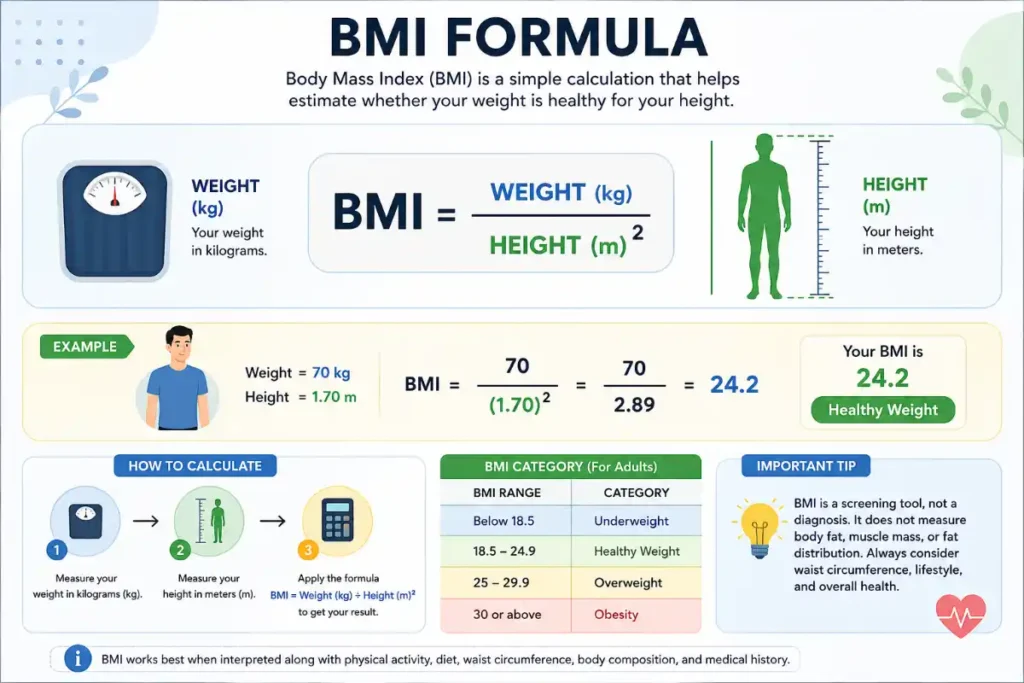
BMI stands for Body Mass Index, a simple mathematical calculation used worldwide to estimate whether a person’s body weight falls within a healthy range based on their height.
The formula is straightforward:
BMI = Weight (kg) ÷ Height (m²)
Although it doesn’t directly measure body fat, BMI remains one of the most widely used screening tools recommended by healthcare organizations for identifying potential weight-related health risks.
According to international health guidelines, BMI categories for adults generally include:
A BMI below 18.5 suggests underweight.
A BMI between 18.5 and 24.9 is considered healthy.
A BMI between 25 and 29.9 indicates overweight.
A BMI of 30 or above falls within the obesity range.
However, it is important to understand that BMI is only a screening tool. Athletes with high muscle mass may have a higher BMI without having excess body fat, while some individuals with a normal BMI may still carry unhealthy amounts of abdominal fat.
In my clinical experience, BMI works best when interpreted alongside waist circumference, body composition, physical activity, and overall health status.
Advantages and Limitations of BMI
Body Mass Index (BMI) is one of the most widely used health screening tools worldwide. While it provides a quick estimate of whether your weight is appropriate for your height, it also has certain limitations. Understanding both helps you interpret your BMI more accurately.
✅ Advantages of BMI
- Quick and easy to calculate.
- Requires only height and weight.
- Helps identify underweight, overweight, and obesity.
- Recommended by organizations like WHO and CDC as a screening tool.
- Useful for monitoring weight trends over time.
- Can help identify people at higher risk of diabetes, heart disease, and hypertension.
⚠️ Limitations of BMI
- Does not measure body fat percentage.
- Cannot distinguish muscle from fat.
- May classify muscular athletes as overweight.
- Does not show where fat is stored in the body.
- May underestimate health risks in people with excess abdominal fat.
- Should always be interpreted alongside waist circumference, lifestyle, and overall health.
👨⚕️ Expert Tip: BMI is an excellent screening tool, but it should never be the only measure of health. Doctors often evaluate BMI together with waist circumference, body composition, blood tests, physical activity, and medical history to get a complete picture of your health.
Why BMI Matters More Than Most People Think
Many people believe BMI is only important if they want to lose weight.
That is a common misconception.
Clinically, many patients visit physiotherapy clinics because of persistent knee pain, lower back pain, heel pain, or reduced mobility. Surprisingly, excess body weight often plays a major role in worsening these conditions.
Even a modest increase in body weight significantly increases the force transmitted through the knees and hips during walking and climbing stairs.
On the other hand, being underweight can also be problematic. Low BMI may be associated with reduced muscle strength, poor immunity, osteoporosis, slower healing, nutritional deficiencies, and increased risk of fractures.
One common pattern observed in rehabilitation settings is that patients who achieve a healthier BMI often recover faster after orthopedic injuries and surgeries because their muscles work more efficiently and the joints experience less mechanical stress.
⚠️ Doctor Insight
Many patients focus only on their body weight while ignoring body composition. Two people can weigh exactly the same yet have very different levels of muscle, body fat, and overall fitness. BMI should always be interpreted along with your lifestyle, waist size, and physical activity.
Hidden Health Risks of an Unhealthy BMI
An unhealthy BMI does much more than change your appearance.
Over time, it can silently affect nearly every organ system in the body.
People with obesity are at increased risk of developing type 2 diabetes, high blood pressure, heart disease, stroke, sleep apnea, fatty liver disease, osteoarthritis, and certain cancers.
From a rehabilitation perspective, excess body weight places continuous stress on the spine, hips, ankles, and knees. This extra mechanical load can accelerate cartilage wear, contribute to chronic joint pain, and reduce physical endurance.
Conversely, individuals with a very low BMI may experience muscle wasting, poor bone density, hormonal imbalance, anemia, and delayed recovery from illness or surgery.
These changes often occur gradually, making them easy to overlook until significant symptoms develop.
Common Causes of an Unhealthy BMI
Today’s lifestyle makes maintaining a healthy BMI more challenging than ever.
Urbanization, desk jobs, online work, and long hours of sitting have dramatically reduced daily physical activity. Many Indian office workers spend eight to ten hours sitting in front of computers before commuting home in traffic and then relaxing with smartphones late into the night.
This pattern gradually reduces calorie expenditure while increasing unhealthy eating habits.
Frequent consumption of sugary beverages, fast food, refined carbohydrates, oversized meal portions, irregular sleep schedules, chronic stress, emotional eating, and limited exercise all contribute to unhealthy weight gain.
Early Warning Signs That Should Not Be Ignored
Your body often provides subtle clues long before serious complications develop.
You may notice climbing stairs becoming more difficult, increased fatigue during daily activities, shortness of breath with minimal exertion, persistent knee discomfort, lower back pain after standing, frequent snoring, reduced stamina, or difficulty fitting into previously comfortable clothing.
Individuals with low BMI may experience frequent tiredness, poor muscle strength, recurrent infections, feeling cold easily, brittle hair, fragile nails, or delayed wound healing.
These symptoms should not be ignored, particularly when accompanied by a steadily increasing or decreasing BMI over several months.
How Doctors and Physiotherapists Assess BMI
A BMI calculator is only one part of a complete health assessment.
Healthcare professionals usually begin by measuring height and weight accurately before calculating BMI.
In my physiotherapy practice, additional assessments often include posture analysis, movement quality, muscle strength, flexibility, balance, walking pattern, endurance, and functional mobility.
If obesity-related medical conditions are suspected, your doctor may recommend blood sugar testing, cholesterol profile, thyroid evaluation, liver function tests, blood pressure monitoring, waist circumference measurement, and occasionally body composition analysis.
BMI alone should never replace a comprehensive health evaluation, but it provides an excellent starting point for identifying potential risks early.
Treatment and Physiotherapy Management
Improving BMI is rarely about following extreme diets or exhausting workout routines.
Sustainable lifestyle changes consistently produce better long-term results.
For individuals with excess weight, treatment usually combines balanced nutrition, gradual calorie control, aerobic exercise, resistance training, improved sleep, stress management, and regular monitoring.
Physiotherapy plays a particularly important role for people who already experience joint pain, arthritis, obesity-related mobility limitations, or previous injuries that make exercise difficult.
Exercise programs are carefully individualized to reduce pain while gradually improving strength, flexibility, cardiovascular fitness, and confidence in movement.
In my clinical experience, patients improve faster when they begin with low-impact activities such as walking, cycling, swimming, or supervised strengthening exercises rather than attempting intense workouts immediately.
Common Myths About BMI
One of the biggest myths is that BMI tells you everything about your health.
It doesn’t.
BMI is an excellent screening tool, but it cannot distinguish fat from muscle, identify where fat is stored, or measure fitness levels.
Another misconception is that people with a normal BMI are always healthy.
Clinically, many patients have normal BMI yet possess excessive abdominal fat, poor cardiovascular fitness, and metabolic problems.
Similarly, some athletes have elevated BMI because of greater muscle mass rather than excess body fat.
Understanding these limitations helps people use BMI wisely instead of relying on it as the only measure of health.
Prevention: Small Habits That Protect Your Future Health
Maintaining a healthy BMI rarely depends on dramatic changes. Instead, it is the result of consistent daily habits practiced over months and years.
Choosing home-cooked meals more often than processed foods, walking regularly, performing strength exercises at least two or three times each week, sleeping seven to eight hours nightly, limiting sugary beverages, managing stress effectively, and reducing prolonged sitting all contribute to healthier body weight.
When Should You See a Doctor?
Many people assume that being overweight or underweight is simply a cosmetic concern. In reality, a persistently abnormal BMI can be an early sign of an underlying health condition that deserves medical attention.
You should consult a doctor if your BMI remains below 18.5 or above 25 despite making healthy lifestyle changes for several months. Sudden, unexplained weight loss or rapid weight gain should never be ignored, especially if accompanied by fatigue, fever, persistent digestive problems, swelling, breathlessness, or changes in appetite.
If your excess weight is causing knee pain, back pain, heel pain, difficulty walking, or shortness of breath during everyday activities, a medical evaluation is recommended. Similarly, people with diabetes, thyroid disorders, high blood pressure, heart disease, kidney disease, or hormonal problems should seek professional guidance before beginning an intensive weight-loss program.
Early assessment often helps identify problems before they become more serious.
Who Should Avoid Certain Exercises or Weight-Loss Programs?
Not every exercise program is suitable for everyone.
People with severe obesity, uncontrolled high blood pressure, recent heart attack, unstable angina, severe arthritis, recent fractures, spinal instability, advanced osteoporosis, or recent surgery should avoid high-impact workouts unless cleared by their healthcare provider.
Pregnant women should also avoid aggressive weight-loss diets. Instead, they should follow pregnancy-specific nutrition and exercise advice under medical supervision.
Individuals with eating disorders, severe nutritional deficiencies, uncontrolled diabetes, chronic kidney disease, or advanced liver disease should work with a multidisciplinary team that may include a physician, dietitian, and physiotherapist.
✅ Key Takeaways
✔ BMI is a useful screening tool but should not be the only measure of health.
✔ A healthy BMI lowers the risk of diabetes, heart disease, joint pain, and mobility problems.
✔ Waist circumference, muscle strength, and physical fitness are equally important.
✔ Sustainable lifestyle changes work better than crash diets or extreme exercise plans.
✔ Consult a healthcare professional if your BMI remains outside the healthy range.
✔ Regular physical activity and balanced nutrition remain the foundation of long-term health.
Frequently Asked Questions (FAQs)
Is BMI accurate for everyone?
BMI is a useful screening tool, but it is not perfect. It may overestimate body fat in muscular individuals and underestimate health risks in people with low muscle mass.
What is a healthy BMI for adults?
For most adults, a BMI between 18.5 and 24.9 kg/m² is considered healthy.
Can I have a normal BMI but still be unhealthy?
Yes. A person may have a normal BMI while carrying excess abdominal fat or having high blood sugar, high cholesterol, or poor physical fitness.
Does BMI measure body fat?
No. BMI estimates weight relative to height. It does not directly measure body fat percentage.
Should children use the same BMI calculator?
No. Children and teenagers require age- and sex-specific BMI percentile charts because their bodies are still growing.
How often should I calculate my BMI?
For most adults, checking BMI every three to six months is sufficient unless advised otherwise by a healthcare professional.
Can exercise reduce BMI without dieting?
Exercise helps improve BMI, but combining regular physical activity with balanced nutrition generally produces better long-term results.
Is BMI enough before starting a gym program?
No. Your medical history, waist circumference, mobility, strength, and existing health conditions should also be assessed before beginning a structured fitness program.
References
World Health Organization. (2024). Obesity and overweight. https://www.who.int/news-room/fact-sheets/detail/obesity-and-overweight
National Institutes of Health. Calculate Your Body Mass Index. https://www.nhlbi.nih.gov/health/educational/lose_wt/BMI/bmicalc.htm
Centers for Disease Control and Prevention. About Adult BMI. https://www.cdc.gov/bmi/adult-calculator/index.html
National Institute of Diabetes and Digestive and Kidney Diseases (NIDDK). Body Weight and Health. https://www.niddk.nih.gov
World Health Organization. Healthy Diet Guidelines. https://www.who.int
National Institute for Health and Care Excellence (NICE). Obesity: identification, assessment and management. https://www.nice.org.uk
Garvey WT, et al. American Association of Clinical Endocrinology Clinical Practice Guidelines for Comprehensive Medical Care of Patients with Obesity. Endocrine Practice.

Dr. Shabbir Hussain, BPT
Registered Physiotherapist | Clinical Rehabilitation Specialist
Maharashtra OTPT Council Reg. No.: PR-2021/08/PT/009532
Society of Onco Physiotherapists Reg. No.: SOP/00033/LM
Dr. Shabbir Hussain, BPT, Registered Physiotherapist with over 8 years of experience in physiotherapy, kidney rehabilitation, oncological rehabilitation, and lymphedema management. He specializes in balance disorders, pain management, musculoskeletal rehabilitation, strengthening programs, and VR-based rehabilitation.