Can Stroke Patients Recover Fully?
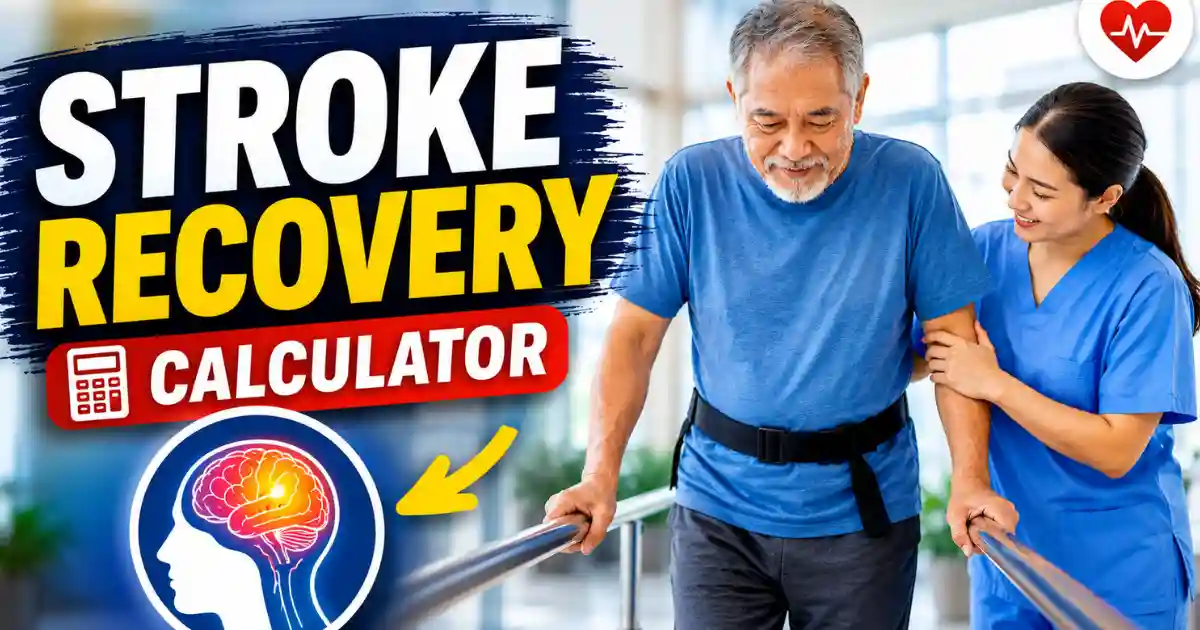
Many stroke survivors improve significantly with early rehabilitation, physiotherapy, speech therapy, and family support. Recovery speed depends on factors like age, stroke severity, mobility, balance, and daily activity level. This Stroke Recovery Calculator helps estimate possible recovery progress based on functional ability and rehabilitation factors.
Will I Walk Again After Stroke?
Recovering from a stroke can be physically and emotionally challenging. Many patients and caregivers often ask the same question:
The answer depends on several important factors including muscle strength, walking ability, balance, physiotherapy participation, and the severity of brain injury.
To help patients better understand their recovery stage, we created this free Stroke Recovery Calculator. This tool estimates rehabilitation progress and walking recovery based on common physiotherapy indicators.
Whether you are recovering from a mild stroke or supporting a loved one through rehabilitation, this calculator can help you understand what stage of recovery you may currently be in.
Why Early Rehabilitation Matters
Research shows that early physiotherapy and rehabilitation can significantly improve mobility, balance, walking ability, and independence after stroke. Consistent therapy during the first few months plays a major role in long-term recovery outcomes.
Stroke Recovery Calculator
How This Stroke Recovery Calculator Works
This calculator estimates stroke recovery potential using functional rehabilitation indicators commonly used in neurological physiotherapy and stroke rehabilitation assessment. It does not replace medical diagnosis or neurologist evaluation.
How Accurate Is This Stroke Recovery Calculator?
This calculator provides an educational estimate based on commonly used stroke rehabilitation outcome measures such as mobility, functional independence, and recovery progression scores. Actual recovery varies depending on stroke severity, age, medical condition, rehabilitation intensity and early physiotherapy intervention.
How Stroke Recovery Works
Stroke recovery happens when the brain gradually rewires itself through a process called neuroplasticity. This means healthy parts of the brain begin taking over functions lost after stroke damage.
Recovery is usually fastest during the first three months after stroke. However, many patients continue improving for months or even years with proper physiotherapy and rehabilitation.
The most common areas affected after stroke include:
- Walking ability
- Balance
- Muscle strength
- Speech
- Coordination
- Hand function
- Daily activities
Early rehabilitation can significantly improve long-term outcomes.
Quick Answer
Stroke recovery depends on brain damage severity, age, physiotherapy consistency, muscle strength, and mobility level. Most patients show major improvement within the first 3–6 months with proper rehabilitation. Use the Stroke Recovery Calculator below to estimate your current recovery stage and rehabilitation progress.
Factors Affecting Stroke Recovery
Several important factors influence stroke rehabilitation progress.
1. Severity of Brain Damage
Smaller strokes often recover faster than major strokes involving larger brain areas.
2. Early Physiotherapy
Patients who begin rehabilitation early usually show better functional improvement.
3. Muscle Strength
Better muscle activation often leads to faster walking recovery.
4. Motivation & Consistency
Regular exercises and home rehabilitation improve outcomes.
5. Age & General Health
Younger patients may recover faster, but older adults can also make excellent progress with therapy.
Role of Physiotherapy in Stroke Recovery
Physiotherapy is one of the most important parts of stroke rehabilitation.
A physiotherapist helps patients improve:
- Walking pattern
- Balance
- Coordination
- Muscle strength
- Joint mobility
- Functional independence
Common stroke physiotherapy exercises include:
- Gait training
- Sit-to-stand practice
- Balance exercises
- Strengthening exercises
- Functional movement training
Patients who consistently participate in therapy often regain mobility faster.
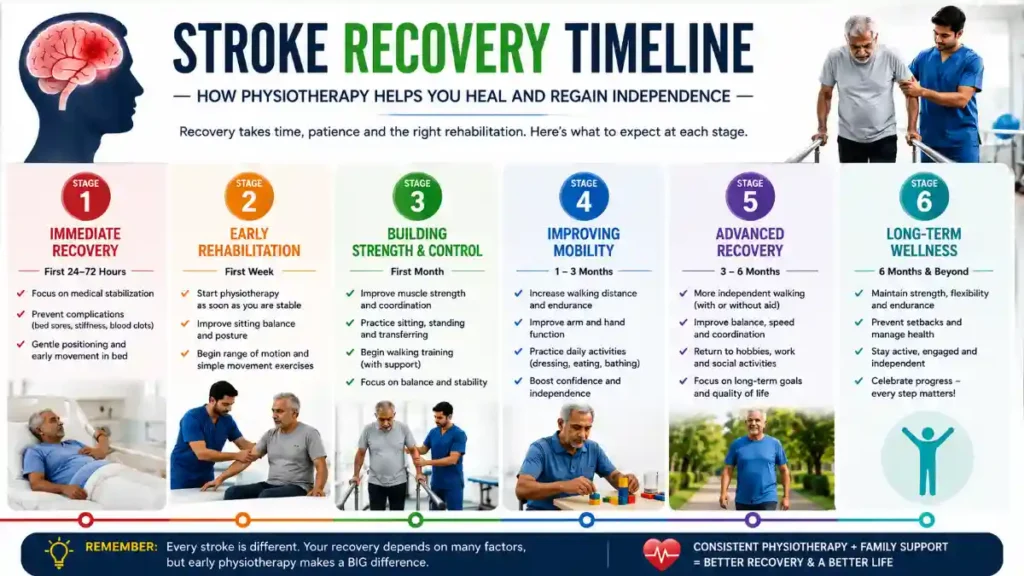
Stroke Recovery Timeline
First Few Weeks
- Focus on medical stabilization
- Basic movement training begins
- Bed mobility and sitting balance improve
1–3 Months
- Walking training progresses
- Muscle control improves
- Balance retraining continues
3–6 Months
- Major recovery phase
- Functional independence improves
- Walking speed may increase
Beyond 6 Months
- Continued improvements still possible
- Advanced exercises help long-term recovery
Frequently Asked Questions
Can stroke patients walk again?
Yes, many stroke patients regain walking ability with physiotherapy, rehabilitation, and regular exercise.
How long does stroke recovery take?
Most recovery occurs within the first 3–6 months, although improvements may continue for years.
Is physiotherapy necessary after stroke?
Yes, physiotherapy helps improve mobility, balance, strength, and independence after stroke.
Can older adults recover from stroke?
Yes, elderly stroke patients can also improve significantly with proper rehabilitation.
Does early treatment improve recovery?
Early rehabilitation often leads to better long-term functional outcomes.
ABOUT AUTHOR

Dr. Shabbir Hussain (BPT)
Dr. Shabbir Hussain is a physiotherapy professional and medical content creator focused on stroke rehabilitation, orthopedic recovery, pain management, and evidence-based physiotherapy education. Through Physio Talk Official, he helps patients and healthcare learners better understand recovery timelines, rehabilitation exercises, injury prevention, and physiotherapy treatment approaches.
Scientific References & Outcome Measures
This stroke recovery calculator is inspired by clinically recognized neurological rehabilitation and stroke outcome assessment systems commonly used in hospitals and rehabilitation settings.
-
NIH Stroke Scale (NIHSS) – A standardized neurological examination tool used to measure stroke severity and predict patient outcomes after stroke.
National Institutes of Health – NIH Stroke Scale -
Barthel Index – Measures a patient’s ability to perform activities of daily living (ADLs) such as walking, bathing, dressing, and mobility.
Barthel Index Overview -
Modified Rankin Scale (mRS) – Commonly used to evaluate the degree of disability or dependence in daily activities after stroke.
American Heart Association – Modified Rankin Scale -
THRIVE Score – A validated scoring system used to estimate stroke recovery outcomes and mortality risk in acute ischemic stroke patients.
THRIVE Score Research Study -
Stroke Rehabilitation Outcome Measures – Evidence-based assessment tools used to monitor motor recovery, walking ability, balance, and functional independence during rehabilitation.
Stroke Outcome Measures Overview -
World Health Organization (WHO) – Stroke rehabilitation and disability recovery guidelines.
World Health Organization -
American Stroke Association – Recovery timelines, rehabilitation, and stroke prevention education.
American Stroke Association -
National Institute of Neurological Disorders and Stroke (NINDS) – Stroke rehabilitation research and neurological recovery resources.
NINDS
Disclaimer: This calculator is intended for educational and informational purposes only and should not replace professional medical assessment, diagnosis, or rehabilitation planning.
Last Updated: JUNE 26, 2026
Dr. Shabbir Hussain, BPT
Registered Physiotherapist | Clinical Rehabilitation Specialist
Maharashtra OTPT Council Reg. No.: PR-2021/08/PT/009532
Society of Onco Physiotherapists Reg. No.: SOP/00033/LM
Dr. Shabbir Hussain, BPT, Registered Physiotherapist with over 8 years of experience in physiotherapy, kidney rehabilitation, oncological rehabilitation, and lymphedema management. He specializes in balance disorders, pain management, musculoskeletal rehabilitation, strengthening programs, and VR-based rehabilitation.