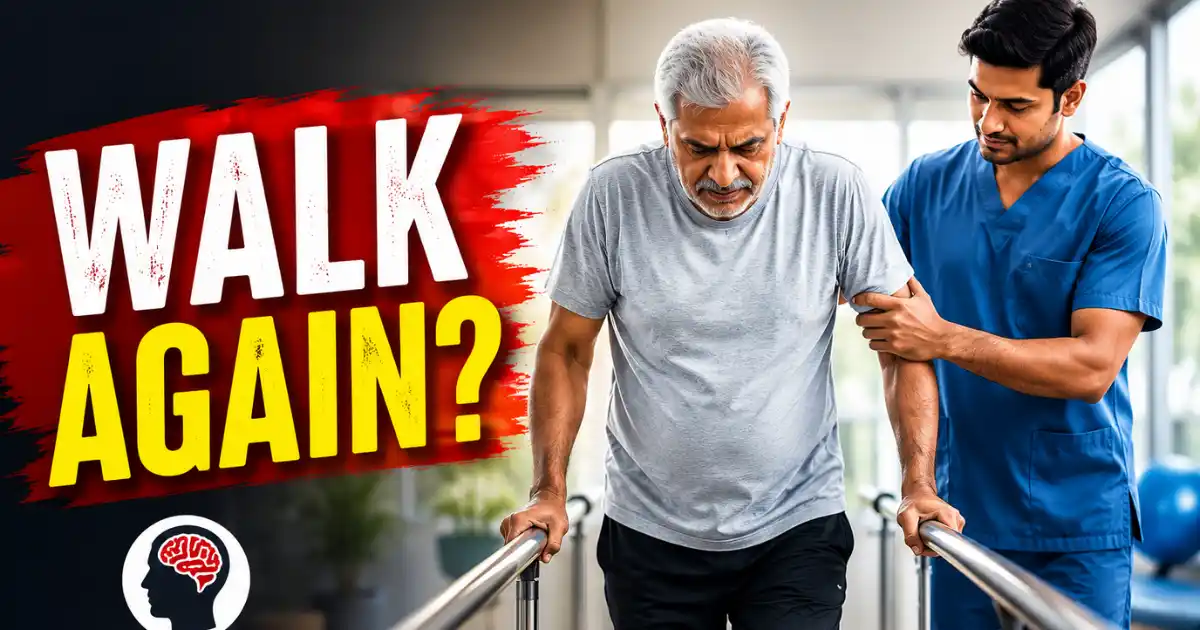
A stroke can change a person’s life within seconds. Simple activities like walking, standing, or even holding a cup may suddenly become difficult. But with proper physiotherapy rehabilitation, many stroke survivors can regain movement, independence, and confidence again.
How Physiotherapy Helps Stroke Patients Recover Faster
One of the hardest moments many families face after a stroke is hearing a loved one say, “Will I ever walk normally again?”
In real rehabilitation settings, this fear is extremely common. Many patients lose confidence long before they lose physical strength. Some avoid movement entirely because of fear of falling, while others delay physiotherapy assuming recovery will happen automatically with medicines alone.

Medically Reviewed By
Dr. Shabbir Hussain (BPT)
Physiotherapist | Neuro Rehabilitation Specialist
Last medically reviewed: May 21, 2026
Read Full Author Profile →Clinically, one common pattern observed is that patients who begin guided rehabilitation early often regain mobility faster and develop fewer long-term complications. But when recovery is delayed, stiffness, muscle weakness, poor balance, and emotional frustration can slowly take over daily life.
The truth is — walking recovery after stroke is possible for many patients, but it requires the right rehabilitation approach, consistency, and patience.
⚡ Quick Summary
Main Risk: Delayed rehabilitation can worsen weakness, balance problems, and dependency.
Key Symptom: Difficulty standing, imbalance, dragging leg, or inability to walk properly.
Best Solution: Early physiotherapy rehabilitation with gait training and neuro-recovery exercises.
Prevention Tip: Control blood pressure, diabetes, inactivity, and smoking habits.
What Is Stroke Rehabilitation?
Stroke rehabilitation refers to the structured recovery process aimed at helping stroke survivors regain movement, speech, balance, coordination, and independence.
A stroke happens when blood supply to part of the brain is interrupted. This may occur due to a blockage (ischemic stroke) or bleeding (hemorrhagic stroke). Because different areas of the brain control movement, sensation, and coordination, many patients experience weakness or paralysis on one side of the body.
Walking becomes difficult because the brain’s communication with muscles is disrupted.
Physiotherapy plays a major role in retraining the brain and body to work together again. In neuro-rehabilitation, this process is known as neuroplasticity — the brain’s ability to reorganize and form new movement pathways.
In my clinical experience, many families assume walking recovery depends only on leg strength. But recovery actually depends on balance, coordination, muscle control, confidence, sensory feedback, and repetition-based movement training.
Quick Answer
Physiotherapy helps stroke patients regain movement, balance, strength, and independence through targeted rehabilitation exercises. Early physiotherapy after stroke can improve walking ability, muscle control, coordination, and daily functioning while reducing long-term disability.
A Stroke Survivor’s Rehabilitation Journey
Many stroke survivors struggle with simple daily activities in the beginning. With regular physiotherapy, gradual improvements in walking, balance, hand movement, and confidence are often possible over time.
Hidden Dangers of Delayed Stroke Rehabilitation
Many stroke patients survive the medical emergency but later struggle with complications that silently reduce quality of life.
When walking recovery is delayed, muscles can become stiff and tight. Joints lose mobility. The patient may develop abnormal walking patterns, knee instability, foot dragging, or severe balance issues.
In physiotherapy practice, prolonged bed rest after stroke often leads to additional problems like pressure sores, lung infections, reduced endurance, and emotional isolation.
For Indian families, another major challenge is dependency. Patients may require help even for simple daily activities like using the bathroom, climbing stairs or walking inside the house.
Personally, I’ve observed that emotional recovery is deeply connected with physical mobility. Once patients start standing and walking with support, their confidence improves significantly.
Causes & Risk Factors
Several lifestyle and medical factors increase stroke risk.
High blood pressure remains one of the biggest causes, especially among urban Indian adults with stressful routines and poor sleep habits. Diabetes, smoking, obesity, elevated cholesterol, and heart disease also contribute significantly.
Sedentary lifestyles have become another hidden problem. Long office hours, excessive mobile use, poor physical activity, and unhealthy eating patterns are increasing stroke risk even in younger adults.
In real rehabilitation settings, many middle-aged patients report years of ignored health warning signs before the stroke occurred.
Long commuting hours, high stress, lack of exercise, and irregular medication habits are commonly observed among Indian working professionals.
Warning Signs You Should Never Ignore
Many patients experience subtle warning signs before or after a stroke.
Sudden weakness on one side of the body is one of the most common symptoms. Some patients notice facial drooping, difficulty speaking, imbalance, or inability to lift the arm properly.
Walking-related symptoms may include:
Difficulty standing without support, Foot dragging while walking , Sudden loss of balance , Fear of walking independently , Uneven weight-bearing , Frequent falls
Advanced symptoms may include complete inability to walk, severe muscle stiffness, or spasticity.
⚠️ One dangerous mistake families make is assuming recovery has “stopped” after a few weeks. In neuro-rehabilitation, improvement may continue for months with structured therapy.
Diagnosis & Physiotherapy Assessment
Stroke diagnosis is usually confirmed using brain imaging such as CT scan or MRI.
However, physiotherapy assessment focuses more on functional recovery.
In clinical neuro-rehabilitation, physiotherapists evaluate:
Muscle strength , Balance control , Coordination , Walking pattern (gait) , Joint mobility, Spasticity , Standing tolerance , Functional independence
One common pattern observed is that some patients appear physically strong but still cannot walk safely because balance reactions remain impaired.
Gold-standard rehabilitation requires individualized assessment rather than generic exercises copied from the internet.
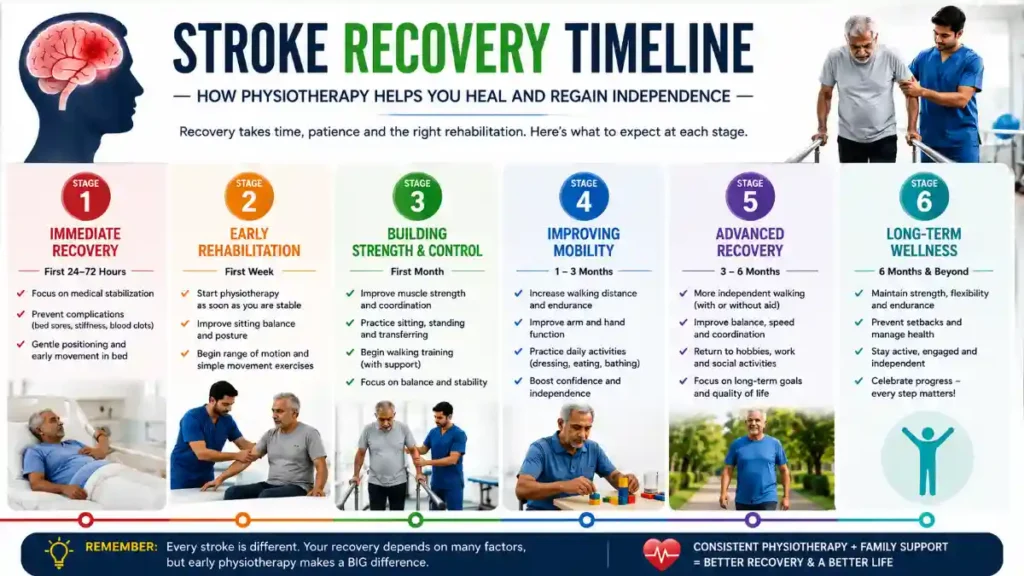
Can Stroke Patients Walk Again?
Physiotherapy after stroke is not simply “exercise.” It is a structured neurological retraining process.
The goal is to teach the brain and body how to coordinate movement again.
In early rehabilitation, physiotherapists often begin with bed mobility, sitting balance, posture correction, and weight shifting exercises.
As recovery progresses, treatment may include:
Gait training , Parallel bar walking , Balance retraining , Strengthening exercises, Functional movement practice , Task-specific walking drills, Stair climbing practice, Foot drop management ,Endurance training
In physiotherapy practice, repetition is extremely important. The nervous system learns through repeated meaningful movement.
Many patients improve faster when therapy is started early and combined with family support.
Best Physiotherapy Exercises After Stroke
Walking is not only about moving the legs.
Stroke survivors often lose balance confidence. Even small movements may trigger fear of falling.
Clinically, many patients initially walk by leaning heavily toward one side. Physiotherapy helps retrain weight distribution and posture control.
This stage requires patience because recovery is gradual.
Myth vs Fact
Many people believe stroke recovery stops after 3–6 months.
This is not completely true.
Neuroplasticity can continue for years with proper rehabilitation and movement training.
Another common myth is that complete bed rest helps recovery. In reality, medically supervised movement is usually essential for preventing complications.
Real Patient Story
A 58-year-old retired school teacher visited the rehabilitation clinic two weeks after suffering a stroke affecting the right side of his body.
Initially, he was unable to stand without support and had severe fear of falling. His family believed walking recovery might never happen.
During physiotherapy sessions, treatment focused on sitting balance, weight transfer training, and assisted standing exercises. Gradually, parallel bar walking and gait correction were introduced.
After three months of consistent rehabilitation, he was able to walk short indoor distances independently with improved confidence.
Personally, I’ve observed similar recovery patterns in many motivated patients who remain consistent with therapy.
🩺 Doctor Insight
⚠️ Many stroke patients lose walking confidence before actual muscle recovery stops. Early physiotherapy often improves not just movement, but emotional confidence and independence.
Prevention Strategies for Long-Term Brain & Mobility Health
Preventing another stroke is equally important.
Daily blood pressure control, diabetes management, smoking cessation, and regular exercise play major roles.
Indian dietary habits rich in salt, fried foods, and processed snacks should be modified gradually.
Walking regularly, maintaining healthy sleep, reducing stress, and avoiding prolonged sitting are important lifestyle changes.
For office workers, simple habits like standing breaks, hydration, and regular movement significantly improve vascular health.
When to See a Doctor Immediately
Seek urgent medical care if a patient develops:
Sudden facial drooping , Difficulty speaking, Sudden weakness, Loss of consciousness , Sudden imbalance , Vision changes , Severe headache
Delayed treatment during stroke can permanently worsen brain damage.
Who Should Avoid Certain Exercises?
Not every stroke patient should perform aggressive rehabilitation exercises immediately.
Patients with unstable blood pressure, severe cardiac conditions, uncontrolled diabetes, recent fractures, or acute medical instability require careful supervision.
In neuro-rehabilitation, exercise intensity must always match the patient’s recovery stage.
Clinically, unsupervised internet exercises sometimes increase fall risk in elderly stroke survivors.
✅ Key Takeaways
Early physiotherapy improves walking recovery potential after stroke.
Balance retraining is as important as muscle strengthening.
Consistent rehabilitation often produces gradual long-term improvement.
Fear of falling can delay recovery significantly.
Family support plays a major role in patient confidence.
Lifestyle control helps prevent future strokes.
Conclusion
Stroke recovery is physically challenging, emotionally exhausting, and often unpredictable.
But one thing remains clear in rehabilitation practice — movement matters.
Walking recovery rarely happens overnight. It develops through structured therapy, repeated movement training, emotional encouragement, and consistent effort.
Many stroke survivors regain meaningful independence when rehabilitation is started early and continued patiently.
For families, hope should always be balanced with realistic rehabilitation goals.
Because sometimes, the first assisted step after stroke becomes the turning point that changes everything.
⚠️ Medical Disclaimer
This content is intended for educational and public awareness purposes only and should not replace professional medical advice, diagnosis, or treatment. Always consult a qualified doctor or physiotherapist before starting rehabilitation exercises.
FAQs
Can stroke patients walk normally again?
Many stroke patients regain partial or significant walking ability with structured physiotherapy and rehabilitation. Recovery varies depending on stroke severity and timing of treatment.
How soon should physiotherapy start after stroke?
In many medically stable patients, physiotherapy begins within 24–48 hours under hospital supervision.
Why do stroke patients drag one leg?
This usually happens due to muscle weakness, poor coordination, balance deficits, or foot drop after neurological damage.
Is walking good for stroke recovery?
Yes, supervised walking training improves balance, circulation, muscle activation, and confidence during recovery.
Can physiotherapy improve balance after stroke?
Absolutely. Balance retraining is one of the core components of neuro-rehabilitation.
How long does stroke rehabilitation take?
Some patients improve within weeks, while others require months or years of continued therapy.
References
- World Health Organization – Stroke Facts
- NIH Stroke Rehabilitation Information
- PubMed – Stroke Rehabilitation Review
- American Stroke Association
- National Institute of Neurological Disorders and Stroke
Medically Reviewed By
Dr. Shabbir Hussain (BPT)
Physiotherapist | Neuro Rehabilitation Specialist
Read more about the reviewer here: About Dr. Shabbir Hussain
Last medically reviewed and updated: May 21, 2026
Dr. Shabbir Hussain, BPT
Licensed Physiotherapist | Clinical Rehabilitation Specialist
Maharashtra OTPT Council Reg. No.: PR-2021/08/PT/009532
Society of Onco Physiotherapists Reg. No.: SOP/00033/LM
Dr. Shabbir Hussain, BPT, Registered Physiotherapist with over 8 years of experience in physiotherapy, kidney rehabilitation, oncological rehabilitation, and lymphedema management. He specializes in balance disorders, pain management, musculoskeletal rehabilitation, strengthening programs, and VR-based rehabilitation.