
Last Updated: July 5, 2026
Evidence-Based Review: Reviewed according to current physiotherapy practice, peer-reviewed research, and international rehabilitation guidelines.
Estimated Reading Time: 12–15 Minutes
Grip Strength Calculator: Why This Simple Test Deserves More Attention
Have you ever struggled to open a tightly sealed water bottle or noticed that carrying grocery bags feels harder than it used to? Most people blame age, stress, or simply being tired. In reality, these seemingly minor changes may reflect something much more important—your grip strength.
As a physiotherapist, I often meet patients who come to the clinic because of neck pain, shoulder stiffness, or wrist discomfort. During their assessment, a simple grip strength test frequently reveals that their hand strength is much lower than expected for their age. Many are genuinely surprised because they assumed weak hands were merely a normal part of getting older.
In my clinical experience, grip strength is one of the simplest yet most informative measurements of overall physical function. It provides valuable insight into muscle health, recovery after injury, and even long-term wellbeing. Research over the past decade has shown that reduced grip strength is associated with poorer mobility, increased risk of falls in older adults, delayed recovery after illness, and reduced independence in daily activities.
⚡ Quick Summary
Main Concern: Weak grip strength may indicate reduced muscle function, nerve problems, age-related muscle loss, or underlying health conditions.
Key Symptom: Difficulty opening jars, carrying groceries, holding objects securely, or frequent dropping of items.
Best Solution: Measure your grip strength using a validated dynamometer, compare it with age- and sex-specific reference values, and begin targeted strengthening exercises if needed.
Prevention Tip: Stay physically active, include resistance training, maintain adequate protein intake, and avoid prolonged inactivity.
Grip Strength Calculator
| Result | Meaning |
|---|---|
| Weak | Below expected range. Physiotherapy assessment may help. |
| Average | Within expected range. |
| Excellent | Above average grip strength. |
Medical Note:
This calculator provides an educational estimate only and should not be used to diagnose any medical condition. Persistent weakness, pain, numbness, or sudden loss of grip strength should be evaluated by a qualified healthcare professional.
📊 Normal Grip Strength by Age (Reference Values)
Compare your grip strength with approximate reference values for healthy adults measured using a calibrated hand dynamometer.
| Age Group (Years) | Men (kg) | Women (kg) |
|---|---|---|
| 20–29 | 46–54 | 27–35 |
| 30–39 | 44–52 | 26–34 |
| 40–49 | 42–50 | 25–33 |
| 50–59 | 39–47 | 23–31 |
| 60–69 | 35–43 | 20–28 |
| 70–79 | 30–38 | 17–25 |
| 80+ | 24–33 | 14–21 |
⚡ Quick Facts: Grip Strength at a Glance
- ✔ Grip strength reflects overall muscle function, not just the strength of your hands and fingers.
- ✔ Weak grip strength may increase the risk of falls, reduced mobility, and loss of independence, especially in older adults.
- ✔ Grip strength often declines gradually, so many people do not notice weakness until everyday tasks become difficult.
- ✔ Testing usually takes less than one minute using a calibrated hand dynamometer.
- ✔ The Jamar Hydraulic Hand Dynamometer is considered the clinical gold standard for measuring grip strength.
- ✔ Regular resistance training, physiotherapy, adequate protein intake, and staying physically active can help improve grip strength in many individuals.
- ✔ Persistent weakness, numbness, or sudden loss of grip strength should always be evaluated by a qualified healthcare professional.
🩺 Clinical Insight
Grip strength is one of the simplest functional assessments used by physiotherapists because it provides valuable information about muscle performance, rehabilitation progress, nerve function, and overall physical health. A quick grip strength test can help identify early weakness before it begins to interfere with everyday activities.
Clinical Pearl: In my physiotherapy practice, reduced grip strength is often caused by problems beyond the hand itself. Poor posture, shoulder weakness, cervical nerve compression, and prolonged inactivity commonly reduce grip performance. Treating the underlying cause often restores grip strength more effectively than hand exercises alone.
What Is a Grip Strength Calculator?
A Grip Strength Calculator is a practical assessment tool that helps estimate whether your hand grip strength is within the expected range for your age and biological sex. It uses the force generated while squeezing a calibrated hand dynamometer and compares the measured value with established reference standards derived from healthy populations.
Grip strength is commonly measured in kilograms (kg) or pounds (lb). During testing, you squeeze the dynamometer as hard as possible for a few seconds. The highest value, usually recorded after multiple attempts, is compared with age- and sex-specific reference values to determine whether your strength is below average, average, above average, or excellent.
From a physiotherapy perspective, grip strength reflects much more than the strength of the fingers or forearm. It serves as a convenient indicator of overall muscle function, neuromuscular coordination, and functional capacity. This is one reason why hospitals, rehabilitation centers, sports medicine clinics, and geriatric assessment units frequently include grip strength testing as part of routine evaluations.
International organizations and researchers increasingly recognize grip strength as a meaningful functional health measure because it is quick to perform, inexpensive, non-invasive, and highly reproducible when standardized testing techniques are used.
Real Patient Story
A 34-year-old software engineer visited my clinic after noticing that he was dropping his coffee mug several times a week. He had no major pain but admitted that opening jars had become increasingly difficult over the previous six months.
He worked from home for nearly ten hours each day and rarely exercised. His workstation consisted of a laptop placed on a dining table, forcing him into a rounded-shoulder posture for prolonged periods.
During assessment, his grip strength measured well below the expected range for his age. He also demonstrated poor shoulder stability, tight forearm muscles, reduced wrist mobility, and mild cervical posture-related dysfunction.
Rather than focusing only on hand exercises, his rehabilitation program included posture correction, shoulder strengthening, ergonomic modifications, wrist mobility exercises, progressive grip training, and scheduled movement breaks throughout the workday.
Within eight weeks, his grip strength had improved substantially. More importantly, he reported greater confidence performing daily activities, reduced fatigue while typing, and no further episodes of dropping objects.
This case highlights an important lesson: weakness is often the result of multiple contributing factors rather than a problem isolated to the hand alone.
Why Grip Strength Is Becoming More Important Than Ever
Not long ago, grip strength was mainly measured in athletes, manual workers, or patients recovering from hand injuries. Today, it has become one of the most valuable functional health indicators used in physiotherapy, rehabilitation, sports medicine, and geriatric care.
So, why has grip strength suddenly become so important?
The answer lies in how dramatically our lifestyles have changed.
Across India, millions of people spend 8–12 hours each day using smartphones, laptops, and desktop computers. Students attend online classes, professionals work from home, gamers spend hours holding controllers, and office employees type continuously with minimal physical activity. While technology has improved productivity, it has also reduced the amount of natural muscle-loading our bodies receive.
In my clinical experience, I have noticed a clear pattern over the past few years. Many younger adults who appear healthy have surprisingly weak grip strength compared to what we would expect for their age. Most are not experiencing a disease—they are experiencing deconditioning.
💡 Did You Know?
- Grip strength is a reliable indicator of overall muscle function and is widely used in physiotherapy and rehabilitation.
- Even healthy young adults with sedentary lifestyles can develop below-average grip strength due to prolonged sitting and reduced physical activity.
- Physiotherapists routinely measure grip strength to monitor recovery after injuries, nerve disorders, fractures, and orthopedic surgery.
Hidden Dangers Most People Don’t Realize
A weak grip is often dismissed as a trivial inconvenience. However, from a rehabilitation perspective, it can have far-reaching consequences that extend well beyond the hands.
One of the first problems patients notice is a gradual loss of confidence during everyday tasks. Holding a heavy shopping bag becomes uncomfortable. Opening jars requires assistance. Carrying luggage feels unusually difficult. Even lifting a child or holding cooking utensils for extended periods may become tiring.
While these changes may seem insignificant individually, together they reduce functional independence.
Clinically, many patients compensate without realizing it. They begin using both hands instead of one, avoid lifting heavier objects, or unconsciously rely on family members. Because these adaptations occur slowly, weakness often remains unnoticed until it significantly affects quality of life.
Common Mistakes People Make
One of the most frustrating aspects of rehabilitation is that many patients unknowingly delay their own recovery by making avoidable mistakes.
Waiting Until Weakness Becomes Severe
Perhaps the most common mistake is assuming that hand weakness will simply improve on its own.
Many people ignore symptoms for months because they are not experiencing severe pain. Unfortunately, muscle weakness often progresses gradually, making it harder to reverse later.
Early intervention usually produces better outcomes.
Poor Exercise Technique
Many individuals squeeze hand grippers repeatedly without considering posture, wrist alignment, breathing, or exercise progression.
Strength training should always follow gradual progression rather than maximum effort from the first day.
Incorrect technique may overload tendons instead of strengthening muscles.
Shocking Findings & Recent Research
Scientific interest in grip strength has grown remarkably over the last decade.
Researchers now consider it far more than a measurement of hand power.
One of the most important discoveries is that grip strength correlates with overall muscle function and physical performance across different age groups.
Large population studies have shown that individuals with stronger grip strength generally demonstrate better mobility, improved balance, and greater independence in daily activities compared with those who have significantly reduced grip strength.
Researchers studying healthy aging have also found that grip strength tends to decline earlier than many people realize, making it a useful screening tool for detecting early physical decline before noticeable disability develops.
In rehabilitation medicine, grip strength has become an objective way to monitor recovery following fractures, tendon injuries, ligament reconstruction, stroke rehabilitation, nerve injuries, and orthopedic surgeries.
Early Warning Signs of Reduced Grip Strength
Weak grip strength rarely develops overnight. In most people, it progresses gradually, making it easy to overlook until everyday tasks become noticeably difficult. Many patients adapt without realizing that their muscles are becoming weaker. They may start using both hands to lift objects, avoid carrying heavy bags, or ask family members to open jars—all subtle changes that can signal declining hand function.
In my clinical experience, recognizing these early signs is one of the best ways to prevent long-term functional limitations. Early assessment allows us to identify the underlying cause and begin appropriate rehabilitation before weakness interferes with work, hobbies, or independence.
Don’t Ignore These Signs
Some symptoms require prompt medical evaluation because they may indicate an underlying neurological or orthopedic condition rather than simple muscle weakness.
Seek medical attention if you experience:
- Sudden loss of grip strength in one hand.
- Progressive weakness over a few days or weeks.
- Persistent numbness or tingling in the thumb, index, or middle fingers.
- Weakness associated with severe neck pain or radiating arm pain.
- Inability to lift the wrist or fingers.
- Significant swelling, redness, or deformity after an injury.
- Difficulty speaking, facial drooping, or weakness affecting one side of the body.
Physiotherapy Assessment
In physiotherapy practice, grip strength is interpreted as part of a broader functional assessment rather than in isolation.
In my clinical experience, patients often focus only on their hands, while the actual problem may originate elsewhere. Poor shoulder stability, restricted wrist mobility, nerve compression at the neck, or postural dysfunction can all reduce grip performance.
A comprehensive physiotherapy assessment typically includes:
Postural Evaluation
Rounded shoulders, forward head posture, and prolonged sitting may alter upper-limb biomechanics and contribute to muscle imbalance.
Cervical Spine Assessment
Neck movement is assessed to identify cervical radiculopathy or nerve root irritation that may affect hand strength.
Shoulder Function
Weakness around the shoulder blade can reduce force transmission through the upper limb, indirectly affecting grip strength.
Elbow and Wrist Mobility
Restricted movement or pain may limit the ability to generate maximal gripping force.
Hand Function Assessment
The therapist evaluates finger movement, thumb function, dexterity, coordination, and pinch strength to identify specific deficits.
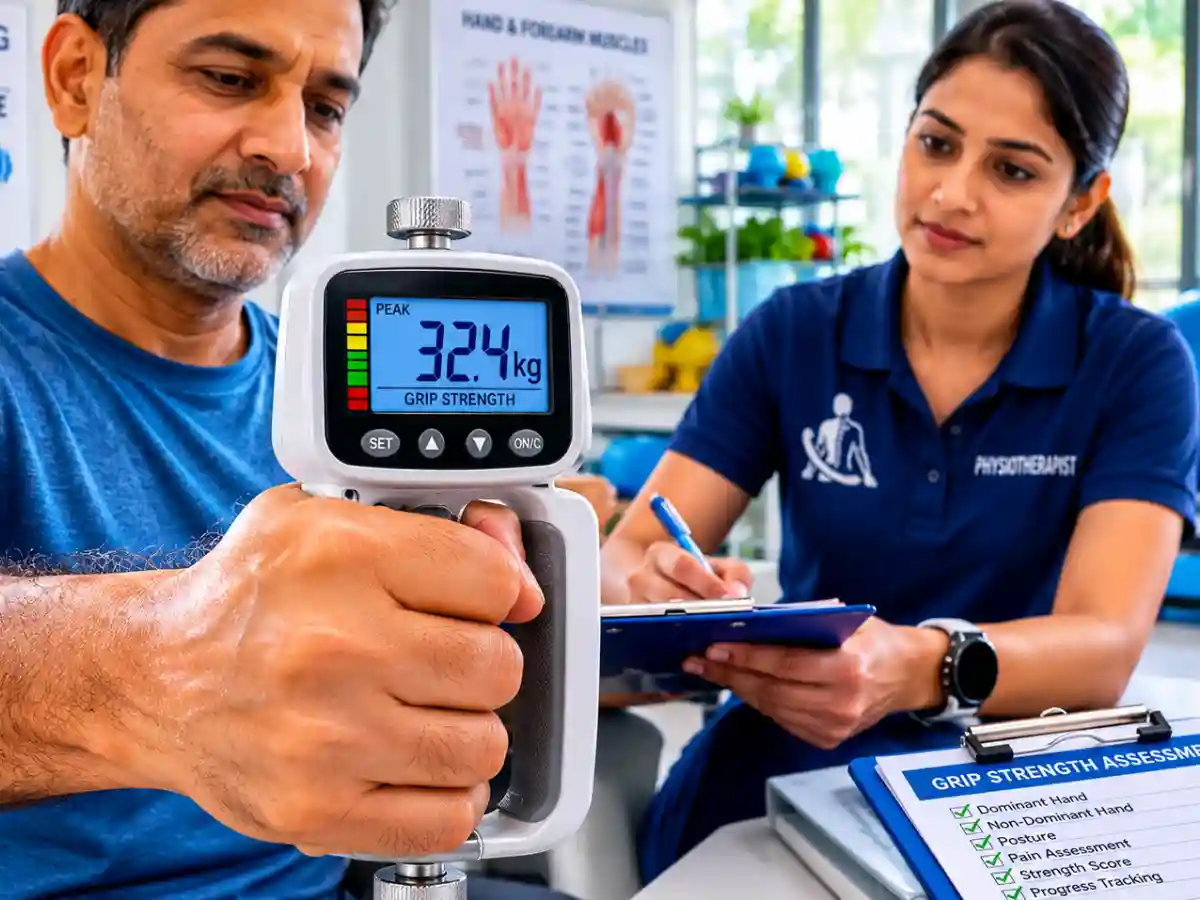
Gold-Standard Grip Strength Testing
The most reliable method of measuring grip strength is the use of a calibrated hand dynamometer, with the Jamar Hydraulic Hand Dynamometer widely regarded as the gold standard in clinical practice and research.
To ensure accurate and reproducible results, standardized testing procedures are recommended.
Standard Testing Position
The patient is usually seated with:
- Shoulder adducted and in a neutral position.
- Elbow flexed to approximately 90 degrees.
- Forearm in a neutral position.
- Wrist slightly extended (about 0–30 degrees).
This position minimizes the influence of body posture and allows for consistent measurements.
Testing Procedure
The individual is instructed to squeeze the dynamometer as hard as possible for approximately 3–5 seconds.
Three attempts are usually performed for each hand, with short rest periods between trials to prevent fatigue.
The highest value or the average of the best attempts—depending on the testing protocol—is recorded and compared with age- and sex-specific reference values.
Clinical Perspective
In my clinical experience, grip strength testing is one of the simplest yet most informative assessments we perform in physiotherapy. It takes less than a minute, causes no discomfort, and provides objective information that can guide rehabilitation, monitor recovery, and motivate patients by showing measurable improvement over time.
However, it is important to remember that a Grip Strength Calculator is a screening tool—not a diagnosis. A low score should encourage further evaluation rather than cause unnecessary anxiety. When interpreted alongside a thorough medical history, physical examination, and functional assessment, grip strength becomes a valuable indicator of overall musculoskeletal and neurological health.
When Should You See a Doctor Immediately?
While mild reductions in grip strength may improve with rehabilitation and lifestyle changes, certain situations require urgent medical attention.
Seek immediate medical evaluation if you experience:
- Sudden inability to grip objects.
- Weakness affecting one side of the body.
- Severe neck pain with rapidly progressing arm weakness.
- Loss of sensation in the hand or fingers.
- Sudden difficulty walking or maintaining balance.
- Speech problems or facial drooping.
- Persistent severe swelling following trauma.
Conclusion
Grip strength is much more than a measure of how firmly you can shake someone’s hand. It reflects the health of your muscles, nerves, joints, and overall physical function.
A Grip Strength Calculator provides a simple and practical way to screen for reduced hand strength, but it should never replace a professional medical or physiotherapy assessment. If your results are below the expected range or you experience persistent weakness, pain, numbness, or difficulty performing everyday activities, seeking timely evaluation is the best next step.
In my clinical experience, early intervention almost always leads to better outcomes. Small changes—such as improving posture, staying physically active, performing evidence-based strengthening exercises, eating a balanced diet, and addressing underlying medical conditions—can make a meaningful difference in your recovery and long-term independence.
✅ Key Takeaways
- Grip strength is an important indicator of overall muscle function, mobility, and physical health—not just hand strength.
- A weak grip may result from inactivity, aging, nutritional deficiencies, nerve compression, arthritis, injury, or certain medical conditions.
- A Grip Strength Calculator is a useful screening tool but does not replace a medical or physiotherapy assessment.
- Regular resistance training, ergonomic improvements, balanced nutrition, and physiotherapy can significantly improve grip strength.
- Persistent weakness, numbness, severe pain, or sudden loss of grip strength should always be evaluated by a healthcare professional.
- Early intervention often leads to faster recovery and helps maintain independence in everyday activities.
Frequently Asked Questions (FAQs)
1. What is a normal grip strength?
Normal grip strength depends on your age, biological sex, body size, and the hand being tested. Adult men generally have higher grip strength than women, and strength gradually declines with advancing age. A grip strength calculator compares your measured value with established reference ranges.
2. Can weak grip strength be improved?
Yes. In many cases, grip strength improves through progressive strengthening exercises, physiotherapy, proper nutrition, treatment of underlying medical conditions, and regular physical activity. Recovery varies depending on the cause of weakness.
3. Does weak grip always mean a serious disease?
No. A weak grip may simply reflect physical inactivity or temporary deconditioning. However, persistent weakness—especially if accompanied by numbness, pain, or muscle wasting—should be evaluated by a healthcare professional.
4. How often should grip strength be tested?
Healthy adults may only need occasional testing, while individuals undergoing rehabilitation, recovering from injury, or participating in strength training may benefit from periodic reassessment every few weeks to monitor progress.
5. Which hand should be tested?
Ideally, both hands should be tested using standardized techniques. Comparing the dominant and non-dominant hands helps identify asymmetry that may indicate injury or neurological problems.
6. Can poor posture reduce grip strength?
Yes. Poor posture, particularly prolonged forward-head posture and rounded shoulders, can alter upper-limb mechanics and may contribute to reduced grip performance in some individuals.
Medical Disclaimer
This article is intended for educational and informational purposes only and should not be considered a substitute for professional medical advice, diagnosis, or treatment.
A Grip Strength Calculator is a screening tool and cannot diagnose medical conditions. If you experience persistent weakness, numbness, severe pain, sudden loss of strength, or difficulty performing everyday activities, consult a qualified healthcare professional or physiotherapist for a comprehensive assessment.
Individual treatment recommendations should always be based on a detailed medical history, physical examination, and appropriate investigations where necessary.
References
- World Health Organization. (2023). Healthy ageing and functional ability. https://www.who.int
- National Institutes of Health. National Institute on Aging. (2024). Muscle weakness and healthy aging. https://www.nia.nih.gov
- PubMed. Bohannon RW. (2019). Grip Strength: An Indispensable Biomarker for Older Adults. Clinical Interventions in Aging.
- Cruz-Jentoft AJ, et al. (2019). Revised European Consensus on Definition and Diagnosis of Sarcopenia (EWGSOP2). Age and Ageing.
- Roberts HC, et al. (2011). A Review of the Measurement of Grip Strength in Clinical and Epidemiological Studies. Age and Ageing.

Dr. Shabbir Hussain, BPT
Licensed Physiotherapist | Clinical Rehabilitation Specialist
Maharashtra OTPT Council Reg. No.: PR-2021/08/PT/009532
Society of Onco Physiotherapists Reg. No.: SOP/00033/LM
Dr. Shabbir Hussain, BPT, Registered Physiotherapist with over 8 years of experience in physiotherapy, kidney rehabilitation, oncological rehabilitation, and lymphedema management. He specializes in balance disorders, pain management, musculoskeletal rehabilitation, strengthening programs, and VR-based rehabilitation.