
Medically Reviewed & Evidence-Based
Written & Reviewed By: Dr. SHABBIR HUSSAIN (BPT)
Clinical Experience: 8+ Years in Musculoskeletal & Rehabilitation Physiotherapy
Last Updated: June 26, 2026
✅ This article has been reviewed by a qualified physiotherapist for medical accuracy and public health awareness. The information is based on current clinical evidence, rehabilitation guidelines, and practical physiotherapy experience.
Could Your Daily Sitting Habit Be Quietly Damaging Your Spine?
Most people don’t notice poor posture until something begins to hurt.
It usually starts with a mild stiffness after work. A slight ache in the neck after scrolling on the phone. A feeling that your shoulders are becoming tighter every month.
Then one day, turning your head becomes uncomfortable. Sitting through a meeting feels exhausting. Even sleeping no longer provides relief.
In my physiotherapy practice, this pattern is remarkably common. Many patients believe their pain appeared “suddenly,” but when we look closer, the problem has often been developing silently for months—or even years.
Today’s modern lifestyle has created what many rehabilitation professionals call an “epidemic of postural dysfunction.” Long office hours, online classes, smartphone addiction, prolonged commuting, and reduced physical activity have changed the way our spine functions.
⚡ Quick Summary
Main Risk: Poor posture gradually increases stress on the spine, muscles, joints, and discs.
Key Symptom: Persistent neck stiffness, shoulder tightness, or lower back pain that worsens after prolonged sitting.
Best Solution: Early posture correction combined with physiotherapy exercises and ergonomic improvements.
Prevention Tip: Change your sitting position every 30–45 minutes and strengthen your core and upper back muscles.
⚠️ Doctor’s Clinical Insight
“One of the biggest mistakes I see in clinical practice is waiting until pain becomes severe before seeking help. By the time daily activities become difficult, poor posture has often been placing excessive stress on the spine for months. Early correction almost always leads to better outcomes.”
— Dr. SHABBIR HUSSAIN (BPT)
A Real Patient Story
A 34-year-old software engineer visited the clinic after experiencing persistent neck pain for nearly eight months.
Initially, he blamed his pillow.
Later, he changed mattresses, tried painkillers, and even reduced gym workouts.
However, the discomfort kept returning.
During assessment, one common pattern became obvious. He spent nearly ten hours each day leaning toward a laptop positioned below eye level while simultaneously checking his phone every few minutes.
After correcting his workstation, improving sitting habits, performing supervised strengthening exercises, and following a structured home rehabilitation program, his pain gradually reduced over eight weeks.
Perhaps the biggest lesson from his recovery was this: the exercises certainly helped, but changing daily habits made the greatest difference.
What Is Poor Posture?
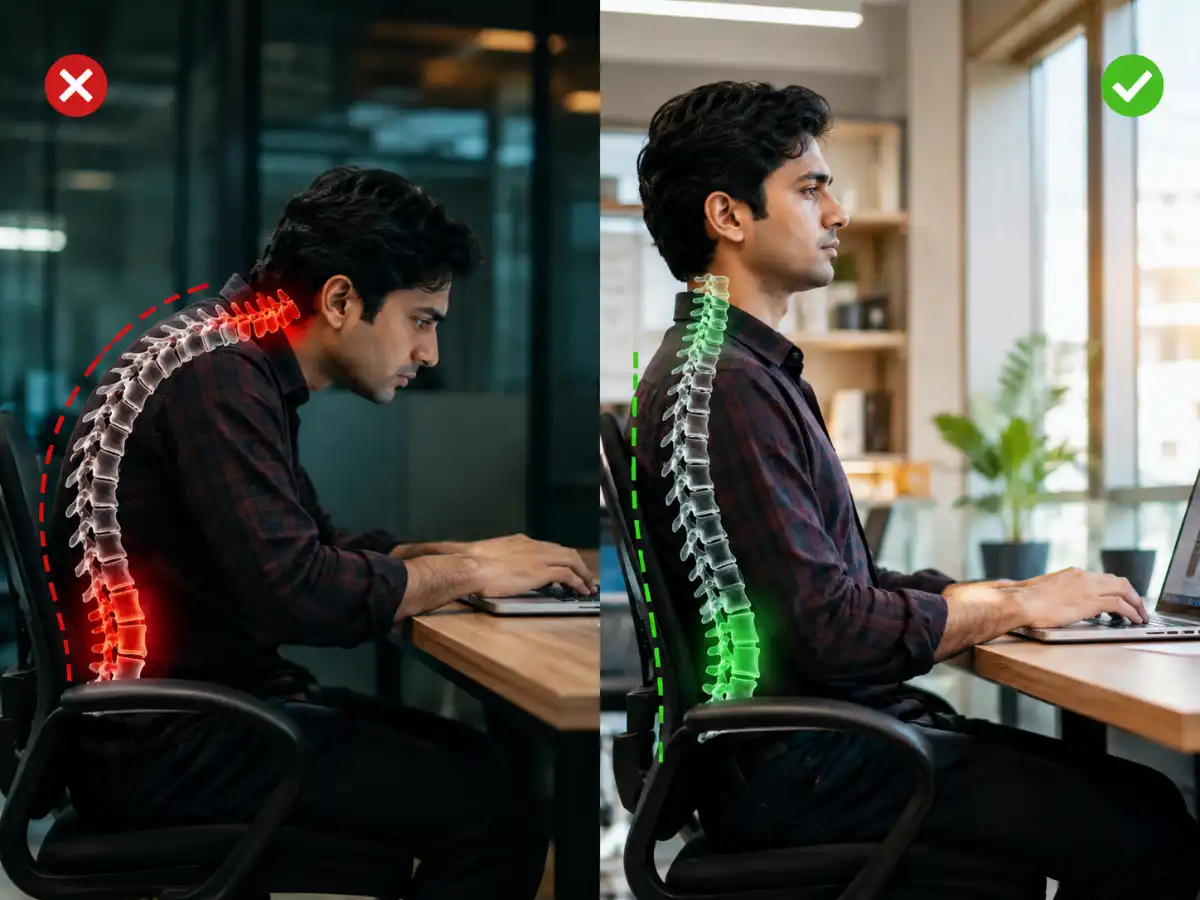
Poor posture is the prolonged misalignment of the body while sitting, standing, walking, or performing daily activities. Over time, it increases stress on the spine, muscles, joints, and supporting ligaments, which may contribute to neck pain, back pain and muscle imbalance.
Poor posture refers to the body’s inability to maintain proper alignment while sitting, standing, walking, or performing daily activities.
A healthy spine naturally has gentle curves that distribute body weight evenly. These curves help absorb shock, maintain balance, and allow efficient movement.
When posture is consistently poor, these natural curves become altered. Instead of muscles sharing the workload evenly, certain muscles become overworked while others gradually weaken. Over time, joints, ligaments, spinal discs, and nerves experience abnormal stress.
Clinically, poor posture is rarely caused by a single bad sitting position. Instead, it develops through thousands of small habits repeated every day.
Looking down at a smartphone for hours.
Working on a laptop placed too low.
Driving long distances.
Watching television while lying awkwardly on the sofa.
These seemingly harmless habits slowly change how the spine functions.
Why Your Spine Depends on Good Posture
Your spine is far more than a stack of bones.
It protects the spinal cord, supports body weight, allows movement, and helps maintain balance.
Every time posture changes, pressure inside the spinal discs also changes.
Research has shown that prolonged slouching increases mechanical stress on the cervical and lumbar spine. Over time, this can contribute to muscle fatigue, ligament strain, disc degeneration, and joint irritation.
In my clinical experience, many younger patients are surprised to learn that age alone is not responsible for their back pain. Lifestyle often plays a much larger role than they realize.
Did You Know?
Many people believe back pain begins after lifting something heavy. In reality, spinal stress often builds quietly through thousands of small habits—slouching at work, looking down at a phone, or sitting without movement for hours.
Recognizing these habits early can help prevent long-term pain and improve your quality of life.
📊 Poor Posture & Back Pain by the Numbers
- Low back pain affects nearly 620 million people worldwide and is one of the leading causes of disability globally. The number of people living with low back pain is projected to rise significantly in the coming decades due to population growth and ageing.
- Around 80% of people experience low back pain at least once during their lifetime, making it one of the most common musculoskeletal conditions seen in clinical practice.
- Adults who work at a desk often spend 7–10 hours sitting each day. Prolonged sitting, particularly with poor posture and limited movement, increases mechanical stress on the cervical and lumbar spine and is associated with a higher risk of neck and back discomfort.
- Looking down at a smartphone can dramatically increase the load on the cervical spine. As the head tilts forward, the effective force acting on the neck rises substantially compared with maintaining a neutral posture, contributing to muscle fatigue and postural strain over time.
- According to the World Health Organization (WHO), musculoskeletal conditions—including back and neck pain—are among the leading contributors to disability worldwide and affect people of all ages.
Clinical Perspective
While a single episode of slouching is unlikely to cause lasting harm, repeating poor sitting or standing habits every day for months or years can gradually overload the muscles, joints, ligaments, and spinal discs. Regular movement, ergonomic adjustments, and strengthening exercises are key to reducing this cumulative stress.
The Hidden Dangers of Poor Posture
Poor posture affects much more than appearance.
Initially, the body adapts remarkably well. Muscles compensate, joints adjust, and discomfort remains mild.
However, compensation cannot continue indefinitely.
As abnormal loading continues, muscles become imbalanced. Tight chest muscles pull the shoulders forward. Weak upper back muscles struggle to stabilize the shoulder blades. The neck gradually shifts forward, forcing cervical muscles to support several additional kilograms of load.
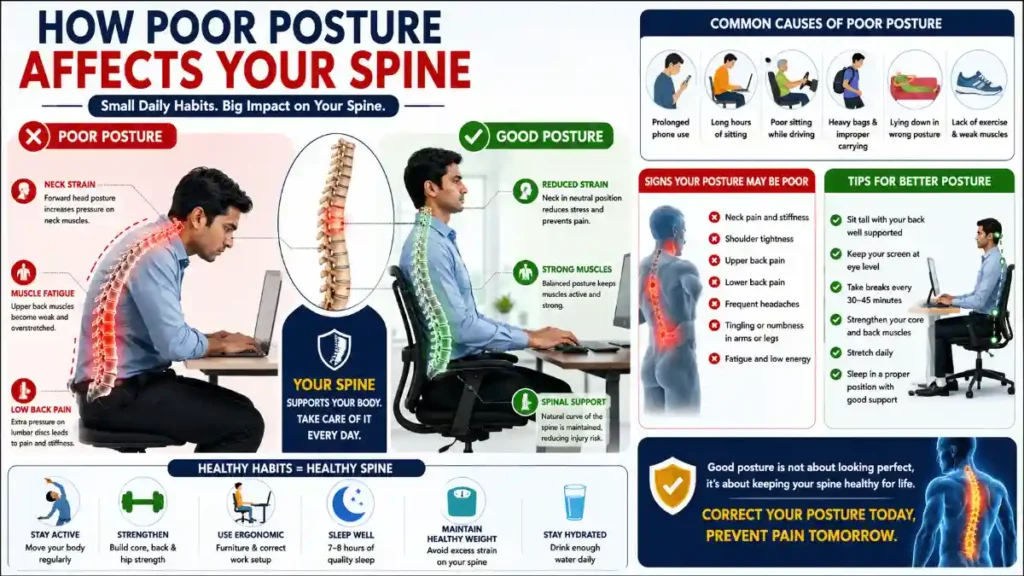
This process often leads to recurring neck pain, tension headaches, shoulder stiffness, upper back discomfort, and chronic lower back pain.
Many patients also report reduced concentration because persistent muscle tension increases fatigue throughout the workday.
Everyday Habits That Help or Harm Your Spine
| Healthy Habit | Habit That Increases Spinal Stress |
|---|---|
| Screen at eye level | Laptop placed too low |
| Feet flat on the floor | Crossing legs for long periods |
| Short movement breaks every 30–45 minutes | Sitting continuously for several hours |
| Holding your phone at eye level | Looking down at your phone for long periods |
| Regular stretching and strengthening exercises | Lack of physical activity |
| Using a supportive chair with lumbar support | Slouching on a sofa or bed while working |
| Sleeping with proper neck support | Sleeping with multiple high pillows |
| Carrying backpacks evenly on both shoulders | Carrying heavy bags on one shoulder only |
Common Causes and Risk Factors
Modern life has dramatically increased exposure to poor posture.
Indian office workers often spend eight to ten hours sitting in front of computers with minimal movement.
Students frequently study for prolonged periods while bending over notebooks or tablets.
Healthcare professionals, dentists, teachers, drivers, bankers, software engineers, and call centre employees often maintain static positions throughout the day.
Another growing concern is smartphone posture.
Repeatedly bending the neck while texting places considerably more force on the cervical spine than maintaining a neutral position.
Clinically, many younger adults now present with symptoms once commonly seen in much older individuals.
Who Is Most at Risk?
Although poor posture can affect anyone, some people are more likely to develop posture-related neck and back problems because of their daily activities.
- 💻 Office workers and software engineers
- 🎓 Students and online learners
- 🚗 Drivers and commuters
- 🩺 Healthcare professionals and dentists
- 👩🏫 Teachers
- 🏦 Bank and call centre employees
- 📱 People who use smartphones or laptops for several hours each day
Clinical Tip: If your work requires prolonged sitting or repetitive movements, taking a short movement break every 30–45 minutes can help reduce spinal stress and muscle fatigue.
📝 Editor’s Note
Medical knowledge evolves continuously. This article is reviewed regularly to reflect current rehabilitation research and evidence-based physiotherapy recommendations.
Early Warning Signs You Should Never Ignore
Poor posture rarely causes severe pain overnight.
Instead, the body sends subtle warning signals.
Many people notice neck stiffness after waking up.
Others experience shoulder tightness while working.
Some develop headaches beginning near the base of the skull.
Lower back discomfort after sitting for long periods is another common complaint.
As the condition progresses, symptoms may include reduced flexibility, frequent muscle fatigue, tingling sensations, occasional arm numbness, reduced endurance, and difficulty maintaining one position.
One common pattern observed in rehabilitation settings is that symptoms improve during holidays but return soon after resuming work—strongly suggesting posture-related mechanical stress.
⚠️ 5 Common Posture Mistakes That Quietly Damage Your Spine
Poor posture usually develops through small everyday habits rather than one major event. Recognizing and correcting these common mistakes early can help reduce stress on your spine and lower the risk of chronic neck and back pain.
| Common Mistake | Why It Matters |
|---|---|
| 📱 Looking Down at Your Phone for Long Periods | Forward head posture increases strain on the neck muscles and cervical spine, often leading to stiffness and headaches. |
| 💻 Working with a Laptop Below Eye Level | A low screen encourages slouching, rounded shoulders, and prolonged spinal loading. |
| 🪑 Sitting for Hours Without Moving | Remaining in one position for long periods reduces muscle activity and increases pressure on spinal discs. |
| 🏋️ Ignoring Core and Upper Back Strength | Weak postural muscles make it harder to maintain proper spinal alignment throughout the day. |
| 🚶 Ignoring Early Neck or Back Pain | Persistent stiffness and mild discomfort are early warning signs that should not be overlooked, as they may worsen over time if daily habits remain unchanged. |
How Physiotherapists Diagnose Posture Problems
Diagnosis begins long before any scan is ordered.
A detailed clinical assessment provides valuable information about movement patterns, muscle balance, flexibility, posture, occupation, lifestyle, and pain behaviour.
In my physiotherapy practice, posture assessment usually includes standing alignment, sitting posture, spinal mobility, muscle strength, balance, gait analysis, ergonomic evaluation, and functional movement testing.
Special orthopedic tests may be performed when nerve compression or joint pathology is suspected.
Imaging such as X-rays, MRI, or CT scans is generally reserved for individuals with severe trauma, persistent neurological symptoms, suspected fractures, infection, tumors, or symptoms that fail to improve with conservative treatment.
For most posture-related problems, careful clinical examination remains the foundation of diagnosis.
Treatment and Physiotherapy Management
The good news is that posture-related pain often responds extremely well to conservative treatment when addressed early.
The first priority is identifying the movement habits responsible for excessive spinal stress.
Exercise alone cannot fully correct poor posture if unhealthy daily habits continue.
Treatment usually combines posture education, ergonomic correction, stretching of shortened muscles, strengthening of weakened muscle groups, spinal mobility exercises, breathing retraining, and gradual return to normal activities.
In rehabilitation settings, individualized exercise programs consistently produce better long-term results than generic online routines.
Core strengthening plays an important role because the deep abdominal and spinal stabilizing muscles help maintain proper alignment throughout daily movement.
Upper back strengthening is equally important. Strong scapular muscles reduce forward shoulder posture and improve neck mechanics.
Patients often ask how long recovery takes.
In my clinical experience, mild posture-related discomfort may improve within several weeks when exercises are performed consistently.
Recovery Timeline: When Can You Expect Improvement?
Recovery from posture-related pain varies depending on how long poor posture has been present, the severity of muscle imbalance, and how consistently you follow your physiotherapy exercises and ergonomic recommendations. While every person heals at a different pace, many people notice gradual improvements when healthy habits are maintained.
| Time After Starting Treatment | What You May Notice |
|---|---|
| Week 1 | Reduced muscle stiffness and greater awareness of posture during daily activities. |
| Weeks 2–4 | Improved flexibility, easier movement, and reduced neck or back discomfort after sitting. |
| Month 2 | Better posture becomes more natural, with improved endurance while working or studying. |
| Month 3 | Stronger core and upper back muscles help support the spine and reduce recurring pain. |
| Around 6 Months | Long-term postural habits are established, helping lower the risk of chronic neck and back problems when combined with regular exercise and ergonomic practices. |
Clinical Note: Recovery is not always linear. Some days may feel better than others, especially if old habits return. Consistency with movement, strengthening exercises, and workstation ergonomics is far more important than trying to maintain a “perfect posture” all day.
Can Poor Posture Be Reversed?
In many cases, yes. Poor posture caused by prolonged sitting, muscle weakness, poor workstation ergonomics, or repetitive daily habits can often improve with consistent physiotherapy exercises, posture education, and regular movement.
Early intervention generally produces the best results because the muscles, joints, and spinal tissues have experienced less prolonged stress. Strengthening the core and upper back muscles, stretching tight muscle groups, and making simple ergonomic changes can gradually restore healthier movement patterns and reduce pain.
However, recovery may take longer if poor posture has contributed to structural changes such as advanced spinal degeneration, severe scoliosis, chronic disc disease, or long-standing joint stiffness. In these situations, symptoms can often still be improved, but rehabilitation usually requires a personalized treatment plan and close supervision by a qualified healthcare professional.
The key message is that posture is a habit—not a fixed position. Small, consistent improvements in the way you sit, stand, walk, and work each day can make a significant difference to your long-term spinal health.
Clinical Insight: Most posture-related problems do not develop overnight, and they rarely improve overnight. Consistent daily exercises, regular movement breaks, and ergonomic adjustments are far more effective than trying to maintain a perfectly straight posture all day.
Myth vs Fact
One of the most common myths is that sitting perfectly straight all day is ideal.
In reality, no sitting posture remains healthy if maintained for several hours without movement.
The best posture is your next posture.
Changing positions regularly reduces prolonged stress on muscles and spinal discs.
Another misconception is that posture braces permanently solve the problem.
While braces may provide temporary support in selected cases, they cannot replace muscle strength, movement education, and active rehabilitation.
When Should You See a Doctor?
While many posture-related aches improve with activity modification and physiotherapy, some symptoms require medical evaluation.
Consult a Doctor if pain lasts longer than two to four weeks, keeps returning, interferes with sleep, limits daily activities, or radiates into the arms or legs. Sudden weakness, numbness, difficulty walking, loss of balance, or changes in bowel or bladder function require immediate assessment, as these may indicate nerve compression or another serious spinal condition.
Who Should Avoid Certain Exercises or Treatments?
Not every posture exercise is suitable for everyone.
Individuals with recent spinal fractures, severe osteoporosis, spinal infections, active inflammatory arthritis, spinal tumors, recent surgery, or significant nerve compression should avoid self-prescribed rehabilitation programs until they have been evaluated by a qualified healthcare professional.
High-velocity spinal manipulation and aggressive stretching should also be avoided in people with spinal instability or neurological symptoms unless specifically recommended by an experienced clinician.
✅ Key Takeaways
Poor posture develops gradually through everyday habits, not from a single bad sitting position.
Early warning signs such as neck stiffness, shoulder tightness, headaches, and lower back discomfort should never be ignored.
Regular movement, ergonomic improvements, and strengthening exercises are far more effective than simply trying to “sit straight.”
Most posture-related problems improve with early physiotherapy intervention and consistent rehabilitation.
Small daily lifestyle changes often produce better long-term spinal health than occasional intensive workouts.
⚠️ Medical Disclaimer
This article is intended for educational and public health awareness purposes only. It should not replace a consultation with a qualified physician or physiotherapist. Individual diagnosis and treatment vary depending on age, medical history, and the underlying cause of symptoms. Always consult your Doctor before starting a new exercise or rehabilitation program, especially if you have severe pain, neurological symptoms, recent surgery, or other medical conditions.
Frequently Asked Questions (FAQs)
1. Can poor posture permanently damage the spine?
Poor posture itself does not usually cause permanent spinal damage overnight. However, maintaining poor posture for months or years can increase stress on the spinal discs, joints, muscles, and ligaments.
Over time, this may contribute to chronic neck pain, lower back pain, muscle imbalance, and, in some people, early degenerative changes. The good news is that many posture-related problems improve significantly with physiotherapy, regular exercise, and lifestyle changes.
2. Can poor posture cause neck pain and headaches?
Yes. One of the most common clinical observations is that forward head posture places extra strain on the neck muscles. This can trigger muscle tension, stiffness, and cervicogenic headaches that usually begin near the base of the skull and spread toward the forehead.
3. How long does it take to correct poor posture?
Recovery depends on how long the problem has existed and whether structural changes have developed.
Mild postural problems may improve within 4–8 weeks with consistent exercise and ergonomic corrections. Long-standing posture problems may require 3–6 months of rehabilitation and habit modification.
4. Can poor posture cause a slipped disc?
Poor posture alone is rarely the only cause of a slipped (herniated) disc. However, prolonged poor posture increases mechanical stress on spinal discs, making them more vulnerable when combined with heavy lifting, sudden twisting, obesity, smoking, or aging.
5. Is walking good for posture?
Yes. Walking activates many muscles responsible for spinal stability and encourages natural movement. Regular walking, combined with posture-specific strengthening exercises, can improve overall spinal health.
6. Should I wear a posture corrector every day?
A posture brace may provide temporary support in selected cases, but it should never replace exercise. Long-term reliance on braces may reduce muscle activity if used excessively. Physiotherapists generally recommend using them only as part of a comprehensive rehabilitation program.
7. Can children and teenagers develop posture problems?
Absolutely. Increased screen time, online learning, heavy school bags, prolonged gaming, and smartphone use have led to a noticeable rise in posture-related problems among adolescents. Early education and physical activity are important preventive measures.
References
World Health Organization. (2023). Musculoskeletal health. https://www.who.int/news-room/fact-sheets/detail/musculoskeletal-conditions
National Institute of Arthritis and Musculoskeletal and Skin Diseases. (2024). Back Pain. https://www.niams.nih.gov/health-topics/back-pain
National Institutes of Health. (2024). MedlinePlus: Back Pain. https://medlineplus.gov/backpain.html
National Institutes of Health. (2024). Neck Pain. https://medlineplus.gov/neckinjuriesanddisorders.html
American Physical Therapy Association. (2024). ChoosePT: Neck Pain and Back Pain Resources. https://www.choosept.com

Dr. Shabbir Hussain, BPT Licensed Physiotherapist | Clinical Rehabilitation SpecialistMaharashtra OTPT Council Reg. No. PR-2021/08/PT/009532Society of Onco Physiotherapists Reg. No. SOP/00033/LM
He is a licensed physiotherapist with over 8 years of experience in physiotherapy, kidney rehabilitation, oncological rehabilitation, and lymphedema management. He specializes in balance disorders, pain management, musculoskeletal rehabilitation, strengthening programs, and VR-based rehabilitation.
Dr. Shabbir Hussain (BPT)