
Last Updated: June 27, 2026
Shoulder pain while lifting your arm? Weakness during workouts? Your deltoid muscle may be the hidden reason. Understanding this powerful shoulder muscle can help prevent injuries, improve posture, and build stronger shoulders.
Most people train shoulders incorrectly because they don’t fully understand the deltoid muscle.
This powerful shoulder muscle controls lifting strength, posture, arm movement and shoulder stability.
In this article, you’ll discover the 3 heads of the deltoid, their functions, common injuries and the best ways to build stronger shoulders.
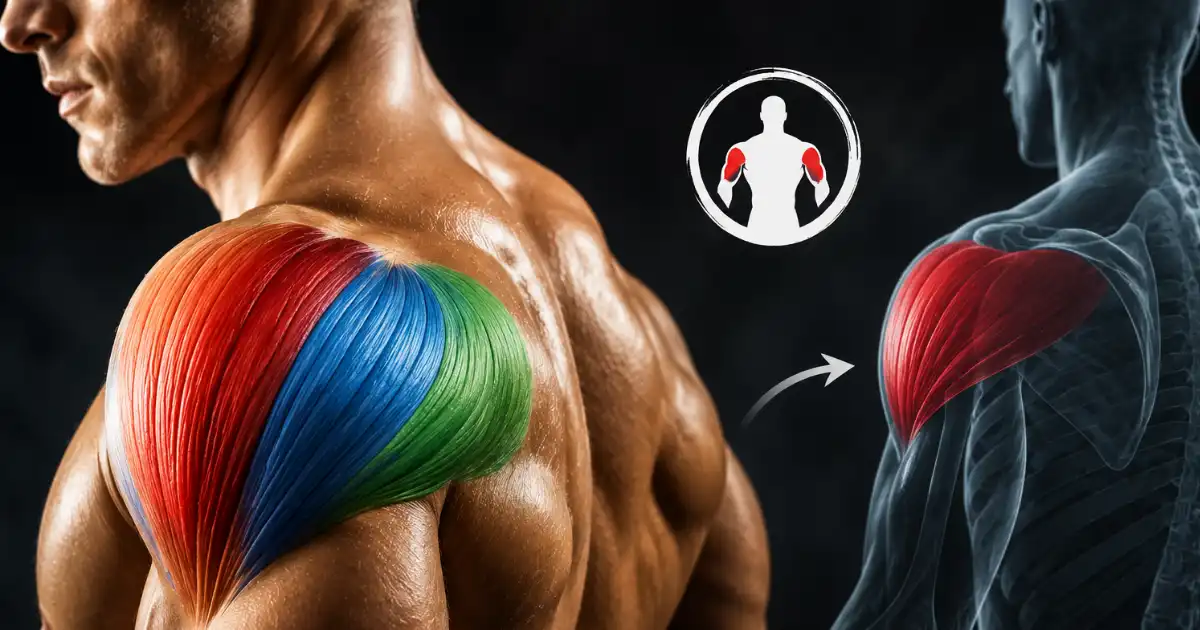
The deltoid muscle, commonly referred to as the deltoid, is a large triangular muscle located in the shoulder.
It is named after its delta-like shape, resembling the Greek letter “delta” (∆).
The muscle is responsible for the majority of the movements of the shoulder joint.
Signs Your Deltoid Muscle May Be Weak
Your deltoid muscle plays a vital role in lifting, rotating, and stabilizing your shoulder. When it becomes weak or injured, even simple daily activities can become difficult. Watch for these common warning signs:
-
✅ Difficulty lifting your arm overhead
You may struggle to reach shelves, comb your hair, or put on a shirt. -
✅ Shoulder pain during exercise
Pain while performing shoulder presses, lateral raises, or throwing movements may indicate deltoid strain or weakness. -
✅ Weakness while carrying objects
Holding shopping bags, lifting children, or carrying backpacks may feel noticeably harder. -
✅ Poor shoulder posture
Rounded shoulders or difficulty maintaining an upright posture can occur when the deltoid and surrounding muscles become weak. -
✅ Pain after sleeping on one side
Persistent soreness when lying on the affected shoulder may suggest irritation or inflammation of the deltoid region. -
✅ Clicking or discomfort during shoulder movement
A clicking sensation accompanied by pain or weakness may indicate muscle imbalance or an underlying shoulder condition.
If these symptoms persist for more than a few days, worsen over time, or interfere with daily activities, consult a qualified physiotherapist or healthcare professional for a proper assessment. Early treatment can help prevent chronic shoulder pain and restore normal shoulder function.
Quick Deltoid Muscle Facts
| Feature | Details |
|---|---|
| Location | Shoulder region |
| Parts | Anterior, lateral, posterior heads |
| Main Function | Arm lifting and stabilization |
| Common Problems | Strain, impingement, weakness |
Quick Fact
The middle deltoid is the primary muscle responsible for wider-looking shoulders.
Who Is More Likely to Develop Deltoid Problems?
Anyone can develop a deltoid muscle injury, but certain activities, occupations, and health conditions place extra stress on the shoulder. If you belong to one of the following groups, paying attention to shoulder strength, posture, and proper exercise technique may help reduce your risk of injury.
-
🏋️ Weightlifters and Bodybuilders
Frequent overhead presses, lateral raises, and heavy shoulder workouts can overload the deltoid muscles if proper technique and recovery are neglected. -
🏊 Swimmers
Repeated overhead arm movements place continuous stress on the shoulder muscles and surrounding tendons. -
⚾ Throwing Athletes
Cricket players, baseball pitchers, tennis players, volleyball players, and javelin throwers frequently use explosive shoulder movements that increase injury risk. -
💻 Office Workers
Long hours of sitting with rounded shoulders and poor posture can weaken the shoulder muscles over time. -
👴 Older Adults
Age-related muscle loss, reduced flexibility, and degenerative shoulder conditions can increase the likelihood of pain and weakness. -
👷 Manual Laborers
Construction workers, painters, electricians, warehouse employees, and others performing repetitive lifting or overhead work place significant demands on the deltoid muscle. -
🩺 People with Previous Shoulder Injuries
Individuals with a history of rotator cuff injuries, shoulder dislocations, impingement syndrome, or previous deltoid strains have a greater chance of reinjury without proper rehabilitation.
Maintaining good posture, warming up before exercise, strengthening the rotator cuff and shoulder muscles, and gradually increasing training intensity can help lower the risk of deltoid injuries. If shoulder pain or weakness persists, consult a qualified physiotherapist for an evaluation.
Deltoid Parts / Sections
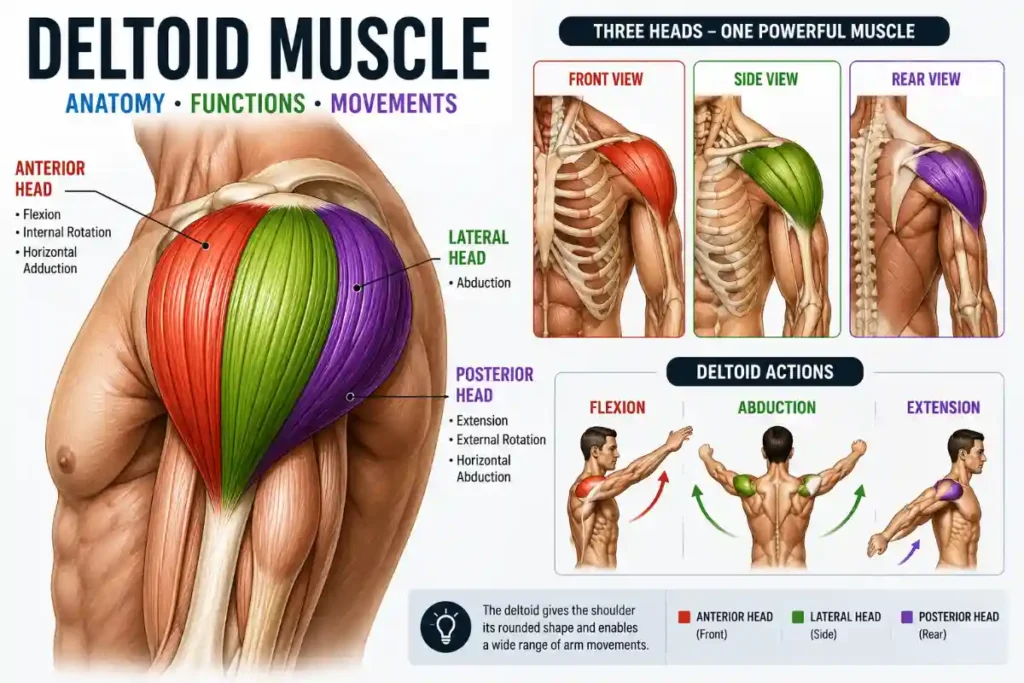
The muscle has three distinct sections or heads: anterior (front), middle, and posterior (back).
Each head has specific functions and contributes to different movements of the shoulder.
Anterior head:
The anterior head of the muscle is located at the front of the shoulder.
It is involved in shoulder flexion, which is the movement of raising the arm forward, as well as internal rotation of the arm.
Middle head:
The middle head of the muscle is located in the central part of the shoulder.
It plays a significant role in shoulder abduction, which is the movement of raising the arm to the side away from the body.
It is the main muscle responsible for lateral or side arm raises.
Posterior head:
The posterior head of the muscle is located at the back of the shoulder.
It assists in shoulder extension, which is the movement of pulling the arm backward, as well as external rotation of the arm.
Deltoid Movement
Overall, the deltoid muscle is crucial for various movements of the shoulder, including lifting, rotating, and moving the arm in different directions.
It works in conjunction with other muscles, such as the rotator cuff muscles, to provide stability and facilitate smooth shoulder movements.
Deltoid Muscle Functions
Certainly! In addition to its primary functions, the muscle also plays a role in stabilizing the shoulder joint during various movements.
It works together with other muscles, such as the rotator cuff muscles (including the supraspinatus, infraspinatus, teres minor, and subscapularis).
To provide dynamic stability and prevent dislocation or excessive movement of the shoulder.
Deltoid muscle innervation
The muscle is innervated by the axillary nerve, which arises from the brachial plexus in the neck.
This nerve supplies motor signals to the muscle, enabling it to contract and produce movement.
Sensory information from the deltoid region is also transmitted through the axillary nerve.
Exercise to keep Deltoid Muscle strong
To keep the muscle strong and functional, exercises that target its different heads are commonly recommended
These exercises may include shoulder presses, lateral raises, front raises, upright rows, and various forms of arm abduction and rotation.
Strengthening the deltoids can help improve shoulder stability, enhance overall upper body strength, and support activities that involve overhead movements.
Injury to Deltoid Muscle
It is important to note that injuries to the deltoid muscle, such as strains or tears, can occur due to overuse, trauma, or improper technique during exercises.
In such cases, rest, physical therapy, and sometimes surgical intervention will be require for recovery.
Overall, the deltoid muscle is a vital component of the shoulder complex.
enabling a wide range of movements and contributing to the overall function and stability of the shoulder joint.
Deltoid Muscle Recovery Timeline
Recovery from a deltoid muscle injury depends on the severity of the damage, your overall health, and whether appropriate treatment and rehabilitation are started early. The following timeline provides a general guide.
| Injury Severity | Typical Recovery Time |
|---|---|
| 🟢 Mild Deltoid Strain (Grade I) | Approximately 1–3 weeks with rest and gentle rehabilitation. |
| 🟡 Moderate Muscle Tear (Grade II) | Usually 3–6 weeks with physiotherapy and progressive strengthening. |
| 🔴 Severe Tear (Grade III) | Recovery may take 3–6 months or longer, especially if surgical repair is required. |
- Allow the shoulder adequate rest after injury.
- Begin gentle range-of-motion exercises only when pain allows.
- Progress to strengthening exercises under the guidance of a physiotherapist.
- Avoid returning to heavy lifting or sports until full strength and shoulder mobility have been restored.
Note: Recovery times are approximate and vary depending on age, injury severity, overall health, and adherence to rehabilitation. Persistent pain, significant weakness, or inability to lift the arm should be evaluated by a qualified healthcare professional.
Some Additional Information about Deltoid
Certainly! Here’s some additional information about the deltoid muscle:
The deltoid muscle receives its blood supply from various arteries, including the posterior circumflex humeral artery, thoracoacromial artery, and deltoid branches of the thoracoacromial artery.
These arteries ensure that the muscle receives an adequate oxygen and nutrient supply for its proper function.
The deltoid muscle is surrounded by a layer of connective tissue called the deltoid fascia.
This fascia helps to support and protect the muscle, as well as provide a structural framework for its attachment to the clavicle (collarbone), acromion process of the scapula (shoulder blade), and the spine of the scapula.
The deltoid muscle is highly visible and contributes to the overall aesthetic appearance of the shoulder region.
Well-developed deltoid muscles are often associate with a V-shaped upper body and are a common focus in strength training and bodybuilding exercises.
Injuries to the deltoid muscle can range from mild strains to more severe tears.
Deltoid injury Symptoms
Symptoms of a deltoid muscle injury may include pain, weakness, swelling, and limited range of motion in the shoulder.
Rest, ice, compression, and elevation (RICE) are commonly recommend for initial treatment, followed by physical therapy to restore strength and flexibility.
It is worth noting that while the deltoid muscle is primarily responsible for shoulder movements, other muscles in the upper body, such as the pectoralis major, trapezius, and rotator cuff muscles, also contribute to shoulder stability and motion.
Overall, the deltoid muscle is a powerful and important muscle of the shoulder, enabling a wide range of movements and providing stability to the shoulder joint.
Its proper functioning is crucial for activities that involve arm movements, such as lifting, throwing, pushing, and pulling.
Final Thoughts
The deltoid muscle does much more than make shoulders look bigger. It plays a major role in stability, posture, strength, and daily arm movement. Understanding how the three deltoid heads work can help prevent injury and improve shoulder performance.
Click here to read our intresting articles on femur anatomy
FAQ’s
Q: What is the deltoid muscle and where is it located?
A: The deltoid muscle is a large, triangular shoulder muscle that caps the shoulder joint. It’s located on the outer aspect of the shoulder, extending from the collarbone (clavicle) and shoulder blade (scapula) down to the upper arm bone (humerus). This muscle is responsible for giving your shoulders their rounded, defined appearance.
Q: What are the 3 heads of the deltoid muscle?
A: The deltoid muscle consists of three distinct heads: 1) Anterior Deltoid (front) – responsible for forward arm elevation and internal rotation, 2) Lateral Deltoid (middle) – handles side arm raises and provides shoulder width, and 3) Posterior Deltoid (rear) – controls backward arm movement and external rotation. Each head must be trained specifically for complete shoulder development.
Q: What are the best exercises to build explosive deltoid strength?
A: The most effective deltoid exercises include: Overhead Press (barbell or dumbbell) for overall mass, Lateral Raises for middle delt width, Face Pulls for rear delts, Arnold Press for complete development, and Pike Push-ups for functional strength. Compound movements like overhead press should form the foundation, followed by isolation exercises to target specific deltoid heads.
Q: How often should I train my deltoids for maximum growth?
A: Train deltoids 2-3 times per week for optimal growth. Allow 48-72 hours of recovery between intense shoulder sessions. You can train shoulders twice weekly with heavy compound movements or use a higher frequency approach with varied intensity – one heavy day and one lighter, high-volume day. Avoid training shoulders intensely on consecutive days to prevent overtraining and injury.
Q: Why does my deltoid muscle hurt after working out?
A: Deltoid pain after working out typically results from delayed onset muscle soreness (DOMS), which is normal and indicates muscle fiber breakdown and growth. However, sharp or persistent pain may signal injury, improper form, or overtraining. If pain lasts beyond 3-4 days, limits range of motion, or worsens with movement, consult a healthcare professional to rule out strains, tears, or rotator cuff issues.
Q: How long does it take to see deltoid muscle definition?
A: Visible deltoid definition typically appears within 6-8 weeks of consistent training for beginners, though this varies based on body fat percentage, genetics, and training intensity. Significant muscle growth becomes noticeable after 12-16 weeks. To accelerate results, combine progressive overload training with proper nutrition (adequate protein intake) and maintain body fat below 15% for men and 22% for women to reveal shoulder definition.
Q: What’s the difference between deltoid soreness and rotator cuff injury?
A: Deltoid soreness feels like a dull ache in the outer shoulder muscle, improves with rest, and doesn’t significantly limit movement. Rotator cuff injuries cause deep, internal shoulder pain, often with clicking or popping sounds, weakness during overhead movements, and pain that worsens at night. Rotator cuff issues typically involve pain when reaching behind your back or lifting objects, while deltoid soreness is surface-level and exercise-induced.
Q: Can I train deltoids every day or will I overtrain?
A: Training deltoids every day will likely lead to overtraining, injury, and stunted growth. Muscles grow during recovery, not during workouts. Deltoids need 48-72 hours to repair and strengthen between intense sessions. However, you can perform light shoulder mobility work or low-intensity exercises daily. For optimal results, stick to 2-3 dedicated shoulder training sessions per week with adequate rest between workouts.
Q: How do I target each deltoid head separately?
A: Target each deltoid head with specific exercises: Anterior Deltoid – front raises, overhead press, and incline bench press; Lateral Deltoid – lateral raises, upright rows, and wide-grip overhead press; Posterior Deltoid – reverse flyes, face pulls, and bent-over lateral raises. Adjust your hand position and movement angle to emphasize different heads. Use a variety of rep ranges (6-15 reps) for comprehensive development.
Q: What are the most common deltoid training mistakes to avoid?
A: Common deltoid training mistakes include: using too much weight with poor form, neglecting rear deltoids, overtraining shoulders, lifting weights too high during lateral raises (above shoulder level), not controlling the eccentric phase, training shoulders after chest workouts when fatigued, ignoring rotator cuff strengthening, and lacking exercise variety. Focus on controlled movements, full range of motion, and balanced development across all three deltoid heads.
✔ Content Accuracy & Medical Review
This article has been reviewed according to current anatomy references, evidence-based physiotherapy rehabilitation principles, and accepted musculoskeletal rehabilitation practices to help ensure medical accuracy and educational value.
The information provided is intended for educational and informational purposes only and should not be considered a substitute for professional medical advice, diagnosis, or treatment. If you have persistent shoulder pain, weakness, or limited movement, consult a qualified healthcare professional or licensed physiotherapist for an individual assessment.
🩺 Medical Disclaimer
The information provided in this article is intended for educational and informational purposes only. While every effort has been made to ensure the accuracy of the content, it should not be considered a substitute for professional medical advice, diagnosis, or treatment.
Deltoid muscle pain, weakness, or restricted shoulder movement may have multiple causes, including muscle strain, rotator cuff injuries, nerve disorders, arthritis, or other medical conditions. A proper diagnosis requires evaluation by a qualified healthcare professional.
Always seek the advice of your physician or licensed physiotherapist if you experience severe shoulder pain, sudden weakness, swelling, numbness, loss of function, or symptoms that persist or worsen despite rest. Never ignore professional medical advice or delay seeking treatment because of information you have read on this website.
✔️ Medically Reviewed by DR.SHABBIR HUSSAIN (BPT)
Reviewed for anatomy accuracy, muscle function and rehabilitation relevance.

Dr. Shabbir Hussain, BPT
Registered Physiotherapist | Clinical Rehabilitation Specialist
Maharashtra OTPT Council Reg. No.: PR-2021/08/PT/009532
Society of Onco Physiotherapists Reg. No.: SOP/00033/LM
Dr. Shabbir Hussain, BPT, Registered Physiotherapist with over 8 years of experience in physiotherapy, kidney rehabilitation, oncological rehabilitation, and lymphedema management. He specializes in balance disorders, pain management, musculoskeletal rehabilitation, strengthening programs, and VR-based rehabilitation.