

🩺 Medical Review & Author Information
Written & Reviewed By: Dr. SHABBIR HUSSAIN (BPT)
Designation: Senior Physiotherapist, Rehabilitation Specialist & Medical Health Writer
Clinical Experience: 8+ Years in Musculoskeletal Rehabilitation, Pain Management, Oncology Rehabilitation, Kidney Rehabilitation & Functional Recovery
About the Author: Learn more about Dr. Shabbir Hussain’s qualifications, clinical expertise, professional experience and editorial standards: About Dr. Shabbir Hussain
Evidence-Based Review: This article has been medically reviewed and written by a qualified physiotherapist to ensure clinical accuracy, patient safety and public health awareness.
Last Updated: June 18, 2026
Early Frozen Shoulder Signs: The Early Symptoms Many People Ignore Until Daily Life Becomes Painful
Many people assume shoulder pain is simply due to sleeping in the wrong position or getting older. They wait for weeks or even months, hoping it will disappear on its own. Unfortunately, that delay is one of the biggest mistakes I see in physiotherapy practice.
In my clinical experience, frozen shoulder rarely starts with severe stiffness. It often begins quietly—with mild pain at night, discomfort while reaching overhead, or difficulty fastening a bra or putting on a shirt. Because these symptoms seem harmless initially, people ignore them until everyday activities become frustrating and painful.
⚠️ Why This Matters
Many people ignore mild shoulder pain for months, but early frozen shoulder symptoms often begin long before severe stiffness develops. According to clinical guidelines, early treatment and physiotherapy may help reduce disability and improve recovery.
Personally, I have seen many patients who wish they had sought treatment earlier. Early intervention often means a smoother recovery, while delayed treatment may result in months of restricted movement and prolonged rehabilitation.
📊 Research Snapshot
- Adults aged 40–60 years are most commonly affected.
- Women are affected more frequently than men.
- People with diabetes have a significantly higher risk.
- Recovery may take several months and sometimes longer.
- Early physiotherapy improves function and mobility.
What Is Frozen Shoulder?
Frozen shoulder, medically known as adhesive capsulitis, is a condition characterized by pain and progressive stiffness of the shoulder joint.
The shoulder joint is surrounded by a capsule of connective tissue. In frozen shoulder, this capsule becomes inflamed, thickened, and tight. Over time, scar-like tissue develops, reducing the joint’s normal range of motion.
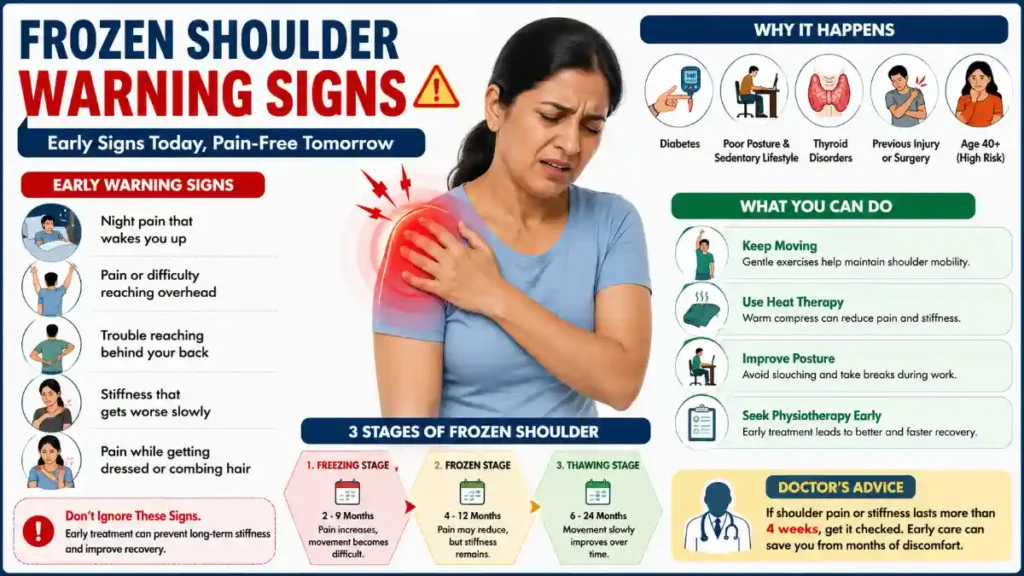
According to information consistent with the National Institutes of Health (NIH) and international clinical guidelines, frozen shoulder usually progresses through three phases:
1. Freezing Phase
Pain gradually increases and shoulder movement becomes uncomfortable.
2. Frozen Phase
Pain may decrease somewhat, but stiffness becomes more noticeable.
3. Thawing Phase
Movement slowly returns, although recovery can take several months or even years.
Frozen shoulder most commonly affects adults between 40 and 60 years of age and is more common among women and people with diabetes.
Why Symptoms Are Ignored
People often continue working, driving, and managing household tasks despite increasing discomfort. Since shoulder pain comes and goes initially, they assume rest alone will solve the problem.
In real rehabilitation settings, delayed treatment often makes recovery slower because stiffness becomes established over time.
Why Early Action Matters
Many patients improve faster when physiotherapy begins during the early phase. Gentle mobility exercises, pain control strategies, and posture correction can help maintain movement and reduce disability.
Real Patient Story
A 46-year-old IT professional visited my clinic after ignoring shoulder pain for nearly seven months.
Initially, she noticed mild pain while sleeping and difficulty reaching overhead. Because she was busy with work, she relied on painkillers and online exercises.
By the time she sought help, she could barely comb her hair and struggled to wear clothes comfortably.
After a detailed assessment, we started a structured rehabilitation program involving:
- Pain management
- Gentle mobility exercises
- Joint mobilization
- Postural correction
- Home exercise guidance
Within three months, she experienced noticeable improvement, and over the following months, her shoulder function gradually returned.
This scenario reflects what I commonly see in practice—early intervention usually leads to better outcomes.
📈 Quick Facts
- Frozen shoulder mainly affects adults aged 40–60 years.
- Women are more commonly affected.
- Diabetes is one of the strongest risk factors.
- Recovery can take months and sometimes longer.
Why Frozen Shoulder Is Becoming More Common
Over the last decade, I have noticed more office workers, homemakers, and even young professionals presenting with shoulder stiffness.
Several modern lifestyle factors contribute:
Smartphone Overuse
Constantly bending the neck and keeping the shoulders rounded forward places abnormal stress on shoulder muscles and joints.
Laptop-Based Jobs
Many IT professionals spend 8–10 hours sitting with poor posture. This reduces shoulder mobility and increases muscle tightness.
Work-From-Home Habits
Improvised workstations, dining chairs, and prolonged sitting became common after the pandemic. Unfortunately, shoulder and neck complaints also increased.
Hidden Dangers Most People Don’t Realize
Frozen shoulder is much more than shoulder pain.
Ignoring symptoms may affect:
Daily Activities
Simple tasks become difficult:
- Wearing clothes
- Combing hair
- Reaching overhead shelves
- Driving
- Sleeping comfortably
Emotional Health
Persistent pain often affects mood, sleep quality, and confidence.
Rehabilitation Becomes Longer
In my clinical experience, patients who seek treatment after six months generally require more rehabilitation sessions compared with those treated earlier.
Common Mistakes People Make
Delaying Treatment
This is probably the most common mistake I encounter.
Many patients say:
“I thought it would improve by itself.”
Unfortunately, prolonged stiffness often becomes harder to reverse.
Self-Medication
Taking painkillers repeatedly may temporarily reduce symptoms without addressing the underlying restriction.
Continuing Poor Posture
Long hours with rounded shoulders and forward head posture place additional stress on the shoulder joint.
Shocking Findings & Recent Research
Recent studies have improved our understanding of frozen shoulder.
Diabetes Increases Risk
Research consistently shows that people with diabetes have a significantly higher risk of developing frozen shoulder.
Women Are More Frequently Affected
Middle-aged women appear to be affected more often than men.
Recovery May Take Longer Than Expected
Contrary to popular belief, recovery isn’t always complete within a few months. Some patients experience residual stiffness for years.
Exercise and Physiotherapy Matter
Evidence increasingly supports structured rehabilitation programs rather than prolonged rest.
Early Warning Signs of Frozen Shoulder
Frozen shoulder usually develops gradually. Symptoms often progress over weeks or months.
⚠️ 5 Early Frozen Shoulder Signs Most People Ignore
- Night pain while sleeping on one side.
- Difficulty reaching overhead.
- Pain when putting on clothes.
- Shoulder discomfort after inactivity.
- Gradually increasing stiffness.
What Is Usually the First Sign of Frozen Shoulder?
The earliest symptom of frozen shoulder is usually pain at night or discomfort when reaching overhead. Stiffness often develops gradually over the following weeks or months.
Progressing Symptoms
- Increasing stiffness
- Difficulty combing hair
- Trouble fastening undergarments
- Reduced arm movement
- Pain during dressing
Advanced Symptoms
- Severe restriction of movement
- Inability to lift the arm fully
- Difficulty driving
- Disturbed sleep
- Weakness due to disuse
Don’t Ignore These Signs
Seek medical evaluation if you notice:
✅ Night pain that wakes you repeatedly.
✅ Progressive reduction in shoulder movement.
✅ Difficulty reaching behind your back.
✅ Inability to raise the arm overhead.
✅ Shoulder stiffness lasting more than four weeks.
✅ Persistent pain despite rest.
Diagnosis: How Frozen Shoulder Is Confirmed
One of the biggest concerns I hear from patients is:
“Doctor, do I need an MRI?”
The answer is—not always.
In my clinical experience, frozen shoulder is primarily a clinical diagnosis, meaning that a detailed history and physical examination are often enough to identify the condition.
Medical Evaluation
Your doctor or physiotherapist will ask:
- When did the pain begin?
- Is the pain worse at night?
- Has movement gradually become restricted?
- Is diabetes or thyroid disease present?
- Was there any previous injury or surgery?
Many patients report that pain started subtly and became progressively worse over several months.
Physiotherapy Assessment
In real rehabilitation settings, physiotherapists assess:
- Active range of motion
- Passive range of motion
- Shoulder biomechanics
- Posture
- Muscle tightness
- Functional limitations
One classic finding in frozen shoulder is that both active and passive shoulder movements become restricted, especially:
- External rotation
- Abduction
- Internal rotation
Functional Testing
Patients may be asked to perform tasks such as:
- Reaching behind the back
- Raising the arm overhead
- Touching the opposite shoulder
- Combing hair
These simple tests often reveal significant restrictions.
Imaging
X-rays are usually normal but help rule out arthritis or fractures.
MRI may be advised when doctors suspect:
- Rotator cuff tear
- Labral injury
- Other shoulder conditions
Gold Standard Diagnosis
There is no single blood test or scan that confirms frozen shoulder.
A combination of:
✔ Clinical history
✔ Physical examination
✔ Functional assessment
remains the gold standard.
Treatment & Physiotherapy Management
The good news is that frozen shoulder is treatable.
Many patients improve significantly with appropriate rehabilitation.
Pain Management
Early pain control may include:
- Activity modification
- Heat therapy
- NSAIDs (if prescribed)
- Corticosteroid injections in selected cases
Pain control helps patients participate more comfortably in rehabilitation.
Role of Physiotherapy
In my clinical experience, physiotherapy plays a central role in recovery.
Treatment focuses on:
- Maintaining mobility
- Reducing stiffness
- Improving posture
- Restoring strength
- Returning to normal activities
Many patients improve faster when therapy begins early rather than waiting until severe stiffness develops.
Exercise Rehabilitation
Common exercises include:
Pendulum Exercises
Gentle swinging movements help maintain mobility without aggravating pain.
Wall Climbing Exercise
Gradual finger-walking against a wall improves overhead motion.
Towel Stretch
Helps restore internal rotation.
Cross-Body Stretch
Improves posterior shoulder flexibility.
Scapular Stabilization Exercises
These strengthen supporting muscles and improve shoulder mechanics.
One common pattern observed in physiotherapy practice is that aggressive stretching often worsens symptoms. Gentle, progressive rehabilitation produces better results.
Postural Correction
Many IT professionals and homemakers develop rounded shoulders and forward head posture.
Correcting posture helps reduce stress on the shoulder joint.
Lifestyle Changes
Simple modifications include:
- Avoid prolonged immobility
- Take movement breaks
- Improve workstation ergonomics
- Maintain diabetes control
- Stay physically active
Myth vs Fact
| Myth | Fact |
|---|---|
| Frozen shoulder affects only elderly people. | It commonly affects adults aged 40–60 years. |
| Complete rest is the best treatment. | Prolonged inactivity may worsen stiffness. |
| MRI is always necessary. | Diagnosis is often clinical. |
| Painkillers alone cure frozen shoulder. | Rehabilitation is essential. |
| Shoulder exercises should be aggressive. | Gentle, progressive exercises are safer. |
| Recovery occurs within a few weeks. | Recovery may take months. |
Expert Clinical Insights
In My Clinical Experience…
Night pain is one of the earliest warning signs many patients ignore.
One Surprising Pattern
Many patients believe stiffness develops suddenly.
In reality, movement restriction often progresses gradually over months.
Why Patients Delay Treatment
Clinically, I often observe that people assume shoulder pain is caused by:
- Sleeping incorrectly
- Aging
- Gas pain
- Vitamin deficiency
Because symptoms fluctuate initially, they delay seeking medical advice.
Who Should Avoid Certain Exercises or Treatments?
Not everyone should start shoulder exercises without medical guidance.
Avoid self-treatment if you have:
Recent Surgery
Aggressive stretching after surgery may damage healing tissues.
Severe Pain
Intense pain requires evaluation before starting exercises.
Red Flag Conditions
Certain serious conditions may mimic shoulder pain, including:
- Cervical radiculopathy
- Heart disease
- Infection
- Tumors
When To See a Doctor Immediately
Seek urgent medical attention if you experience:
🚨 Sudden severe shoulder pain after trauma.
🚨 Fever with shoulder pain.
🚨 Redness and swelling around the shoulder.
🚨 Progressive arm weakness.
🚨 Numbness or tingling.
🚨 Chest pain radiating to the shoulder.
⚠️ What Happens If Frozen Shoulder Is Ignored?
- Loss of shoulder mobility.
- Difficulty dressing and combing hair.
- Sleep disturbance.
- Longer rehabilitation period.
- Reduced quality of life.
⚠️ Why Patients Regret Waiting Too Long
- Shoulder movement becomes harder to restore.
- Simple tasks like dressing become painful.
- Sleep quality worsens.
- Rehabilitation often takes longer.
- Recovery may take several months.
Can Frozen Shoulder Affect Both Shoulders?
Yes. Although frozen shoulder usually affects one shoulder at a time, some people may develop symptoms in the opposite shoulder months or years later. People with diabetes appear to have a higher risk.
Conclusion
Frozen shoulder often begins quietly. What starts as mild pain while sleeping or reaching overhead can slowly become a major limitation affecting daily life.
In my clinical experience, the biggest mistake patients make is waiting too long.
The encouraging news is that recovery is possible.
Most people improve significantly with early diagnosis, physiotherapy, appropriate exercises, and patience.
If you have noticed persistent shoulder pain or increasing stiffness, don’t ignore it. Seeking help early can prevent months of disability and help you return to normal activities with confidence.
Remember, movement is medicine—but the right movement at the right time makes all the difference.
✅ Key Takeaways
- Night shoulder pain may be an early sign of frozen shoulder.
- Delaying treatment often prolongs recovery.
- Early physiotherapy can help maintain movement and function.
- Gentle exercises are safer than aggressive stretching.
- Diabetes and thyroid disease increase risk.
- Consistency and patience are essential for recovery.
⚠️ Doctor Insight
In my clinical practice, many patients ignore night shoulder pain for months. By the time they seek treatment, everyday activities like combing hair, dressing, or reaching overhead have become difficult. Early physiotherapy often makes recovery easier and faster.
Frequently Asked Questions
Can frozen shoulder heal on its own?
Yes, but recovery may take months or years. Physiotherapy often helps restore function faster.
Is walking helpful for frozen shoulder?
Walking improves overall health but specific shoulder exercises are usually needed.
Can diabetes cause frozen shoulder?
Yes. Diabetes is one of the strongest risk factors.
Is frozen shoulder permanent?
Most patients recover significantly, although mild stiffness may persist in some cases.
Which sleeping position is best?
Sleeping on the unaffected side with pillow support under the affected arm often provides comfort.
Can I go to the gym?
Heavy overhead exercises should be avoided until pain and mobility improve.
Medical Disclaimer
This article is intended for educational and public health awareness purposes only. It should not be considered a substitute for professional medical advice, diagnosis, or treatment.
Individual cases vary, and accurate diagnosis requires assessment by a qualified healthcare professional. If symptoms are severe, worsening, or associated with red-flag signs, seek immediate medical attention.
Authoritative References (APA Style)
- National Institute of Arthritis and Musculoskeletal and Skin Diseases. (2025). Frozen Shoulder (Adhesive Capsulitis). NIH.
https://www.niams.nih.gov/health-topics/frozen-shoulder - National Center for Biotechnology Information. (2024). Adhesive Capsulitis. StatPearls Publishing.
https://www.ncbi.nlm.nih.gov/books/NBK532955/ - Kelley, M. J., et al. (2013). Shoulder Pain and Mobility Deficits: Adhesive Capsulitis Clinical Practice Guidelines. Journal of Orthopaedic & Sports Physical Therapy.
https://www.jospt.org - American Academy of Orthopaedic Surgeons. (2025). Frozen Shoulder.
https://orthoinfo.aaos.org/en/diseases–conditions/frozen-shoulder

Dr. Shabbir Hussain, BPT
Licensed Physiotherapist | Clinical Rehabilitation Specialist
Maharashtra OTPT Council Reg. No.: PR-2021/08/PT/009532
Society of Onco Physiotherapists Reg. No.: SOP/00033/LM
Dr. Shabbir Hussain, BPT, Registered Physiotherapist with over 8 years of experience in physiotherapy, kidney rehabilitation, oncological rehabilitation, and lymphedema management. He specializes in balance disorders, pain management, musculoskeletal rehabilitation, strengthening programs, and VR-based rehabilitation.