Published: August 29, 2026 · Updated: August 30, 2026 · Evidence reviewed: August 2026 · Reading time: 8–10 minutes
If you have searched for red light therapy recently, you have probably seen very different promises — from better skin and hair growth to faster recovery and pain relief.
The confusing part is that some of these claims have real research behind them, while others run far ahead of the evidence.
But there is an important distinction between what red light therapy may be capable of doing biologically and what has actually been demonstrated in clinical studies.
Red light therapy—often called photobiomodulation (PBM) or low-level light therapy—uses specific wavelengths of non-ionizing light to influence biological processes without intentionally heating tissue. Research suggests potential benefits for several medical and cosmetic applications, but results depend primarily on the condition being treated, wavelength, dose, treatment schedule and device.
So, does red light therapy work?
For some applications, yes—but it is not a universal treatment and it should not be treated as a cure-all.
I wrote this article to separate the legitimate clinical uses of photobiomodulation from the much broader claims you may see in advertisements and social media.
Authored and reviewed by Dr. Shabbir Hussain, BPT, Licensed Physiotherapist & Clinical Rehabilitation Specialist.
Red light therapy isn’t one treatment with one proven result. Evidence is more convincing for some specific applications, while results for pain, skin, wounds and general wellness depend heavily on the condition, device and treatment protocol.
What Is Red Light Therapy?
Red light therapy is a non-invasive treatment that exposes tissue to relatively low-intensity red or near-infrared light.
It is also known as:
- Photobiomodulation
- PBM therapy
- Low-level light therapy (LLLT)
- Low-level laser therapy in some clinical contexts
Unlike ultraviolet radiation, the light used in PBM is not intended to cause sunburn or DNA damage. A 2025 international evidence-based consensus concluded that PBM is generally considered a safe treatment modality for adults and found no evidence that red-light PBM induces DNA damage within established treatment parameters.
However, “red light therapy” is not one standardized treatment. Different devices can use different wavelengths, power densities, treatment distances and exposure times.
That difference matters.
How Does Red Light Therapy Work?
Researchers believe photobiomodulation can influence cellular processes after light is absorbed by intracellular photoacceptors.
One proposed mechanism involves mitochondrial activity and cellular signaling, potentially affecting processes related to energy metabolism, inflammation, tissue repair and cellular function.
But understanding the biological mechanism does not automatically prove that a treatment improves a patient’s symptoms.
Clinical effectiveness still needs to be assessed separately for each condition.
Red Light Therapy Benefits: What Does the Evidence Show?
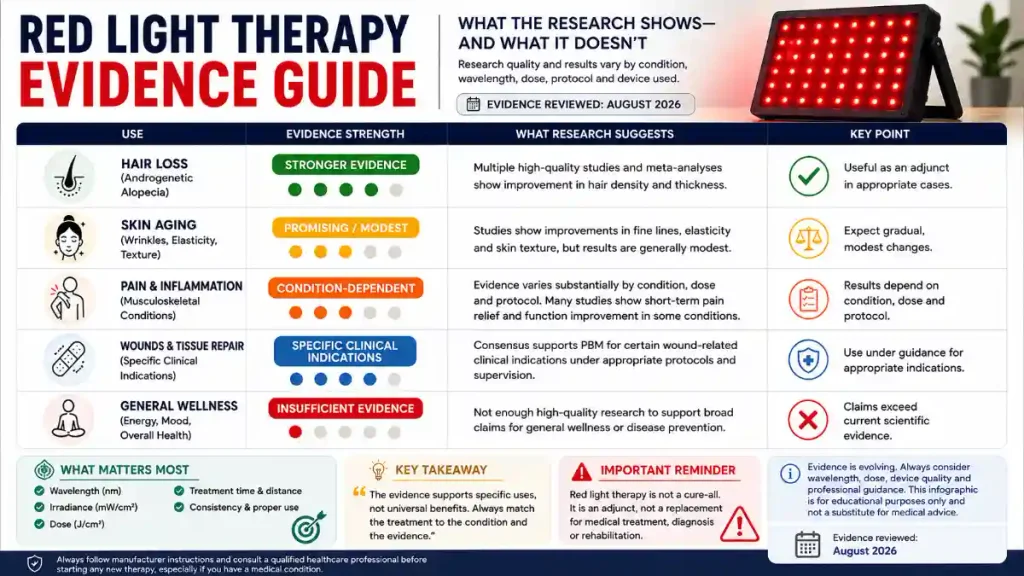
1. Hair Loss
A practical point about hair loss
If someone tells me they are losing hair and wants to buy a red-light cap immediately, I would first ask a simpler question: Why are you losing hair?
A light device makes more sense when the underlying diagnosis fits the evidence. Sudden shedding, patchy hair loss or hair loss accompanied by other symptoms deserves a different evaluation.
In other words, the device should come after the diagnosis, not instead of it.
2. Skin Aging
Red-light devices are widely marketed for wrinkles, rough skin, redness and other signs of aging.
Some studies have reported improvements in fine lines, skin texture and other cosmetic outcomes. The American Academy of Dermatology states that some studies have found benefits, but also emphasizes that studies use different devices and treatment protocols, making results difficult to compare directly.
Therefore, the most accurate description is:
Red light therapy may produce modest improvements in some signs of skin aging, but results are not guaranteed and long-term effects are still being studied.
3. Pain and Rehabilitation
Photobiomodulation has also been studied for pain and rehabilitation-related conditions.
A 2025 umbrella review covering 15 meta-analyses, 204 randomized controlled trials and more than 9,000 participants found significant effects for several outcomes, including some measures related to knee osteoarthritis, fibromyalgia and other conditions. However, the certainty of evidence varied considerably, and many outcomes had low or very-low certainty.
A newer systematic review of chronic pain studies similarly reported potential pain-relieving effects, particularly in fibromyalgia and neuropathy, while highlighting major variation in treatment parameters.
This is why PBM should generally be viewed as a potential adjunct to appropriate rehabilitation, rather than a replacement for diagnosis, exercise therapy, medication when indicated, or other evidence-based care.
What this means in rehabilitation
For someone dealing with pain, the most useful question is often not simply, “Did the pain decrease?”
I would also want to know whether the person can now do something they could not comfortably do before — walk farther, tolerate an exercise better, move the joint more easily or participate more consistently in rehabilitation.
That functional change is often more meaningful than chasing a temporary reduction in pain alone.
4. Wound and Ulcer Care
The consensus supports PBM for certain wound-related clinical indications under appropriate protocols, but that does not mean an arbitrary consumer LED device is appropriate for treating an unexplained wound at home.
Chronic wounds can result from diabetes, poor circulation, infection, pressure injury or other serious conditions and require appropriate medical assessment.
What Most People Get Wrong About Red Light Therapy
Myth 1: “More light means better results.”
Not necessarily.
PBM follows dose-dependent biological effects, and clinical protocols differ. More exposure is not automatically better.
Myth 2: “Every red-light device works the same.”
False.
Devices vary in wavelength, irradiance, treatment area, distance and dose. Two products that both advertise “red light therapy” may deliver substantially different treatment parameters.
Myth 3: “FDA cleared means clinically proven for everything.”
No.
FDA clearance applies to the specific device and its cleared indication. It does not mean every red-light product has been proven effective for every condition.
The FDA maintains separate classifications and 510(k) clearances for specific light-based devices and indications.
Myth 4: “Red light therapy can replace medical treatment.”
It cannot.
A light device should not be used to postpone evaluation of unexplained hair loss, persistent pain, a chronic wound, suspicious skin changes or other medical problems.
Is Red Light Therapy Safe?
Generally, PBM is considered a relatively low-risk modality when appropriately used.
The 2025 expert consensus characterized PBM as safe for adults under established treatment parameters.
However, “low risk” does not mean “risk-free.”
Potential problems can include:
- Eye discomfort or injury from inappropriate light exposure
- Skin irritation
- Temporary redness
- Burns with inappropriate equipment or excessive exposure
- Pigment changes in susceptible individuals
- Worsening of photosensitive conditions
- Problems related to photosensitizing medications
The FDA also warns that light-based procedures can injure the eyes and identifies several situations in which photobiomodulation may not be appropriate, including photosensitivity disorders and photosensitizing medications.
Who Should Be Extra Careful?
Speak with a healthcare professional before using red-light therapy if you:
- Have a photosensitivity disorder
- Take medication that increases photosensitivity
- Have a significant eye condition
- Have an active skin infection or lesion in the treatment area
- Have a suspicious or untreated skin lesion
- Are pregnant or planning pregnancy and considering therapeutic PBM
- Have an implanted medical device and are considering treatment near it
- Are undergoing cancer treatment or considering treatment over an active cancer site
Cancer requires particular caution because the biological effects of PBM can depend on treatment parameters and clinical context. Existing research is reassuring for some cancer-treatment-related applications, but this does not justify independently treating an active tumor with a home device.
How Often Should You Use Red Light Therapy?
There is no single correct schedule for every device or condition.
Treatment frequency depends on:
- Wavelength
- Irradiance
- Energy dose
- Treatment distance
- Treatment duration
- Target condition
- Device design
For home devices, follow the manufacturer’s instructions rather than assuming that longer sessions will produce better results.
The American Academy of Dermatology similarly recommends following device-specific instructions and notes that repeated treatments are generally necessary for cosmetic skin or hereditary hair-loss applications.
How to Choose a Red Light Therapy Device
Before buying a device, check:
- What condition is it actually intended to treat?
- Which wavelengths does it use?
- Does the manufacturer provide irradiance or dose information?
- Are treatment instructions clearly provided?
- Is there appropriate eye protection when required?
- Is the device legally cleared or authorized for the specific indication being advertised in your market?
- Does the product make unrealistic claims such as curing multiple unrelated diseases?
A long list of claimed benefits should not automatically be interpreted as evidence of effectiveness.
The American Academy of Dermatology specifically recommends choosing a device designed for the condition you want to treat and checking whether the device has appropriate FDA clearance when relevant.
Physiotherapy and Red Light Therapy
Photobiomodulation can have a legitimate role as an adjunctive rehabilitation modality in selected clinical situations.
For example, research has examined PBM for pain, neuropathy, wounds and some musculoskeletal conditions.
But the goal of rehabilitation is not simply to reduce symptoms temporarily.
A physiotherapy program may also need to address:
- Strength
- Mobility
- Load tolerance
- Balance
- Functional movement
- Activity modification
- Exercise progression
- Underlying mechanical contributors
Therefore, red light therapy should generally complement—not replace—the active components of rehabilitation when those interventions are clinically indicated.
From a Physiotherapist’s Perspective
One thing I would be careful about is expecting red light therapy to do the work of rehabilitation.
When someone has persistent knee pain, for example, reducing pain is only one part of the problem. We also need to look at strength, movement, activity levels, load tolerance and what is actually causing the symptoms.
That is where I see photobiomodulation as potentially useful: as an additional tool, not the entire treatment plan.
If a person feels better after treatment and can then move, exercise or participate more comfortably in rehabilitation, that can be clinically useful. But using a light device while avoiding the exercises or assessment that address the underlying problem is a very different situation.
Composite Clinical Scenario
Illustrative example — not a real patient
Imagine someone notices gradual thinning around the crown and sees several social-media videos claiming that a red-light cap can “restore lost hair.”
It is easy to jump straight to buying the device.
A more sensible approach would be to first establish the likely cause of the hair loss. If androgenetic alopecia is confirmed, photobiomodulation may be one option to discuss. But expectations should remain realistic: the evidence supports possible improvement in hair density, not a guaranteed return to a full head of hair.
This is an important distinction because marketing usually starts with the device. Clinical decision-making should start with the diagnosis.
Treat the diagnosis, not the advertisement.
When Should You See a Doctor?
Seek medical evaluation rather than relying on red light therapy if you develop:
- Sudden or rapidly progressive hair loss
- A new suspicious skin lesion
- A non-healing wound
- Increasing redness, swelling, warmth or pus around a wound
- Severe or unexplained pain
- New neurological weakness or loss of sensation
- Significant vision changes
- Symptoms suggesting a serious underlying disease
Red light therapy should never be used as a reason to delay urgent medical care.
Red Light Therapy: Evidence vs Claims
| Claim | What the evidence suggests |
|---|---|
| Helps some hereditary hair loss | Supported by clinical evidence |
| May improve some signs of skin aging | Promising, but effects vary |
| Helps every type of hair loss | Not established |
| Treats chronic pain universally | it varies by condition |
| Replaces physiotherapy | No |
| Replaces medical treatment | No |
| More exposure always gives better results | Not established |
| Every home device works equally | False |
| Completely risk-free | False |
Key Takeaways
- Red light therapy is a form of photobiomodulation, using specific wavelengths of red or near-infrared light.
- Evidence is strongest for selected applications rather than for broad “wellness” claims.
- Androgenetic alopecia is one of the better-supported uses, although results are generally partial rather than miraculous.
- Some evidence supports PBM for selected pain, wound and rehabilitation-related applications.
- Different devices can deliver very different doses, so the phrase “red light therapy” alone does not tell you whether a product is effective.
- Eye protection, photosensitivity, medications and underlying medical conditions should be considered before home treatment.
Conclusion
Red light therapy is neither a miracle cure nor simply a marketing gimmick.
The science supports genuine biological and clinical effects for several specific applications, but the strength of evidence differs substantially between conditions.
If you are considering red light therapy for hair loss, skin aging, pain or another health problem, the most important question is not “Does red light therapy work?”
It is:
“Does this particular type of photobiomodulation, at this dose and with this device, have good evidence for my specific condition?”
That question leads to a much safer and more evidence-based decision.
FAQs
1. What is red light therapy?
Red light therapy is a non-invasive treatment using specific red or near-infrared wavelengths of light. It is also called photobiomodulation or low-level light therapy.
2. Does red light therapy really work?
It can. Evidence supports selected uses, including androgenetic alopecia and some pain, wound and rehabilitation-related applications. Evidence is weaker or inconsistent for many broader wellness claims.
3. Can red light therapy regrow hair?
It may increase hair density in some people with androgenetic alopecia. It does not guarantee complete hair restoration and may not work for other causes of hair loss.
4. Is red light therapy good for skin?
Some research suggests improvements in selected signs of skin aging, but results vary between devices and protocols. More research is needed to determine optimal home-treatment schedules.
5. Can red light therapy reduce pain?
Photobiomodulation has shown potential for pain reduction in several conditions, but evidence quality varies and treatment parameters are not standardized.
Medical Disclaimer: This article is for educational and general health-information purposes only. Red light therapy may not be appropriate for everyone, and evidence varies depending on the medical condition, device, wavelength and treatment protocol. This information does not replace an individualized diagnosis, medical examination or treatment plan from a qualified healthcare professional. Do not delay urgent medical care because of information presented in this article.
Clinical consensus
Maghfour J, et al. Evidence-based consensus on the clinical application of photobiomodulation. Journal of the American Academy of Dermatology, 2025.
PubMed — Evidence-based consensus on photobiomodulation
Umbrella review
Effects of photobiomodulation on multiple health outcomes: an umbrella review of randomized clinical trials, 2025.
PubMed — Photobiomodulation umbrella review
Hair loss
Perez SM, et al. Low-Level Laser and LED Therapy in Alopecia: A Systematic Review and Meta-Analysis, 2025.
PubMed — Alopecia systematic review and meta-analysis
Dermatology guidance
American Academy of Dermatology — Is red light therapy right for your skin?
American Academy of Dermatology — Red light therapy guidance
FDA
FDA — Photobiomodulation Devices: Premarket Notification Guidance.
FDA — Photobiomodulation device guidance
FDA safety information
FDA — Non-Invasive Body Contouring Technologies / Low-Level Light Therapy
Chronic pain
Photobiomodulation in chronic pain: systematic review of randomized clinical trials, 2026.
PubMed — Chronic pain systematic review

Dr. Shabbir Hussain, BPT
Licensed Physiotherapist | Clinical Rehabilitation Specialist
Maharashtra OTPT Council Reg. No.: PR-2021/08/PT/009532
Society of Onco Physiotherapists Reg. No.: SOP/00033/LM
Dr. Shabbir Hussain, BPT, Registered Physiotherapist with over 8 years of experience in physiotherapy, kidney rehabilitation, oncological rehabilitation, and lymphedema management. He specializes in balance disorders, pain management, musculoskeletal rehabilitation, strengthening programs, and VR-based rehabilitation.