
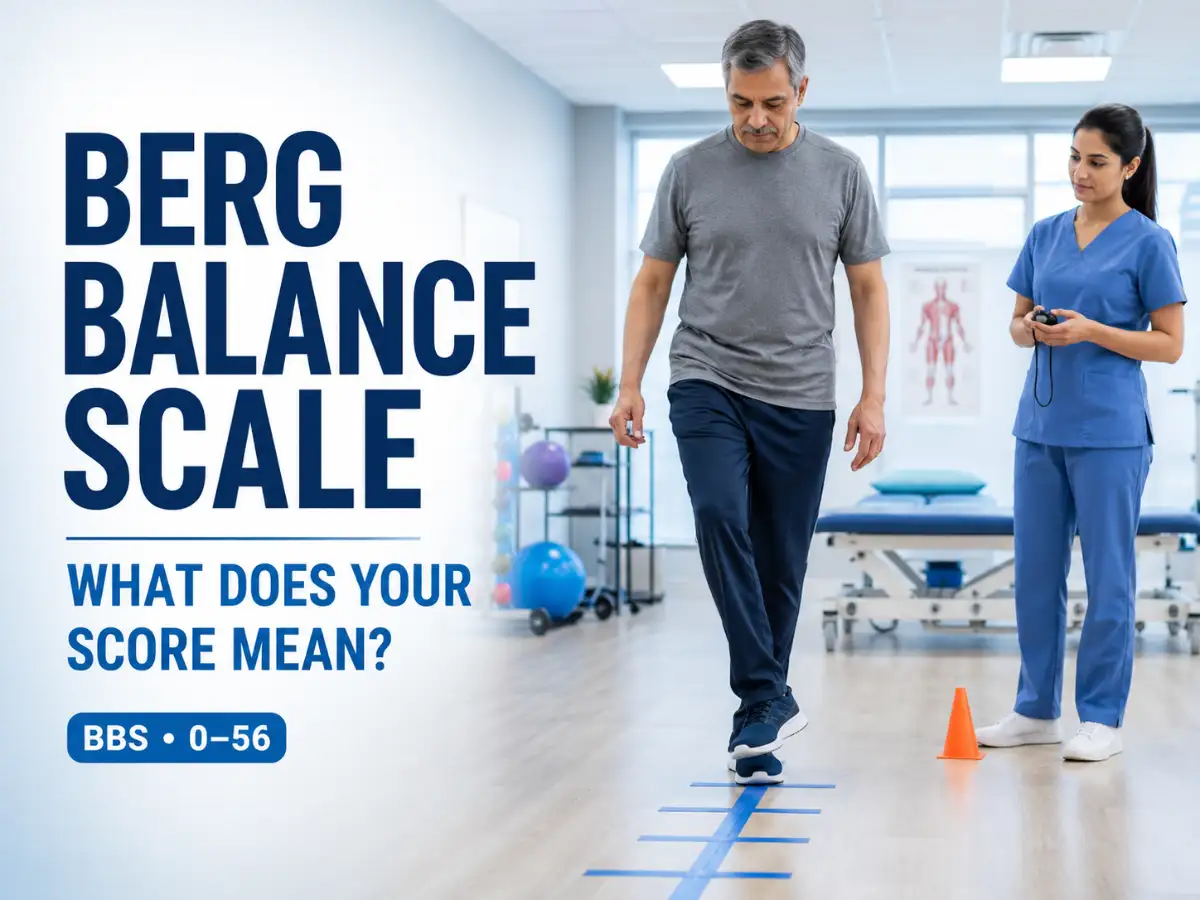
The Berg Balance Scale (BBS) is a commonly used clinical performance measure for assessing balance during a range of functional activities. It can be useful in physiotherapy, rehabilitation, neurological rehabilitation, geriatric care, and other clinical settings where balance performance needs to be assessed.
This Berg Balance Scale Calculator allows you to enter the scores assigned to the 14 BBS items and automatically calculate the total score out of 56.
Important: The calculator only adds the scores entered by the user. It does not perform the clinical assessment or replace standardized administration of the Berg Balance Scale.
Berg Balance Scale (BBS) Calculator
Enter the clinician-assigned score for each of the 14 Berg Balance Scale items. Each item is scored from 0 to 4, producing a maximum total of 56 points.
| BBS Item | Score (0–4) |
|---|---|
| 1. Sitting to standing | |
| 2. Standing unsupported | |
| 3. Sitting unsupported | |
| 4. Standing to sitting | |
| 5. Transfers | |
| 6. Standing with eyes closed | |
| 7. Standing with feet together | |
| 8. Reaching forward with outstretched arm | |
| 9. Retrieving object from floor | |
| 10. Turning to look behind | |
| 11. Turning 360 degrees | |
| 12. Placing alternate foot on stool | |
| 13. Standing with one foot in front | |
| 14. Standing on one foot |
Maximum possible score: 560 / 56
Important
The Berg Balance Scale is a clinical performance measure. This calculator is a scoring aid only. It does not replace standardized administration, observation, clinical judgment, or professional interpretation.
Reference: Shirley Ryan AbilityLab RehabMeasures Database — Berg Balance Scale. The BBS is described as a 14-item measure with item scores from 0–4 and a maximum total of 56.
What Is the Berg Balance Scale?
The Berg Balance Scale (BBS) is a 14-item performance-based assessment designed to evaluate balance during different functional tasks.
The activities include tasks involving sitting, standing, transfers, reaching, turning, and maintaining balance under different conditions. Each item is scored according to the person’s ability to complete the assessed activity.
The individual item scores are added together to produce a total score ranging from 0 to 56 points.
The BBS can provide useful information about functional balance, but the result should always be considered alongside the person’s medical history, symptoms, mobility, strength, gait, and other relevant clinical findings.
How Is the Berg Balance Scale Scored?
The BBS contains 14 items.
Each item receives a score from:
- 0 = lowest level of performance
- 1 = limited performance
- 2 = moderate performance
- 3 = relatively independent performance
- 4 = highest level of performance for that task
The scores from all 14 items are then added.
Maximum possible score
14 items × 4 points = 56 points
Therefore:
BBS Total Score = Sum of all 14 item scores
The calculator performs this addition automatically after you enter the clinician-assigned scores.
What Does the BBS Assess?
The BBS includes functional balance activities that challenge different aspects of postural control.
The assessment includes tasks involving:
- Moving from sitting to standing
- Maintaining unsupported standing
- Sitting without support
- Moving from standing to sitting
- Performing transfers
- Standing with the eyes closed
- Standing with the feet together
- Reaching forward
- Picking an object up from the floor
- Turning to look behind
- Turning through 360 degrees
- Stepping onto a stool
- Maintaining a tandem stance
- Standing on one leg
Together, these activities provide a structured assessment of balance during several functional situations.
How to Use the Berg Balance Scale Calculator
This online calculator is designed to make BBS score calculation quicker and reduce manual addition errors.
Step 1: Perform the assessment
The BBS should be administered using an appropriate standardized clinical procedure by a trained healthcare professional.
Step 2: Assign each item a score
Each of the 14 items receives a score between 0 and 4, according to the person’s observed performance.
Step 3: Enter the scores
Enter the 14 scores into the calculator.
Step 4: Calculate the total
Select Calculate Total.
The calculator adds all 14 scores and displays the result as:
BBS Total Score / 56
For example:
4 + 3 + 4 + 2 + 3 + 4 + 2 + 3 + 2 + 4 + 3 + 2 + 3 + 2 = 41
Therefore:
BBS Total Score = 41 / 56
What Does a Higher BBS Score Mean?
In general, a higher BBS score represents better performance on the balance tasks assessed by the scale. A lower score indicates greater difficulty performing the assessed balance activities.
However, a BBS score should not be interpreted in isolation.
The clinical meaning of a particular score can vary depending on factors such as:
- Age
- Diagnosis
- Previous falls
- Neurological status
- Lower-limb strength
- Walking ability
- Use of an assistive device
- Cognitive function
- Environmental factors
- The population being assessed
Different populations may have different clinically relevant reference values and cutoff findings. For example, research has reported different BBS findings in older adults, people after stroke, people with Parkinson’s disease, and other populations.
Can the BBS Predict Fall Risk?
The BBS can provide information related to balance and has been studied in relation to fall risk. However, there is no single cutoff that should be applied universally to every patient and every clinical situation.
The RehabMeasures Database reports different cutoff findings for different populations, illustrating why clinical context matters.
For example, a threshold reported in one population should not automatically be applied to a patient with a different diagnosis or clinical profile.
Therefore, the BBS should be considered one component of a comprehensive balance and falls assessment, rather than a standalone fall-risk diagnosis.
Is the Berg Balance Scale Reliable?
The BBS has been studied extensively across different populations.
The RehabMeasures Database reports strong reliability findings in several groups, including older adults, people after stroke, individuals with Parkinson’s disease, and other clinical populations. However, reliability and measurement characteristics can vary depending on the population and testing circumstances.
This means that the BBS can be a useful standardized clinical measure, but results should still be interpreted within the appropriate clinical context.
What Is the Difference Between the BBS and a BBS Calculator?
The Berg Balance Scale is the clinical assessment itself.
The BBS Calculator is simply a digital scoring aid.
The calculator on this page:
- Accepts the 14 item scores
- Adds the scores automatically
- Displays the total score out of 56
- Helps reduce manual calculation errors
It does not:
- Observe the patient’s performance
- Decide the appropriate score for an item
- Perform the clinical assessment
- Diagnose a balance disorder
- Determine fall risk independently
- Replace professional clinical judgment
This distinction is important when using online assessment calculators.
Why Is the BBS Useful in Physiotherapy?
Balance is an important component of mobility and functional independence.
A structured balance assessment can help physiotherapists document a patient’s performance and identify areas that may require further assessment or rehabilitation.
Depending on the patient’s condition, the BBS may be used alongside other assessments of:
- Gait
- Lower-limb strength
- Functional mobility
- Transfers
- Walking speed
- Endurance
- Confidence during movement
- Fall history
The BBS should therefore be viewed as one part of a broader physiotherapy assessment rather than a complete evaluation of mobility.
Can the BBS Be Used to Monitor Rehabilitation Progress?
Yes, the BBS can be used as an outcome measure when clinically appropriate.
When the assessment is repeated, it is important to maintain consistent testing procedures as much as possible. Changes in instructions, assistance, environment, equipment, or other testing conditions may influence the result.
A change in score should also be considered in relation to measurement error and the characteristics of the population being assessed.
For example, the RehabMeasures Database reports different minimal detectable change values in different populations, demonstrating that a change in score should not automatically be interpreted in the same way for every patient.
Limitations of the Berg Balance Scale
Although the BBS is useful, it does not assess every aspect of balance and mobility.
Potential limitations include:
- Some activities may be difficult or inappropriate for certain patients.
- The assessment requires observation by a trained assessor.
- Performance can be influenced by pain, fatigue, cognition, fear, and motivation.
- Results may vary between different clinical populations.
- A single score cannot fully describe a person’s overall fall risk.
- A high score does not guarantee that a person will never fall.
- A low score does not identify the exact cause of balance impairment.
For these reasons, the BBS should be combined with clinical history and other appropriate assessments when making rehabilitation decisions.
Medical Disclaimer
This online Berg Balance Scale Calculator is provided for educational and scoring purposes only.
It does not diagnose balance disorders, determine an individual’s medical fitness, prescribe treatment, or independently establish fall risk.
The calculator only adds the scores entered by the user. The actual Berg Balance Scale assessment should be performed and scored according to an appropriate standardized clinical procedure by a qualified healthcare professional.
Do not make treatment or safety decisions based solely on an online calculator.
Clinical Reference
Shirley Ryan AbilityLab — RehabMeasures Database: Berg Balance Scale. The database describes the BBS as a 14-item performance measure with item scores ranging from 0–4 and a maximum score of 56, and summarizes reliability, validity, and population-specific measurement findings.

Dr. Shabbir Hussain, BPT
Licensed Physiotherapist | Clinical Rehabilitation Specialist
Maharashtra OTPT Council Reg. No.: PR-2021/08/PT/009532
Society of Onco Physiotherapists Reg. No.: SOP/00033/LM
Dr. Shabbir Hussain, BPT, Registered Physiotherapist with over 8 years of experience in physiotherapy, kidney rehabilitation, oncological rehabilitation, and lymphedema management. He specializes in balance disorders, pain management, musculoskeletal rehabilitation, strengthening programs, and VR-based rehabilitation.