Updated October 8, 2026 — Written by Dr. Shabbir Hussain, BPT, Registered Physiotherapist | Clinical Rehabilitation Specialist
Quick Answer
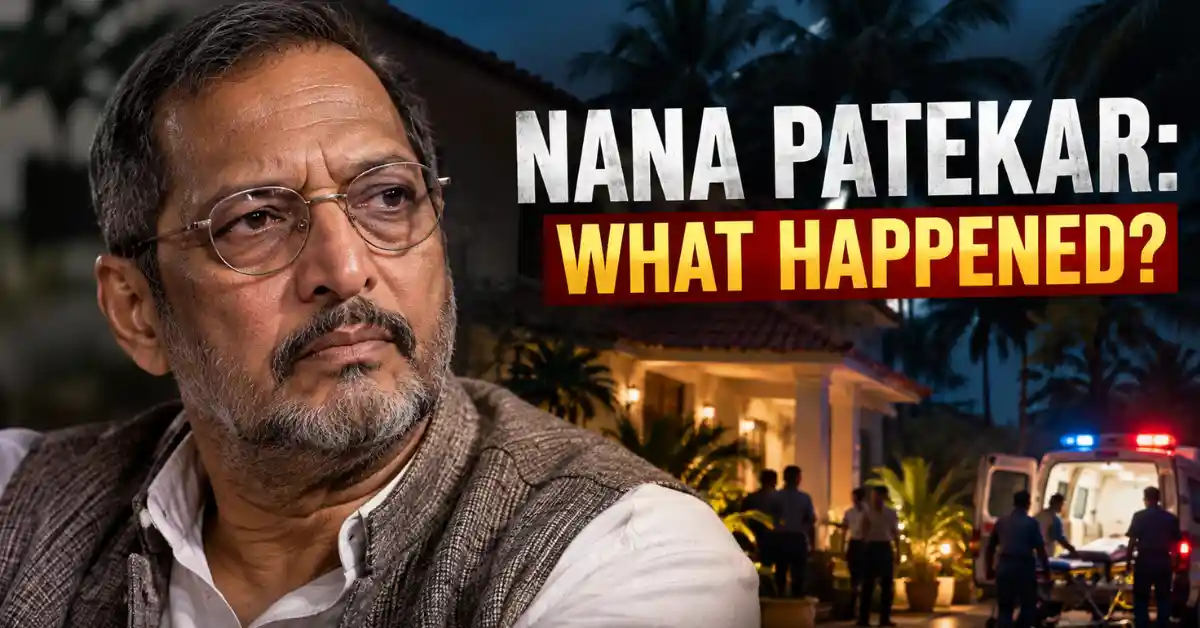
Veteran actor Nana Patekar died at the age of 75 on October 8, 2026, after suffering a cardiac arrest at his residence in Dona Paula, Goa. According to doctors, he had contacted a friend during the early hours saying he was not feeling well, later became progressively unconscious, and was found unresponsive when help reached him. Doctors continued CPR and cardiac resuscitation for approximately 45 minutes, but he could not be revived.
What happened to Nana Patekar?
Nana Patekar reportedly became unwell during the early hours of Thursday at his Goa residence.
According to Dr Shekhar Salkar, Patekar messaged a friend around 2:30 a.m. saying he was feeling unwell. India Today reported that he had also complained of discomfort or pain on the left side of his chest before his condition worsened.
Was Nana Patekar unconscious when help arrived?
Reports from the medical team say Patekar was found unconscious at his Goa residence. He was taken to Manipal Hospital, where doctors attempted resuscitation for approximately 45 minutes.
Nana Patekar’s Final Hours: Timeline
Around 2:30 a.m. — Patekar reportedly messaged a friend saying he was not feeling well.
Around 4:00 a.m. — The friend reportedly reached his residence and found him in a deteriorating condition.
Around 4:20–4:30 a.m. — He was taken to Manipal Hospital.
About 45 minutes — Doctors attempted CPR/resuscitation.
Around 5:10–5:20 a.m. — He was declared dead, according to reports. Hindustan Times
What was Nana Patekar’s cause of death?
Doctors identified cardiac arrest as the immediate medical event. The specific underlying trigger of the cardiac arrest had not been established in the initial reports, so claims about a particular heart disease or other underlying condition would be premature.
Cardiac arrest occurs when the heart suddenly stops pumping blood effectively. This is different from a heart attack, although a heart attack can sometimes trigger cardiac arrest. Without immediate treatment, the lack of blood flow can rapidly threaten the brain and other vital organs.
A medico-legal case was registered, and his body was taken to Goa Medical College for a post-mortem examination. The examination is expected to provide further clarity about the circumstances surrounding his death.
Why couldn’t CPR save Nana Patekar?
CPR does not necessarily restart the heart; its immediate purpose is to maintain circulation to vital organs while definitive treatment, including defibrillation when appropriate, is provided.
During cardiac arrest, chest compressions help maintain blood circulation to vital organs while medical teams attempt to restore an effective heart rhythm. Defibrillation may also be required when an appropriate shockable rhythm is present.
The American Heart Association recommends immediate CPR and rapid use of an automated external defibrillator (AED) when cardiac arrest is suspected.
In Patekar’s case, doctors reportedly continued resuscitation efforts for around 45 minutes, but he could not be revived.
How old was Nana Patekar?
Nana Patekar was 75 years old when he died on October 8, 2026. He was one of the most prominent actors in both Hindi and Marathi cinema, with a career spanning several decades.
Nana Patekar’s final public appearance
Four days before his death, Patekar attended an event in Goa on October 4, where he spoke about life, mortality and the limited nature of time.
When should cardiac arrest be treated as an emergency?
If a person suddenly collapses, does not respond and is not breathing normally—or is only gasping—cardiac arrest should be suspected.
Call emergency medical services immediately, begin CPR and use an AED if one is available. Early intervention can substantially improve the chance of survival.
The important lesson from this tragedy is not to assume that a person who appears merely weak or unwell is necessarily experiencing a minor problem. Sudden deterioration, collapse, severe breathing difficulty, chest symptoms or loss of consciousness require urgent medical attention.
Key Takeaway
Nana Patekar’s death followed a sudden cardiac arrest at his Goa residence. Doctors reported that he became progressively unconscious before emergency assistance arrived and that prolonged resuscitation efforts were unsuccessful. While cardiac arrest has been identified as the immediate event, the precise underlying cause should not be speculated about until the medical investigation is complete.
This article summarizes publicly reported information and explains the medical context of cardiac arrest. It is not based on direct examination or treatment of Nana Patekar.
Medical Sources
- American Heart Association — What Is Cardiac Arrest? American Heart Association: What Is Cardiac Arrest? www.heart.org
- American Heart Association — Treatment of Cardiac Arrest American Heart Association: Treatment of Cardiac Arrest www.heart.org
- American Heart Association — What Is an AED? American Heart Association: What Is an AED? www.heart.org
Reporting Sources
- Hindustan Times — Nana Patekar death: Doctor reveals actor’s final hours Hindustan Times
- Reuters — Bollywood actor Nana Patekar dies at 75 Reuters
Medical Disclaimer
This article is for general educational and informational purposes only. It is not a substitute for professional medical diagnosis, treatment, or individualized medical advice. If you have persistent, severe, worsening, or concerning symptoms, consult a qualified healthcare professional. Seek urgent medical care for emergency symptoms.

Dr. Shabbir Hussain, BPT
Registered Physiotherapist | Clinical Rehabilitation Specialist
Maharashtra OTPT Council Reg. No.: PR-2021/08/PT/009532
Society of Onco Physiotherapists Reg. No.: SOP/00033/LM
Dr. Shabbir Hussain, BPT, Registered Physiotherapist with over 8 years of experience in physiotherapy, kidney rehabilitation, oncological rehabilitation, and lymphedema management. He specializes in balance disorders, pain management, musculoskeletal rehabilitation, strengthening programs, and VR-based rehabilitation.