
Updated September 21, 2026 — Written by Dr. Shabbir Hussain, BPT, Registered Physiotherapist | Clinical Rehabilitation Specialist
Quick Answer – How To recover From Stroke Quickly
There’s no shortcut that heals the brain overnight, but stroke recovery can be meaningfully accelerated through consistent, high-repetition therapy that harnesses neuroplasticity — the brain’s ability to rewire itself. Combining structured physiotherapy, good sleep, nutrition, mental health support, and a realistic long-term mindset gives survivors the best chance at a faster, fuller recovery. Be wary of anyone promising instant results.
Recovering from a stroke is rarely a straight line. Some survivors regain function within weeks; others need months or years of steady work. What decides the pace isn’t luck — it’s how consistently the brain gets the right kind of stimulation. Here’s what the evidence actually supports.
How Does the Brain Heal After a Stroke?
Stroke rehabilitation uses task-specific and appropriately dosed practice to support motor learning and functional recovery. Repetition can help, but the amount and type of practice should be individualized according to the survivor’s abilities, medical condition, and rehabilitation goals.
Can People Go Back to Normal After a Stroke?
Some survivors do regain most or all of their pre-stroke function, especially with early, intensive rehabilitation. Others are left with lasting deficits. Recovery depends on the stroke’s size and location, how quickly treatment began, age, overall health, and how consistently rehab is followed. “Normal” looks different for everyone — the realistic goal is maximizing independence and function.
Can a Stroke Be Cured Completely?
There is no cure that reverses the underlying brain injury. However, “complete recovery” — where a person regains essentially full function — does happen for a meaningful number of survivors, particularly after mild to moderate strokes with prompt treatment. For others, rehabilitation focuses on regaining as much function as possible rather than a full reversal.
What Should You Expect Six Months After a Stroke?
Recovery is often fastest during the early months after stroke, but the pace varies widely. Improvements can continue beyond six months and may be supported by ongoing, appropriately targeted rehabilitation.
What Is the Best Way to Recover From a Stroke?
No single method works alone. The strongest approach combines:
- Consistent, repetitive practice of therapy exercises, even after formal sessions end
- Full-body training, not just the affected limb — walking, for instance, involves balance, core strength, and coordination
- Assistive devices when needed (like ankle-foot orthotics for foot drop), paired with active exercise rather than reliance alone
- Speech and swallowing therapy for survivors with aphasia or dysphagia
- Quality sleep, which helps consolidate motor learning
- A balanced diet rich in omega-3s, nuts, and antioxidant-rich fruits, which may support brain health
- Mental health support, including meditation or counseling, since depression and anxiety are common after stroke and can slow progress
- Medical follow-up for setbacks — a sudden regression should always be reported to a doctor, as it can signal a new medical issue
How Physiotherapy Can Help
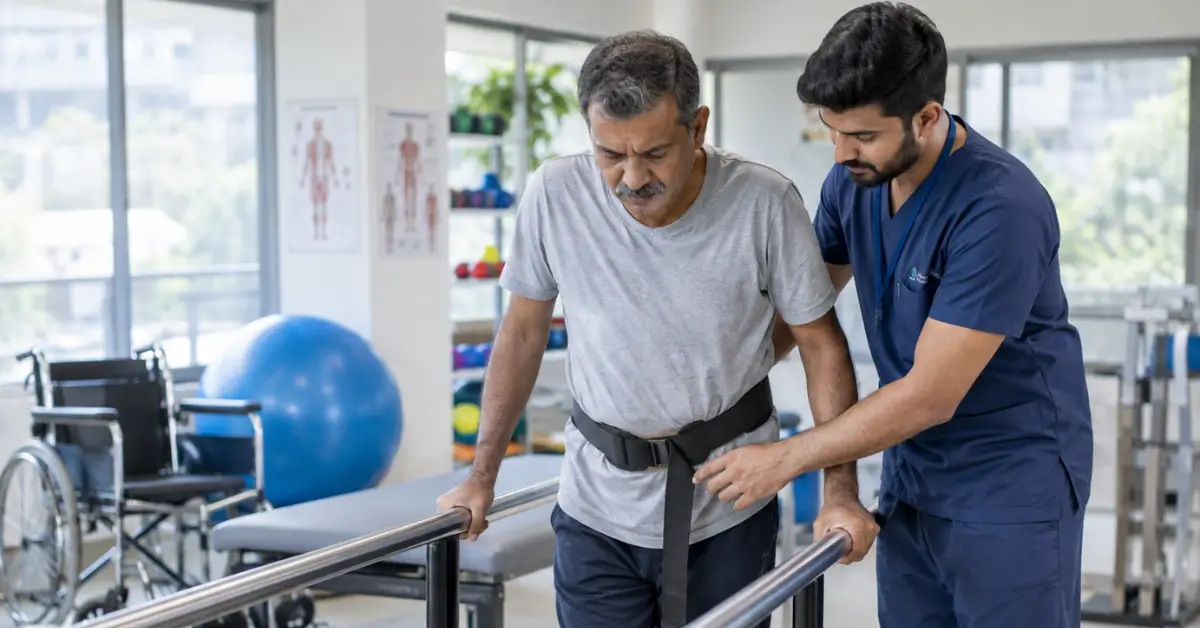
A physiotherapist plays a central role in stroke recovery. They assess movement, balance, and strength deficits and design a structured, progressive exercise program targeting walking, transfers, coordination, and safety.
Physiotherapy typically includes:
- Gait and balance retraining
- Strengthening exercises for the affected side
- Task-specific practice (e.g., reaching, standing, stair climbing)
- Fall-prevention strategies and, where appropriate, guidance on orthotic devices
Who benefits: Nearly all stroke survivors, from the acute hospital stage through long-term community rehabilitation.
When to seek assessment: As early as medically safe after a stroke, and again if you notice a plateau, a new regression, or increasing pain, since these can signal the need for a revised plan.
Red flags requiring urgent medical attention: Sudden worsening of weakness, new speech difficulty, severe headache, loss of consciousness, or difficulty swallowing with choking — these need immediate emergency care, not home exercise.
The Bottom Line
Stroke recovery isn’t about finding a quick fix — it’s about consistent, well-guided effort over time. Survivors who stay engaged with structured rehab, take care of their overall health, and seek professional guidance for setbacks give their brain the best possible conditions to heal.
Medical Sources
- National Institute of Neurological Disorders and Stroke (NINDS) — Post-Stroke Rehabilitation Fact Sheet
Link: https://www.ninds.nih.gov/health-information/patient-caregiver-education/post-stroke-rehabilitation - Mayo Clinic — Stroke Rehabilitation: What to Expect as You Recover
Link: https://www.mayoclinic.org/diseases-conditions/stroke/in-depth/stroke-rehabilitation/art-20045172 - American Stroke Association (part of the American Heart Association) — Rehabilitation Therapy After a Stroke
Link: https://www.stroke.org/en/life-after-stroke/stroke-rehab - NHS — Recovering After a Stroke
Link: https://www.nhs.uk/conditions/stroke/recovery/
Medical Disclaimer
This article is for general educational and informational purposes only. It is not a substitute for professional medical diagnosis, treatment, or individualized medical advice. If you have persistent, severe, worsening, or concerning symptoms, consult a qualified healthcare professional. Seek urgent medical care for emergency symptoms.

Dr. Shabbir Hussain, BPT
Licensed Physiotherapist | Clinical Rehabilitation Specialist
Maharashtra OTPT Council Reg. No.: PR-2021/08/PT/009532
Society of Onco Physiotherapists Reg. No.: SOP/00033/LM
Dr. Shabbir Hussain, BPT, Registered Physiotherapist with over 8 years of experience in physiotherapy, kidney rehabilitation, oncological rehabilitation, and lymphedema management. He specializes in balance disorders, pain management, musculoskeletal rehabilitation, strengthening programs, and VR-based rehabilitation.