
🩺 Medical Review & Author Information
Written & Reviewed By: Dr. SHABBIR HUSSAIN (BPT)
Designation: Senior Physiotherapist, Rehabilitation Specialist & Medical Health Writer
Clinical Experience: 8+ Years in Musculoskeletal Rehabilitation, Pain Management, Oncology Rehabilitation, Kidney Rehabilitation & Functional Recovery
About the Author: Learn more about Dr. Shabbir Hussain’s qualifications, clinical expertise, professional experience and editorial standards: About Dr. Shabbir Hussain
Evidence-Based Review: This article has been medically reviewed and written by a qualified physiotherapist to ensure clinical accuracy, patient safety and public health awareness.
Last Updated: June 16, 2026
Introduction
“I stopped running because everyone told me it would destroy my knees.”
Most people believe running destroys your knees. Surprisingly, research suggests recreational runners may have similar—or even lower—rates of knee osteoarthritis than inactive adults.
As a physiotherapist with years of experience treating musculoskeletal conditions, I have seen patients unnecessarily give up activities they love because of misconceptions about knee health. Understanding when to walk, when to run, and when to temporarily avoid both can make a significant difference in recovery.
2026 Research Update: What Scientists Recently Discovered About Running and Arthritis.
Researchers analyzed multiple studies involving recreational runners and found no clear evidence that running alone increases knee arthritis risk. Some experts believe moderate running may help maintain cartilage health through regular joint loading. However, factors such as obesity, previous injuries, poor biomechanics, and sudden increases in training volume can increase knee stress.
Researchers analyzing recreational runners found no clear evidence that running alone increases the risk of knee osteoarthritis compared with a sedentary lifestyle.
⚡ Quick Summary
Main Risk: Choosing the wrong activity can worsen knee pain and delay recovery.
Key Symptom: Pain during walking, running, stair climbing, or prolonged standing.
Best Solution: Match activity level to the cause of knee pain and build strength gradually.
Prevention Tip: Maintain healthy body weight, strengthen leg muscles, and avoid sudden increases in activity.
Does Running Really Damage Your Knees?
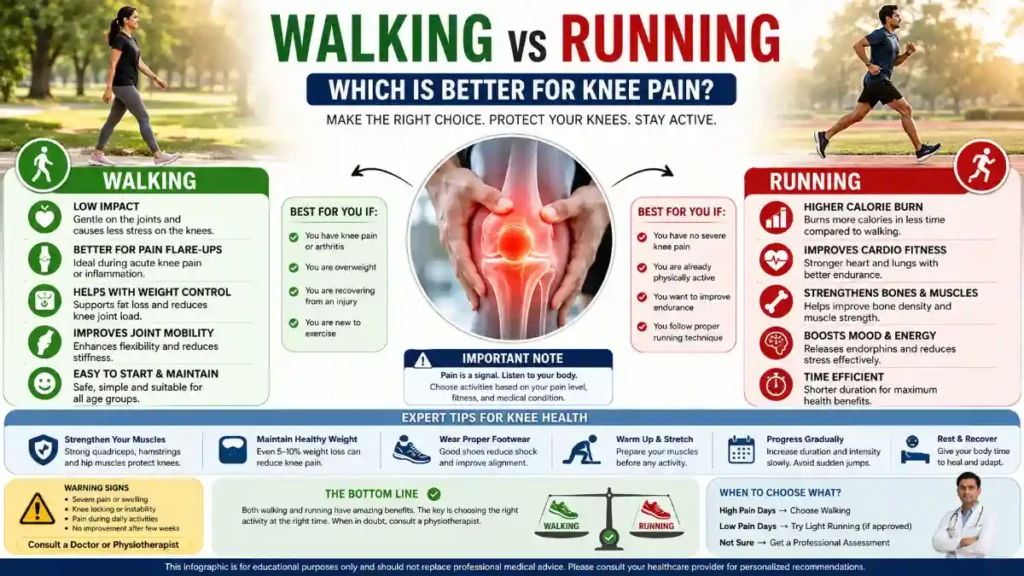
Walking and running are both weight-bearing activities that involve repetitive movement of the hips, knees, ankles, muscles, tendons, and joints.
The difference lies in the amount of force transmitted through the body.
During walking, one foot remains in contact with the ground at most times, resulting in relatively lower impact forces.
During running, there is a brief phase where both feet leave the ground. When the foot lands again, the knee experiences higher loading forces.
Many people assume higher force automatically means greater damage. However, the human body adapts remarkably well to appropriately graded stress.
According to modern rehabilitation principles, movement itself is generally beneficial for joint health. The key factor is not whether you move, but whether the amount of movement matches your current tissue capacity.
For someone with mild knee discomfort, running may be safe.
For someone with acute inflammation, walking may be more appropriate.
For someone with severe arthritis, a modified exercise program may be necessary.
The answer depends on the individual rather than a universal rule.
Real Patient Story
A 36-year-old IT professional visited my clinic after experiencing knee pain for nearly eight months.
He worked from home, spent most of the day sitting, and had recently started running because he wanted to lose weight.
Initially, he felt mild discomfort while climbing stairs. Instead of addressing the issue, he increased his running distance every week.
Eventually, even short walks became painful.
Like many patients, he assumed running had permanently damaged his knees.
After assessment, we discovered something different.
His primary issue was weakness in the hip muscles, reduced ankle mobility, poor running progression, and inadequate recovery between workouts.
We temporarily reduced running volume and introduced a structured rehabilitation program focusing on strength, movement control, and gradual loading.
Within six weeks, stair pain reduced significantly.
By three months, he returned to running without symptoms.
“In clinical practice, I often find that poor progression, muscle weakness, and fear of movement cause more problems than running itself.”
— Dr. Shabbir Hussain
Doctor Explains
Why So Many People Believe Running Causes Arthritis
One of the biggest myths I encounter is the belief that running automatically causes arthritis.
Clinically, many patients arrive convinced that years of running have permanently damaged their knees.
In reality, research has repeatedly shown that recreational running does not necessarily increase the risk of knee osteoarthritis in healthy individuals. The situation becomes different when significant injury, obesity, poor biomechanics, or existing joint disease are present.
Another misunderstanding is assuming that pain always indicates damage.
Sometimes pain reflects temporary overload rather than structural injury.
Sometimes weak muscles around the hip and knee create abnormal stress that can be corrected.
Sometimes lifestyle habits are contributing more than exercise itself.
Why Symptoms Are Often Ignored
Many people initially experience only mild discomfort while climbing stairs, squatting, or standing after prolonged sitting.
Because the pain is manageable, they continue their routine without addressing the underlying issue.
Personally, I have seen many patients wait months before seeking professional advice. By then, compensatory movement patterns have developed, making rehabilitation more challenging.
Why Early Action Matters
Early intervention often produces faster recovery.
Many patients improve faster when strength deficits, flexibility restrictions, and movement abnormalities are identified before chronic pain develops.
The sooner the root cause is addressed, the easier it becomes to return to normal activity levels.
Why This Problem Is Becoming More Common
Knee pain is becoming increasingly common across all age groups in India.
One major reason is the dramatic shift toward sedentary lifestyles.
Many professionals spend eight to ten hours daily working on laptops. Students attend online classes and spend additional hours on smartphones. Long periods of sitting weaken important stabilizing muscles around the hips and knees.
Hidden Dangers Most People Don’t Realize
Knee pain is often dismissed as a minor inconvenience.
However, untreated knee problems can gradually influence nearly every aspect of daily life.
In the early stages, discomfort may only appear during exercise.
Over time, patients often begin avoiding stairs, squatting, walking long distances, or participating in recreational activities.
This reduction in movement can lead to progressive weakness, reduced cardiovascular fitness, weight gain, and worsening joint function.
Common Mistakes People Make
Delaying Professional Assessment
The most common mistake is waiting too long.
Patients frequently hope symptoms will disappear on their own. While minor irritation may resolve naturally, persistent pain deserves proper evaluation.
Self-Medicating for Months
Painkillers can temporarily mask symptoms without addressing underlying causes.
Many patients continue activities that aggravate the condition because medication reduces discomfort temporarily.
Ignoring Warning Signs
Swelling, instability, locking sensations, and recurring pain should never be ignored.
These symptoms may indicate more significant pathology requiring assessment.
The Surprising Finding That Changed How We Think About Running
Recent research has challenged several long-standing beliefs about running and knee health.
One of the most surprising findings is that recreational runners often demonstrate similar—or sometimes lower—rates of knee osteoarthritis compared with sedentary individuals.
Researchers believe moderate running may help maintain cartilage health through appropriate mechanical stimulation.
Another important finding is that muscle strength may predict knee health more strongly than activity type alone.
Strong quadriceps, gluteal muscles and calf muscles help distribute forces efficiently across the lower limb.
Emerging evidence also suggests that physical inactivity may be more harmful than previously appreciated.
Another Case From My Practice
A 52-year-old school teacher came to my clinic believing she would need to stop all exercise because of recurring knee pain.
She had read online that running and brisk walking could “wear out” her knees faster. As a result, she gradually became less active and gained weight over several years.
During assessment, we found that her biggest challenges were reduced leg strength, decreased physical activity, and fear of movement rather than severe joint damage.
Instead of avoiding exercise completely, we introduced a gradual walking program combined with strengthening exercises for the quadriceps, gluteal muscles, and calf muscles.
Over the following months, her walking tolerance improved, daily pain decreased, and she regained confidence in her ability to stay active.
Her case reinforced an important lesson I frequently see in practice: avoiding movement often creates more long-term problems than appropriate movement itself.
🚨 Don’t Ignore These Signs
- Knee swelling that repeatedly returns
- Pain lasting longer than several weeks
- Knee locking or catching sensations
- Feeling that the knee may “give way”
- Difficulty bearing weight
- Night pain that disrupts sleep
- Progressive loss of mobility
- Pain associated with significant injury
These symptoms warrant professional evaluation rather than continued self-management.
Treatment & Physiotherapy Management
The most effective treatment depends on the underlying diagnosis rather than simply choosing walking or running.
For many patients, physiotherapy serves as the foundation of recovery.
The first step involves identifying aggravating factors and temporarily modifying activities that exceed current tissue capacity.
Contrary to popular belief, complete rest is rarely the best solution.
Appropriate movement encourages circulation, maintains strength, and supports recovery.
Strengthening exercises targeting the quadriceps, hamstrings, gluteal muscles, and calf muscles are frequently prescribed because these structures play a critical role in shock absorption and joint stability.
Manual therapy may help improve joint mobility and reduce pain in selected individuals.
Education is equally important. Understanding pain mechanisms often reduces fear and improves adherence to rehabilitation programs.
Walking programs are commonly introduced for individuals who tolerate low-impact activity better than running.
MYTH VS FACT:
| Myth | Fact |
|---|---|
| Running always damages the knees. | Research suggests recreational running does not automatically increase knee arthritis risk in healthy individuals. |
| If your knee hurts, complete rest is best. | Prolonged inactivity can weaken muscles and worsen joint function. Appropriate movement is usually beneficial. |
| Walking is always safer than running. | Walking may be better during flare-ups, but for some people, controlled running is safe and beneficial. |
| Knee pain only affects older adults. | Knee pain is increasingly common among younger adults due to sedentary lifestyles, obesity, and poor movement habits. |
| Pain always means structural damage. | Pain can result from overload, muscle weakness, inflammation, or movement dysfunction—not just injury. |
| Strong knees come from exercise alone. | Recovery also depends on sleep, nutrition, body weight, stress levels, and overall health. |
| Online exercises work for everyone. | The best exercise depends on the specific cause of knee pain and individual assessment findings. |
| Arthritis means you should never run again. | Some people with mild arthritis can safely participate in modified running programs under professional guidance. |
Expert Clinical Insights
Over the years, certain patterns repeatedly appear in patients dealing with knee pain.
In My Clinical Experience…
Many individuals are surprised to learn that weak hips often contribute more to knee pain than the knee itself.
The body functions as a connected chain. When the hips fail to control movement efficiently, excessive stress is transferred to the knee.
Who Should Avoid Certain Exercises or Treatments?
Not every exercise is suitable for every individual.
Some situations require additional caution or temporary activity modification.
Individuals recovering from recent knee surgery should follow surgeon and physiotherapist recommendations rather than self-prescribed exercise programs.
Those experiencing severe pain, significant swelling, or inability to bear weight should avoid high-impact activities until properly assessed.
Neurological symptoms such as numbness, tingling, weakness, or altered sensation require medical evaluation before continuing intense exercise.
Patients with uncontrolled inflammatory conditions, severe osteoarthritis, fractures, infections, or systemic illness may require specialized rehabilitation strategies.
Red Flag Situations
Exercise should be postponed and medical assessment sought if knee pain is associated with:
- Fever
- Significant trauma
- Sudden inability to walk
- Severe swelling
- Suspected fracture
- Joint infection symptoms
- Rapidly worsening symptoms
The safest exercise is always the one matched to the individual’s current condition.
When to See a Doctor Immediately
Although most knee pain develops gradually, certain symptoms require urgent medical attention.
Seek immediate medical evaluation if you experience:
- Severe knee swelling after injury
- Inability to bear weight
- Visible joint deformity
- Sudden locking of the knee
- Significant instability after trauma
- Fever combined with knee pain
- Redness, warmth, and severe swelling
These symptoms may indicate serious conditions requiring prompt diagnosis and treatment.
Do not rely solely on home remedies when red flags are present.
⚠️ Doctor’s Clinical Insight
One of the biggest mistakes I see in physiotherapy practice is patients stopping all physical activity because of knee pain. In many cases, complete rest weakens the muscles that protect the knee. Appropriate movement, progressive strengthening, and early rehabilitation often produce better long-term outcomes than prolonged inactivity.
— Dr. SHABBIR HUSSAIN (BPT)
Conclusion
For most healthy individuals, recreational running does not automatically damage the knees. The real risk comes from poor progression, untreated injuries, muscle weakness, and ignoring warning signs.
✅ Key Takeaways
- Walking is often better during painful flare-ups, but running is not automatically harmful.
- Knee pain should be evaluated based on its cause, not just the activity that triggers it.
- Strong hip and leg muscles play a major role in protecting the knee joint.
- Ignoring persistent symptoms can lead to weakness, reduced mobility, and longer recovery times.
- Most patients benefit from gradual activity progression rather than complete rest.
- Professional assessment can identify movement problems that imaging alone may miss.
FAQ SECTION
1. Is walking better than running for knee pain?
It depends on the cause of the pain. Walking is usually better tolerated during acute symptoms, but some people can safely continue running with proper rehabilitation.
2. Can running cause knee arthritis?
Current evidence suggests recreational running alone does not automatically cause knee osteoarthritis in healthy individuals.
3. Should I stop exercising if my knee hurts?
Not always. Mild discomfort may allow modified activity, but persistent or worsening pain should be professionally assessed.
4. What is the best exercise for painful knees?
Strengthening exercises targeting the quadriceps, glutes, hamstrings, and calf muscles are commonly recommended, but treatment should be individualized.
5. How do I know if my knee pain is serious?
Swelling, locking, instability, inability to bear weight, fever, or severe pain after injury are warning signs that require medical evaluation.
6. Is walking every day good for knee arthritis?
For many individuals, regular walking can improve mobility, reduce stiffness, and support overall joint health when performed within comfortable limits.
7. Can losing weight reduce knee pain?
Yes. Even modest weight loss can significantly reduce stress on the knee joints and improve symptoms.
📢 Medical Disclaimer
This article is intended for educational and informational purposes only. The information provided does not replace professional medical advice, diagnosis, or treatment.
Every individual is unique, and knee pain can have multiple causes requiring personalized assessment. Readers should consult a qualified healthcare professional, physiotherapist, or physician before starting, stopping, or modifying any exercise or treatment program.
Individual medical recommendations require a detailed clinical evaluation and cannot be provided solely through educational content.
REFERENCES
- World Health Organization. (2023). Physical Activity Fact Sheet. https://www.who.int/news-room/fact-sheets/detail/physical-activity
- National Institute of Arthritis and Musculoskeletal and Skin Diseases (NIAMS). Osteoarthritis. https://www.niams.nih.gov/health-topics/osteoarthritis
- National Institutes of Health (NIH). Exercise and Physical Activity. https://www.nih.gov
- Alentorn-Geli, E., Samuelsson, K., Musahl, V., Green, C. L., Bhandari, M., & Karlsson, J. (2017). The association of recreational and competitive running with hip and knee osteoarthritis: A systematic review and meta-analysis. Journal of Orthopaedic & Sports Physical Therapy, 47(6), 373–390.

Dr. Shabbir Hussain, BPT
Registered Physiotherapist | Clinical Rehabilitation Specialist
Maharashtra OTPT Council Reg. No.: PR-2021/08/PT/009532
Society of Onco Physiotherapists Reg. No.: SOP/00033/LM
Dr. Shabbir Hussain, BPT, Registered Physiotherapist with over 8 years of experience in physiotherapy, kidney rehabilitation, oncological rehabilitation, and lymphedema management. He specializes in balance disorders, pain management, musculoskeletal rehabilitation, strengthening programs, and VR-based rehabilitation.