

🩺 Medical Review & Author Information
Written & Reviewed By: Dr. SHABBIR HUSSAIN (BPT)
Designation: Senior Physiotherapist, Rehabilitation Specialist & Medical Health Writer
Clinical Experience: 8+ Years in Musculoskeletal Rehabilitation, Pain Management, Oncology Rehabilitation, Kidney Rehabilitation & Functional Recovery
About the Author: Learn more about Dr. Shabbir Hussain’s qualifications, clinical expertise, professional experience and editorial standards: About Dr. Shabbir Hussain
Evidence-Based Review: This article has been medically reviewed and written by a qualified physiotherapist to ensure clinical accuracy, patient safety and public health awareness.
Last Updated: June 15, 2026
Why Waking Up With Numb Hands? While Sleeping: The Hidden Nerve Warning Sign You Shouldn’t Ignore
Waking Up With Numb Hands? You wake up at 3 AM. Your hand feels completely dead. You shake it for a few seconds and the feeling returns. Most people ignore this warning sign—but recurring numbness can sometimes indicate nerve compression, diabetes, or even neck-related problems.
While occasional numbness may occur from sleeping in an awkward position, recurring numbness can sometimes indicate nerve compression, circulation problems, neck-related issues, or even an underlying medical condition. Ignoring these symptoms for months—or even years—can allow the problem to worsen gradually.
📊 Quick Fact
Carpal Tunnel Syndrome affects an estimated 3–6% of adults worldwide, making it one of the leading causes of nighttime hand numbness, tingling, and weakness.
In my clinical experience as a physiotherapist, many patients seek help only after numbness begins affecting their grip strength, work performance, sleep quality, or daily activities.
⚡ Quick Summary
Main Risk: Nerve compression during sleep or underlying medical conditions.
Key Symptom: Tingling, numbness, pins-and-needles sensation in one or both hands.
Best Solution: Identify the cause early and follow proper physiotherapy, posture correction and lifestyle changes.
Prevention Tip: Avoid sleeping with bent wrists and maintain healthy posture throughout the day.
What Is Hand Numbness During Sleep?
Hand numbness during sleep refers to a temporary or persistent loss of sensation, tingling, pins-and-needles feeling, or weakness that occurs while resting or sleeping.
Medically, numbness usually develops when:
- A nerve becomes compressed
- Blood flow is temporarily restricted
- The brain receives altered sensory signals
- An underlying medical condition affects nerve function
The sensation may affect:
- One finger
- Several fingers
- The entire hand
- Both hands simultaneously
Many people describe it as:
“My hand fell asleep.”
In reality, the hand is not sleeping. Instead, the nerves responsible for sensation are being disturbed or compressed.
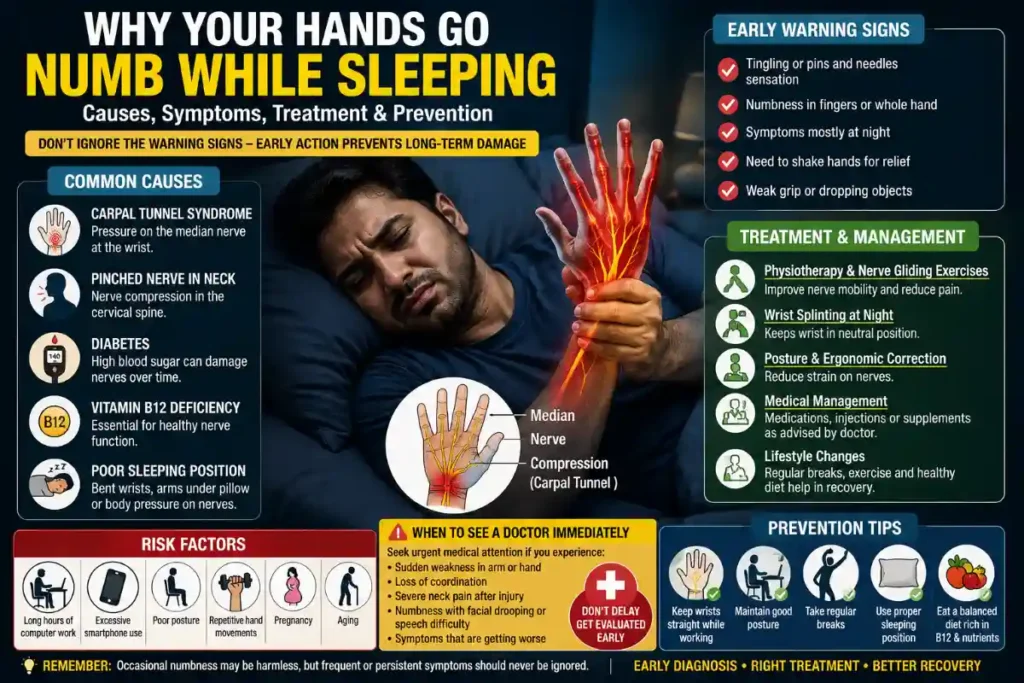
What Most People Misunderstand
One of the biggest misconceptions is that numb hands during sleep are always caused by poor sleeping posture.
While posture is certainly a common reason, it is not the only one.
Personally, I have seen many patients whose nighttime numbness was eventually linked to:
- Carpal tunnel syndrome
- Cervical nerve compression
- Diabetes-related nerve damage
- Vitamin deficiencies
- Chronic repetitive strain injuries
Many patients continue ignoring symptoms because the numbness disappears after a few minutes.
Why This Problem Is Becoming More Common
Over the last decade, I have noticed a clear increase in patients reporting nighttime hand numbness.
Several modern lifestyle habits appear to be contributing.
Smartphone Overuse
Many individuals spend several hours daily gripping smartphones.
Extended thumb movement, wrist flexion, and prolonged hand positioning can increase strain on nerves and tendons around the wrist.
Clinically, many patients report symptoms worsening after excessive nighttime phone use.
📊 Quick Fact
People who spend prolonged hours typing, using a mouse, gaming, or gripping smartphones may be at increased risk of developing nerve compression symptoms over time. Repetitive hand and wrist movements can place extra stress on the structures surrounding important nerves, particularly around the wrist and forearm.
Laptop and Computer Work
Office workers often spend 8–10 hours per day:
- Typing
- Using a mouse
- Working at non-ergonomic desks
Poor wrist positioning can gradually irritate structures surrounding the median nerve.
Hidden Dangers Most People Don’t Realize
Most people think numbness is merely an inconvenience.
Unfortunately, repeated nerve compression can eventually create more significant problems.
Progressive Nerve Damage
Persistent compression may reduce normal nerve function.
Over time, symptoms can progress from:
- Occasional tingling
to
- Constant numbness
- Weakness
- Reduced coordination
Loss of Grip Strength
Many patients are surprised when they begin dropping objects.
This happens because the muscles controlled by affected nerves gradually become weaker.
Common Mistakes People Make
Delaying Treatment
The most common mistake is assuming symptoms will disappear on their own.
Sometimes they do. Sometimes they don’t.
Without proper assessment, it is impossible to know which situation applies.
Self-Medicating
Many individuals rely on painkillers or topical creams.
These approaches may temporarily reduce symptoms but rarely address the root cause.
Ignoring Neck Problems
A surprising number of hand numbness cases actually originate in the neck.
Treating only the hand while ignoring cervical dysfunction often leads to incomplete recovery.
Following Social Media Advice
Not every exercise online is appropriate for every condition.
Shocking Findings & Recent Research
Recent scientific research continues to highlight the growing burden of nerve-related disorders affecting the hands and upper limbs.
Several studies have found that prolonged repetitive hand use, computer work, and poor ergonomic habits may increase the risk of developing nerve compression syndromes, particularly carpal tunnel syndrome.
Emerging evidence also suggests that sleep position can influence nerve compression symptoms. Individuals who sleep with excessive wrist flexion or prolonged arm pressure often report more nighttime numbness.
Another surprising finding is that diabetes and prediabetes may contribute to nerve dysfunction long before patients notice obvious symptoms.
In my clinical practice, I frequently encounter patients who initially believe their symptoms are solely due to posture, only to discover that blood sugar control, vitamin deficiencies, or cervical spine issues are playing a significant role.
Causes and Risk Factors
One of the reasons hand numbness is often misunderstood is that multiple conditions can produce very similar symptoms. In my clinical experience, patients are frequently surprised when the source of their hand numbness turns out to be the neck, shoulder, or an underlying medical condition rather than the hand itself.
Carpal Tunnel Syndrome
Carpal tunnel syndrome is among the most common causes of nighttime hand numbness.
The median nerve passes through a narrow tunnel in the wrist called the carpal tunnel. When pressure builds within this tunnel, the nerve becomes compressed.
Typical symptoms include:
- Numbness in the thumb, index finger, middle finger, and part of the ring finger
- Tingling that wakes you at night
- Symptoms relieved temporarily by shaking the hand
- Weak grip strength over time
Many office workers, homemakers, tailors, factory workers, and individuals who perform repetitive hand movements are at increased risk.
🤔 Could It Be Carpal Tunnel Syndrome?
Carpal Tunnel Syndrome (CTS) is one of the most common causes of nighttime hand numbness. It occurs when the median nerve becomes compressed as it passes through a narrow tunnel in the wrist.
✅ Common Signs of Carpal Tunnel Syndrome
- 👉 Numbness in the thumb, index finger, and middle finger
- 👉 Tingling or “pins and needles” sensation at night
- 👉 Symptoms that are worse while sleeping
- 👉 Temporary relief after shaking the hand
- 👉 Weak grip strength or dropping objects
- 👉 Difficulty holding a phone, cup, or steering wheel
□ Does your thumb feel numb?
□ Is your index finger affected?
□ Are symptoms worse at night?
□ Does shaking your hand help temporarily?
□ Do you wake up because of tingling or numbness?
If you answered “Yes” to 3 or more questions, carpal tunnel syndrome may be a possibility and professional evaluation is recommended.
Many people assume their hand is simply “falling asleep” during the night. In reality, recurring numbness affecting the thumb, index, and middle fingers is one of the classic early warning signs of carpal tunnel syndrome and should not be ignored.
✋ Which Fingers Are Numb?
The location of numbness can provide important clues about which nerve may be affected. While a professional evaluation is needed for diagnosis, the pattern below may help you understand possible causes.
➜ Often associated with Carpal Tunnel Syndrome (median nerve compression at the wrist).
➜ May suggest Ulnar Nerve Compression, often occurring around the elbow or wrist.
➜ May indicate neck-related nerve irritation, circulation issues, or widespread nerve involvement.
➜ May be associated with conditions such as diabetes, vitamin deficiencies, repetitive strain, or sleeping posture issues.
Cervical Radiculopathy (Pinched Nerve in the Neck)
A compressed nerve in the neck can send symptoms all the way down the arm and into the hand.
Personally, I have seen many patients treated repeatedly for wrist pain when the real problem was located in the cervical spine.
Common signs include:
- Neck stiffness
- Shoulder pain
- Arm tingling
- Numbness affecting specific fingers
- Symptoms worsening after prolonged sitting
Poor Sleeping Position
Sleeping with:
- Bent wrists
- Arms under the pillow
- Elbows tightly flexed
- Body weight resting on the arm
can temporarily compress nerves and blood vessels.
Occasional numbness from posture is common, but repeated episodes should not be ignored.
Diabetes
Diabetes can damage peripheral nerves through a condition known as diabetic neuropathy.
Patients often notice:
- Burning sensations
- Tingling
- Numbness
- Reduced sensation in the hands and feet
Poorly controlled blood sugar significantly increases the risk.
Vitamin B12 Deficiency
Vitamin B12 is essential for healthy nerve function.
Deficiency may lead to:
- Numbness
- Tingling
- Weakness
- Balance problems
This issue is increasingly seen in individuals with dietary restrictions, digestive disorders, and older adults.
Early Warning Signs
Nighttime hand numbness rarely appears suddenly as a severe problem. Most cases develop gradually.
Recognizing early symptoms can help prevent long-term complications.
Early Symptoms
Patients often report:
- Occasional tingling during sleep
- Pins-and-needles sensation
- Mild numbness that resolves quickly
- Temporary discomfort upon waking
At this stage, symptoms may only occur once or twice per week.
Progressing Symptoms
As the condition worsens, patients may notice:
- More frequent episodes
- Longer-lasting numbness
- Symptoms during daytime activities
- Difficulty holding objects
- Hand fatigue
Advanced Symptoms
When nerve compression becomes significant, symptoms may include:
- Persistent numbness
- Muscle weakness
- Reduced coordination
- Difficulty gripping items
- Hand muscle wasting in severe cases
Don’t Ignore These Signs
Seek professional evaluation if you experience:
- Numbness occurring every night
- Progressive weakness
- Difficulty gripping objects
- Frequent dropping of items
- Symptoms affecting work performance
- Persistent symptoms lasting weeks or months
These signs may indicate ongoing nerve dysfunction that requires treatment.
🔍 The 30-Second Hand Numbness Self-Check Test
Answer the following questions. While this test cannot diagnose a condition, it may help you recognize patterns that deserve professional evaluation.
1️⃣ Which fingers become numb?
□ Thumb, index, and middle fingers
□ Ring finger and little finger
□ Entire hand
2️⃣ Does shaking your hand temporarily relieve the numbness?
□ Yes
□ No
3️⃣ Do you also have neck pain, stiffness, or shoulder discomfort?
□ Yes
□ No
4️⃣ Is the numbness affecting one hand or both hands?
□ One hand
□ Both hands
5️⃣ How often does it happen?
□ Once in a while
□ Several nights per week
□ Every night
- Frequent nighttime numbness may indicate ongoing nerve compression.
- Thumb, index, and middle finger symptoms are commonly associated with carpal tunnel syndrome.
- Neck pain along with hand numbness may suggest a cervical nerve issue.
- Symptoms occurring several nights a week should not be ignored.
🚨 Red Flag Symptoms: Seek Immediate Medical Attention
While occasional hand numbness is often harmless, certain symptoms may indicate a serious neurological or medical emergency. Do not ignore these warning signs:
- ⚠️ Sudden weakness in one arm or hand
- ⚠️ Facial drooping or uneven smile
- ⚠️ Slurred speech or difficulty speaking
- ⚠️ Loss of coordination or balance
- ⚠️ Numbness spreading rapidly through the arm or body
- ⚠️ Severe neck pain after injury or trauma
- ⚠️ Loss of bladder or bowel control
- ⚠️ Complete loss of hand movement or grip strength
- ⚠️ Sudden vision changes or confusion
Diagnosis
Accurate diagnosis is essential because treatment depends on the underlying cause.
Medical Evaluation
A healthcare professional will typically ask:
- Which fingers are affected?
- How long have symptoms been present?
- Are symptoms worsening?
- Do you have diabetes or other medical conditions?
The pattern of symptoms often provides important diagnostic clues.
Physiotherapy Assessment
A physiotherapy evaluation may include:
- Postural assessment
- Cervical spine examination
- Shoulder assessment
- Nerve tension testing
- Strength testing
- Functional movement analysis
In real rehabilitation settings, identifying contributing movement and posture problems is often critical for long-term success.
Functional Testing
Several clinical tests may help identify nerve compression syndromes.
These tests evaluate:
- Nerve sensitivity
- Muscle strength
- Reflexes
- Sensory function
Imaging and Advanced Testing
Depending on findings, a physician may recommend:
- X-rays
- MRI
- Nerve conduction studies
- Electromyography (EMG)
- Blood tests
Gold-Standard Diagnosis
For conditions such as carpal tunnel syndrome, nerve conduction studies are often considered among the most reliable diagnostic tools when symptoms are unclear or severe.
Treatment & Physiotherapy Management
The best treatment depends entirely on the cause.
Fortunately, many patients improve significantly with conservative management.
Education and Activity Modification
The first step is understanding what is irritating the nerve.
Patients often benefit from:
- Adjusting sleeping positions
- Improving workstation ergonomics
- Reducing repetitive strain
- Taking regular movement breaks
Physiotherapy
Physiotherapy plays a crucial role in recovery.
Treatment may include:
Postural Correction
Poor posture increases stress throughout the neck, shoulders, and upper limbs.
Improving posture often reduces nerve irritation.
Nerve Mobilization Exercises
Specific exercises can help improve nerve mobility and reduce sensitivity.
These exercises should be prescribed appropriately because excessive stretching may worsen symptoms.
Manual Therapy
Manual therapy may help improve:
- Joint mobility
- Soft tissue flexibility
- Neck movement
- Shoulder mechanics
Strengthening Exercises
Many patients improve faster when underlying weakness is addressed.
Strengthening may focus on:
- Postural muscles
- Shoulder stabilizers
- Forearm muscles
- Hand function
Ergonomic Correction
One common pattern observed in physiotherapy practice is poor workstation setup.
Small changes can make a significant difference.
Examples include:
- Proper keyboard positioning
- Wrist-neutral posture
- Appropriate chair height
- Screen alignment
Splinting
For some patients with carpal tunnel syndrome, nighttime wrist splints may help maintain neutral wrist positioning during sleep.
Medical Management
Depending on the diagnosis, medical treatment may include:
- Anti-inflammatory medications
- Corticosteroid injections
- Blood sugar management
- Vitamin supplementation
Surgical Intervention
Surgery is generally reserved for:
- Severe nerve compression
- Significant weakness
- Persistent symptoms despite conservative treatment
Recovery Expectations
Recovery varies depending on:
- Cause
- Severity
- Duration of symptoms
- Patient compliance
Many mild to moderate cases improve within weeks to months when treated appropriately.
⚠️ Medical Disclaimer
This article is intended for educational and informational purposes only and should not be considered medical advice, diagnosis, or treatment.
Every individual is different, and symptoms may have multiple causes. Proper diagnosis requires a qualified healthcare professional’s assessment.
If you have persistent numbness, weakness, severe pain, or worsening symptoms, consult a physician, neurologist, or physiotherapist for individualized evaluation and treatment.
Do not delay seeking professional medical care based solely on information contained in this article.
Myth vs Fact
| Myth | Fact |
|---|---|
| Hand numbness is always caused by sleeping awkwardly. | Numbness may result from nerve compression, diabetes, vitamin deficiency, or neck problems. |
| If numbness disappears after shaking the hand, it is harmless. | Temporary relief does not mean the underlying problem is gone. |
| Only older adults develop carpal tunnel syndrome. | Young professionals and students can also develop it. |
| Painkillers cure nerve problems. | Painkillers may reduce symptoms but do not fix the cause. |
| Exercise found online is safe for everyone. | Incorrect exercises may worsen symptoms. |
| Surgery is always required. | Many patients recover successfully with conservative treatment and physiotherapy. |
Real Patient Scenario
A 34-year-old IT professional visited my clinic after ignoring nighttime hand numbness for nearly eight months.
Initially, the symptoms only occurred once or twice per week. He assumed it was due to sleeping incorrectly.
Over time, he began waking up every night with numb fingers. Eventually, he noticed difficulty gripping a coffee mug and experienced fatigue while typing.
Assessment revealed a combination of poor workstation ergonomics, forward-head posture, and median nerve irritation consistent with early carpal tunnel syndrome.
Through ergonomic correction, physiotherapy, nerve mobilization exercises, postural training, and activity modification, his symptoms improved significantly over several weeks.
This case highlights an important lesson: early symptoms often provide an opportunity to prevent more serious nerve dysfunction.
👨⚕️ Doctor Insight
Dr. Shabbir Hussain (BPT): One of the most common mistakes I see is patients ignoring nighttime numbness because it disappears after a few minutes. Repeated nerve compression can gradually progress to weakness, reduced grip strength and functional limitations. Early evaluation often prevents long-term complications.
Who Should Avoid Certain Exercises or Treatments?
Not all exercises are appropriate for everyone.
Avoid self-prescribed exercises and seek professional guidance if you have:
- Recent wrist surgery
- Recent neck surgery
- Severe pain
- Progressive weakness
- Loss of coordination
- Significant numbness
- Suspected nerve injury
- Uncontrolled diabetes
- Neurological disorders
Conclusion
Waking up with numb hands may seem like a minor annoyance, but recurring symptoms should never be dismissed without understanding the cause.
While poor sleeping posture is often responsible, nighttime hand numbness can also signal nerve compression, cervical spine problems, diabetes-related neuropathy, vitamin deficiencies, or other underlying health concerns.
The encouraging news is that many cases respond extremely well to early intervention. In my clinical experience, patients who seek help early, improve their posture, address ergonomic factors, and follow an evidence-based rehabilitation program often achieve excellent outcomes.
📊 Quick Fact
Many nerve compression conditions improve significantly when identified and treated early. Persistent numbness, tingling, or weakness should not be ignored, as timely medical evaluation and appropriate treatment may help prevent long-term nerve dysfunction and improve recovery outcomes.
✅ Key Takeaways
- Recurring hand numbness during sleep should not be ignored.
- Carpal tunnel syndrome and neck-related nerve compression are common causes.
- Poor posture and excessive smartphone use can increase risk.
- Early diagnosis often leads to faster recovery.
- Physiotherapy can help improve nerve mobility, posture and function.
- Seek urgent medical attention if numbness occurs with weakness or stroke-like symptoms.
Frequently Asked Questions (FAQs)
1. Why do my hands go numb only at night?
Nighttime numbness is commonly caused by nerve compression due to sleeping position, carpal tunnel syndrome, or neck-related nerve irritation. Symptoms often become more noticeable during sleep because joints remain in one position for longer periods.
2. Is waking up with numb hands a sign of carpal tunnel syndrome?
It can be. Frequent numbness affecting the thumb, index finger, middle finger, and part of the ring finger is a common symptom of carpal tunnel syndrome. However, other conditions can cause similar symptoms.
3. Can sleeping position cause hand numbness?
Yes. Sleeping with bent wrists, elbows tightly flexed, or hands under your body may temporarily compress nerves and blood vessels, leading to numbness.
4. Should I worry if both hands go numb while sleeping?
Occasional numbness may not be serious, but persistent numbness in both hands should be evaluated by a healthcare professional, especially if it occurs regularly.
5. Can diabetes cause numb hands at night?
Yes. Diabetes can damage nerves over time, leading to diabetic neuropathy, which may cause tingling, burning, or numbness in the hands and feet.
6. Does vitamin B12 deficiency cause hand numbness?
Yes. Vitamin B12 is essential for nerve health. Deficiency can result in tingling, numbness, weakness, and balance problems.
7. Can physiotherapy help numb hands?
In many cases, yes. Physiotherapy may help reduce nerve compression, improve posture, restore movement, strengthen supporting muscles, and address contributing lifestyle factors.
REFERENCES
National Institute of Neurological Disorders and Stroke (NINDS).
Carpal Tunnel Syndrome Fact Sheet.
https://www.ninds.nih.gov/sites/default/files/migrate-documents/carpal_tunnel_syndrome_e_march_2020_508c_0.pdf
National Institute of Arthritis and Musculoskeletal and Skin Diseases (NIAMS).
Carpal Tunnel Syndrome.
https://www.niams.nih.gov/health-topics/carpal-tunnel-syndrome
World Health Organization (WHO).
Neurological Disorders and Public Health.
https://www.who.int/publications/i/item/9789241563369

Dr. Shabbir Hussain, BPT
Registered Physiotherapist | Clinical Rehabilitation Specialist
Maharashtra OTPT Council Reg. No.: PR-2021/08/PT/009532
Society of Onco Physiotherapists Reg. No.: SOP/00033/LM
Dr. Shabbir Hussain, BPT, Registered Physiotherapist with over 8 years of experience in physiotherapy, kidney rehabilitation, oncological rehabilitation, and lymphedema management. He specializes in balance disorders, pain management, musculoskeletal rehabilitation, strengthening programs, and VR-based rehabilitation.