Written & Reviewed By: Dr. SHABBIR HUSSAIN (BPT)
Experience: Physiotherapy & Rehabilitation Specialist
Last Updated: June 4, 2026
Fact Checked: Yes ✓
This article has been reviewed by a qualified physiotherapist for medical accuracy, rehabilitation guidance, and public health awareness.
Air Pollution and Your Lungs: The Silent Damage Most People Don’t Notice Until It’s Too Late
Every morning, millions of people step outside assuming the air around them is harmless. They commute to work, ride motorcycles through traffic, walk children to school, or exercise outdoors without realizing something invisible may be affecting their health every single day.
What makes air pollution dangerous is not always what you feel immediately. The real concern is what happens quietly over months and years.
In my physiotherapy practice, many patients complain of unexplained fatigue, reduced exercise tolerance, recurring cough, or breathlessness during routine activities. Often, air quality is not even considered as a contributing factor until symptoms begin affecting daily life.
Ignoring these early warning signs can allow long-term lung damage to progress unnoticed.
⚡ Quick Summary
Main Risk: Long-term health complications if symptoms are ignored.
Key Symptom: Early warning signs often appear before severe problems develop.
Best Solution: Early diagnosis, lifestyle changes, and physiotherapy management.
Prevention Tip: Address symptoms early rather than waiting for them to worsen.
What Is Air Pollution?
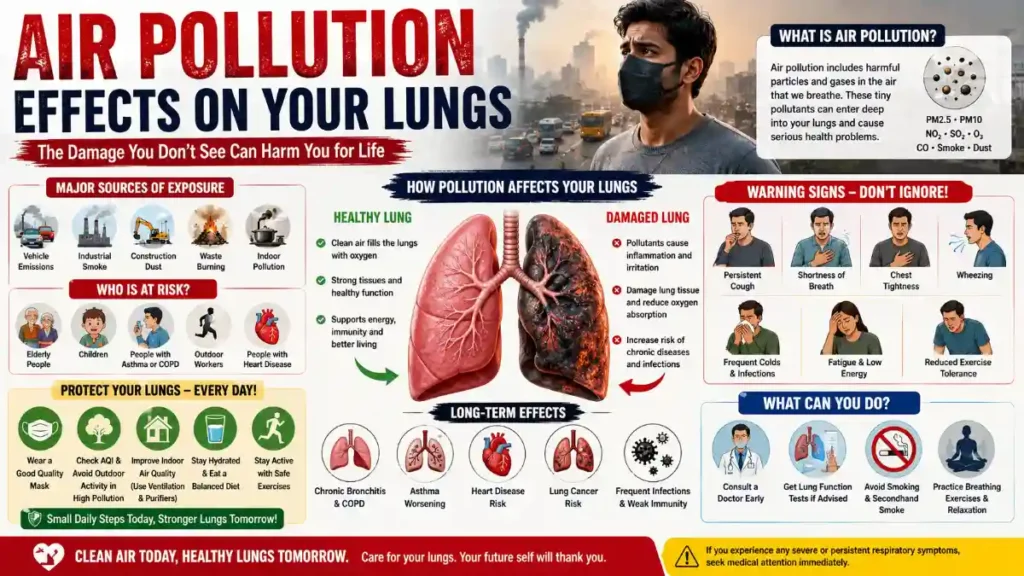
Air pollution refers to harmful substances suspended in the air that can enter the respiratory system during breathing.
These pollutants include particulate matter (PM2.5 and PM10), vehicle emissions, industrial smoke, construction dust, ozone, nitrogen dioxide, sulfur dioxide, and various chemical compounds.
According to the World Health Organization (WHO), air pollution remains one of the largest environmental threats to human health globally.
The smallest particles are particularly concerning because they can bypass the body’s natural defenses and travel deep into the lungs, reaching areas responsible for oxygen exchange.
Over time, repeated exposure can trigger inflammation, irritation, and structural changes within lung tissues.
”Long-term exposure to air pollution can affect not only the lungs but also the heart, brain, and overall quality of life.”
Doctor Explains: Why This Matters More Than Most People Realize
Recent public health research continues to show links between long-term air pollution exposure and chronic respiratory disease, cardiovascular disease, reduced lung function, and premature mortality.
In my clinical experience, many individuals associate breathing problems only with smoking. However, non-smokers living in heavily polluted environments can also develop significant respiratory symptoms.
One common pattern observed is gradual reduction in exercise capacity. Patients often blame aging, work stress, or poor fitness when the underlying issue may involve chronic exposure to polluted air.
❌ Common Mistakes
- Ignoring symptoms for months.
- Relying only on painkillers.
- Self-diagnosing through social media.
- Stopping exercises too early.
- Poor posture and sedentary habits.
Hidden Dangers of Air Pollution
The effects extend beyond occasional coughing.
Repeated exposure can contribute to chronic bronchitis, asthma flare-ups, reduced lung growth in children, decreased oxygen delivery, and increased susceptibility to respiratory infections.
Some individuals experience disturbed sleep due to breathing discomfort. Others notice reduced endurance during exercise.
In real rehabilitation settings, patients recovering from respiratory illnesses often take longer to regain fitness when they continue living in areas with poor air quality.
Long-term exposure has also been associated with increased risks involving the heart and blood vessels because inflammation does not remain limited to the lungs.
Causes and Risk Factors
Modern lifestyles have increased exposure in unexpected ways.
Daily traffic congestion exposes commuters to vehicle emissions for extended periods. Construction activities contribute significant dust particles in rapidly expanding urban areas.
Indian office workers often spend hours traveling through crowded roads before sitting indoors with limited ventilation.
Students walking near busy roads, delivery personnel, traffic police, industrial workers, and outdoor laborers may face even greater exposure.
Indoor pollution also deserves attention. Cooking smoke, poor ventilation, incense burning, mosquito coils, tobacco smoke, and certain household chemicals can negatively affect air quality inside homes.
Clinically, many patients underestimate indoor pollution despite spending most of their time indoors.
According to WHO, air pollution contributes to approximately 7 million premature deaths worldwide each year.
7 Warning Signs You Should Never Ignore
The earliest symptoms are often subtle.
Some people notice throat irritation that persists despite medications. Others develop a morning cough or mild breathlessness during activities that previously felt easy.
Symptoms can include:
- Persistent cough
- Chest tightness
- Frequent respiratory infections
- Wheezing
- Shortness of breath
- Excess mucus production
- Reduced exercise tolerance
Advanced cases may involve worsening asthma symptoms, chronic breathing difficulties, and significant limitations during physical activity.
If symptoms continue despite adequate rest or treatment, professional evaluation becomes important.
In clinical practice, many people ignore mild respiratory symptoms until they begin affecting daily activities. Early recognition of pollution-related symptoms can help reduce long-term health risks.
How Is Air Pollution-Related Lung Damage Diagnosed?
Diagnosis begins with a detailed medical history and symptom assessment.
Healthcare professionals evaluate exposure levels, occupational risks, smoking history, and respiratory symptoms.
Physiotherapy assessment may include breathing pattern analysis, exercise tolerance evaluation, posture assessment, and functional capacity testing.
Medical investigations can include:
Spirometry , Pulmonary function testing , Chest X-ray , High-resolution CT scan , Oxygen saturation assessment , Laboratory investigations when necessary , Spirometry remains one of the most valuable tools for evaluating lung function objectively.
Treatment and Physiotherapy Management
Treatment depends on symptom severity and underlying lung conditions.
Reducing exposure remains the foundation of management.
Physiotherapy plays a significant role in improving breathing efficiency, exercise tolerance, chest mobility, and physical conditioning.
Many patients improve faster when respiratory rehabilitation is combined with lifestyle modification.
Breathing exercises may help optimize lung expansion and respiratory muscle function.
Graduated aerobic activity often improves endurance while minimizing excessive strain.
Posture correction is another overlooked factor. Poor posture can restrict chest expansion and reduce breathing efficiency.
In my clinical experience, office workers frequently demonstrate forward-head posture and rounded shoulders, which may further compromise respiratory mechanics.
Recovery timelines vary considerably. Mild symptoms may improve within weeks after reducing exposure, whereas chronic respiratory conditions often require long-term management.
⏳ Expected Recovery Timeline
Mild Cases: 2–6 weeks
Moderate Cases: 6–12 weeks
Chronic Cases: Several months depending on severity and compliance.
Myth vs Fact
Many people believe masks provide complete protection from polluted air.
The reality is that protection depends heavily on mask quality, fit, and exposure duration.
Another common myth is that only elderly individuals are affected.
In practice, children, young adults, athletes, and healthy working professionals may also experience measurable effects from chronic exposure.
👨⚕️ Doctor Explains
⚠️ Many patients ignore early symptoms because they seem minor. In clinical practice, delayed treatment often makes recovery slower and more complicated.
Real Patient Scenario
A 34-year-old IT employee visited the clinic after noticing breathlessness while climbing stairs.
Initially, he assumed stress and weight gain were responsible.
Further assessment revealed that he spent nearly three hours daily commuting through dense traffic and frequently exercised outdoors during poor air quality conditions.
After implementing respiratory exercises, improving indoor air quality, monitoring AQI levels, adjusting exercise timing, and improving overall fitness, his symptoms gradually improved over the following months.
This example highlights how environmental factors can contribute to symptoms that are often attributed to unrelated causes.
🚨 Red Flags: Seek Medical Attention Immediately
- Sudden severe symptoms
- Progressive weakness
- Difficulty breathing
- Loss of balance or coordination
- Unexplained weight loss
- Symptoms worsening rapidly
Prevention Strategy
Protecting lung health requires consistent daily habits.
Checking local Air Quality Index (AQI) reports before outdoor activities can help reduce unnecessary exposure.
Morning walks may not always be ideal if pollution levels are elevated.
Improving home ventilation, using air purifiers where appropriate, avoiding tobacco smoke, maintaining regular physical activity, and supporting overall fitness can improve resilience.
For Indian urban residents, reducing exposure during peak traffic hours can make a meaningful difference.
Adequate hydration and balanced nutrition may also support respiratory health.
The goal is not simply avoiding pollution but strengthening overall lung capacity and long-term health.
Who Is Most Vulnerable?
- Children
- Elderly adults
- Asthma patients
- COPD patients
- Outdoor workers
- Traffic police
- Construction workers
When Should You See a Doctor?
Medical evaluation is recommended if you experience persistent cough, wheezing, chest discomfort, recurring respiratory infections, unexplained breathlessness, or reduced exercise tolerance.
Immediate medical attention is necessary if severe breathing difficulty develops suddenly.
Individuals with asthma, COPD, cardiovascular disease, or weakened immunity should seek evaluation earlier when symptoms worsen.
Who Should Avoid Certain Exercises or Treatments?
People experiencing acute respiratory infections, uncontrolled asthma attacks, severe breathlessness, unstable heart conditions, or significant oxygen desaturation should avoid strenuous exercise until medically cleared.
Exercise programs should always be individualized based on clinical assessment.
What works for one person may not be appropriate for another.
✅ Key Takeaways
- Early symptoms should never be ignored.
- Proper assessment helps identify the root cause.
- Lifestyle habits often play a major role.
- Physiotherapy can improve recovery outcomes.
- Consistent prevention is better than treatment.
- Seeking help early reduces long- term complications.
Frequently Asked Questions
Can air pollution permanently damage lungs?
Long-term exposure may contribute to chronic lung changes, especially when preventive measures are not taken.
Can healthy people be affected?
Yes. Even healthy adults can experience reduced lung function and respiratory irritation.
Is indoor air pollution harmful?
Absolutely. Indoor pollutants can significantly affect respiratory health.
Does wearing a mask help?
Properly fitted high-quality masks may reduce exposure to certain airborne particles.
Can exercise reverse pollution damage?
Exercise improves lung efficiency and fitness but cannot completely reverse all long-term damage.
Are children more vulnerable?
Yes. Developing lungs are particularly sensitive to air pollution.
How can I check pollution levels?
Monitoring AQI reports through reliable environmental agencies is recommended.
REFERENCES
World Health Organization. Air Pollution and Health. https://www.who.int/health-topics/air-pollution
National Institutes of Health. Air Pollution and Respiratory Health. https://www.niehs.nih.gov/health/topics/agents/air-pollution
PubMed. Air Pollution Exposure and Lung Function Research. https://pubmed.ncbi.nlm.nih.gov/34678126/
American Thoracic Society Clinical Guidelines. https://site.thoracic.org/clinicians-researchers/clinical-practice-guidelines-statements-reports
Global Initiative for Chronic Obstructive Lung Disease (GOLD). https://goldcopd.org
📢 Medical Disclaimer
This article is intended for educational and informational purposes only and should not replace professional medical advice, diagnosis, or treatment. Always consult a qualified healthcare professional regarding any health concerns or symptoms.
🔄 Updated for 2026 Clinical Guidelines & Latest Medical Research

Dr. Shabbir Hussain, BPT Licensed Physiotherapist | Clinical Rehabilitation SpecialistMaharashtra OTPT Council Reg. No. PR-2021/08/PT/009532Society of Onco Physiotherapists Reg. No. SOP/00033/LM
He is a licensed physiotherapist with over 8 years of experience in physiotherapy, kidney rehabilitation, oncological rehabilitation, and lymphedema management. He specializes in balance disorders, pain management, musculoskeletal rehabilitation, strengthening programs, and VR-based rehabilitation.
Dr. Shabbir Hussain (BPT)