
Dialysis is a treatment that performs some of the filtering functions of healthy kidneys when the kidneys can no longer remove enough waste and excess fluid from the body. Depending on the person’s condition, dialysis may be temporary or long-term.
What Is Dialysis?
Dialysis is a medical treatment that performs some of the important filtering functions of the kidneys when they are no longer able to remove enough waste and excess fluid from the body.
Healthy kidneys continuously filter the blood, removing waste products and excess water while helping maintain the body’s electrolyte and acid-base balance. When kidney function becomes severely reduced, waste products, excess fluid and electrolytes can build up in the body.
Dialysis helps remove these substances from the bloodstream and can help maintain a safer internal chemical balance. It is used in people with severe kidney dysfunction and may be needed temporarily in some situations or as long-term treatment for kidney failure.
Types of Dialysis
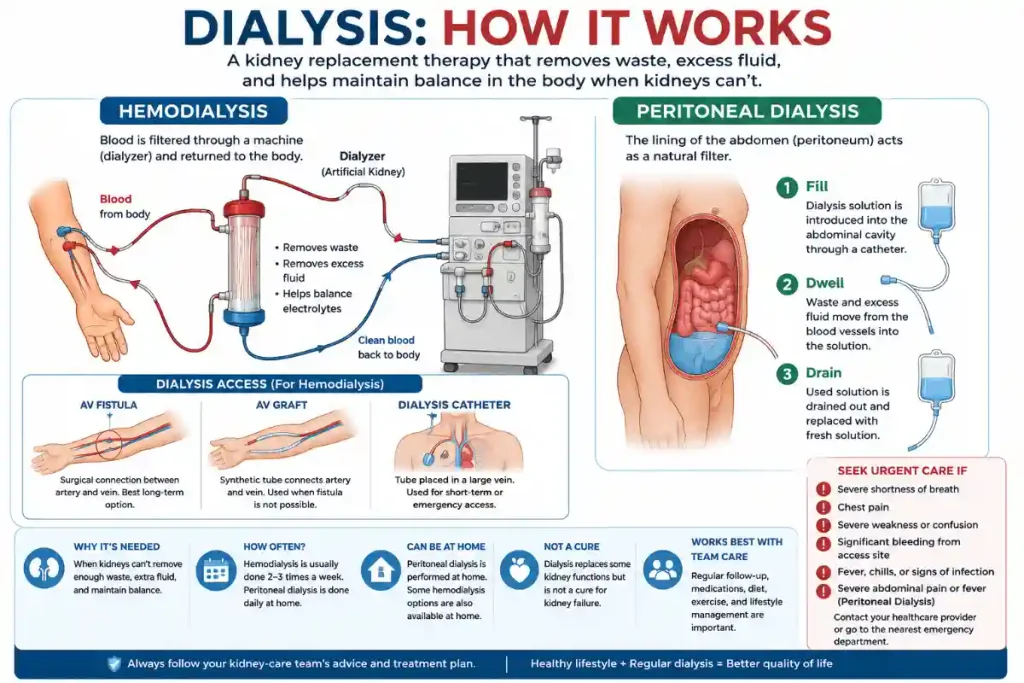
There are two main types of dialysis: hemodialysis and peritoneal dialysis. Both treatments remove waste products and excess fluid when the kidneys cannot do this adequately, but they use different methods.
Hemodialysis
Hemodialysis uses a dialysis machine and a special filter called a dialyzer to remove waste products and excess fluid from the blood. Blood is taken from the body through a dialysis access, passed through the dialyzer, and then returned to the body after filtration.
Hemodialysis may be performed in a dialysis center or, for some patients, at home. The treatment schedule and duration are individualized according to the patient’s medical needs and dialysis prescription.
Hemodialysis Access
Common vascular access options include an arteriovenous (AV) fistula, AV graft, or dialysis catheter. The healthcare team determines the most appropriate access based on the patient’s condition and treatment plan.
Peritoneal Dialysis
Peritoneal dialysis uses the lining of the abdomen, called the peritoneum, as a natural filtering membrane. A dialysis solution is introduced into the abdominal cavity through a catheter.
Waste products and excess fluid move from the blood across the peritoneum into the dialysis solution. The used solution is then drained and replaced with fresh solution according to the prescribed treatment schedule.
Peritoneal dialysis is generally performed at home after appropriate training. It can provide greater flexibility for some patients, although careful hygiene and catheter care are essential to reduce the risk of infection.
CAPD vs APD
Continuous Ambulatory Peritoneal Dialysis (CAPD) involves manual exchanges of dialysis solution, while Automated Peritoneal Dialysis (APD) uses a machine to perform exchanges, often during sleep.
Does Dialysis Replace the Kidneys Completely?
No. Dialysis does not completely replace all the functions of healthy kidneys. It mainly performs some of the kidneys’ filtering and fluid-regulating functions when the kidneys are no longer able to work adequately.
Healthy kidneys perform several important functions, including:
- Fluid and electrolyte regulation: Helping maintain the right balance of water, sodium, potassium, and other electrolytes.
- Acid-base balance: Helping maintain the body’s normal blood pH by regulating acids and bicarbonate.
- Waste removal: Filtering waste products and excess substances from the blood.
- Blood pressure regulation: Contributing to blood pressure control through fluid balance and hormone-related mechanisms.
- Erythropoietin production: Healthy kidneys produce erythropoietin, a hormone that helps stimulate red blood cell production.
- Vitamin D metabolism: Kidneys help convert vitamin D into its active form, which is important for calcium balance and bone health.
Dialysis mainly replaces the waste-filtering and some fluid and electrolyte-regulating functions of the kidneys. It does not fully replace the kidneys’ hormone-producing and metabolic functions. This is why people receiving long-term dialysis may also need medications, nutritional management, and regular monitoring.
When Should a Dialysis Patient Seek Urgent Medical Care?
People receiving dialysis should seek urgent medical attention if they develop symptoms that could indicate a serious complication. Do not attempt to diagnose or treat these symptoms yourself.
- Severe shortness of breath or significant difficulty breathing.
- Chest pain, pressure, or tightness, especially if sudden or severe.
- Severe weakness, fainting, or confusion that is unusual for the patient.
- Significant or uncontrolled bleeding from a hemodialysis fistula, graft, or catheter site.
- Signs of a serious infection, such as high fever, chills, worsening redness, swelling, or pus around a dialysis access site.
- Severe abdominal pain or fever during peritoneal dialysis, particularly when accompanied by cloudy or unusual dialysis fluid.
These symptoms can have different causes, but some may represent medical emergencies. If symptoms are severe, sudden, or rapidly worsening, seek emergency medical care immediately or contact your local emergency service. Patients should follow the emergency instructions provided by their dialysis or kidney-care team.
Important Questions About Dialysis
1. Why Is Dialysis Needed?
Dialysis may be needed when the kidneys can no longer remove enough waste, excess fluid, and electrolytes from the body.
2. Dialysis Access
Hemodialysis usually requires vascular access, such as an AV fistula, AV graft, or dialysis catheter, to allow blood to travel to and from the dialysis machine.
3. How Often Is Dialysis Needed?
The schedule depends on the dialysis type and the patient’s medical needs. Conventional in-center hemodialysis is commonly performed several times a week, while home and peritoneal dialysis schedules can differ.
4. Can Dialysis Be Temporary?
Yes. Dialysis can sometimes be temporary, particularly when kidney function may recover after certain episodes of acute kidney injury. In permanent kidney failure, long-term dialysis or another treatment option may be required.
5. Common Side Effects
Some people may experience fatigue, muscle cramps, dizziness, headache, nausea, or changes in blood pressure during or after dialysis.
6. Possible Complications
Complications depend on the type of dialysis and may include vascular-access problems, infection, bleeding, or peritoneal infection in people receiving peritoneal dialysis.
7. CAPD vs APD
CAPD involves manual exchanges of dialysis fluid during the day, while APD uses a machine to perform exchanges, often while the patient sleeps.
8. Dialysis and Kidney Transplant
A kidney transplant can provide more complete kidney function than dialysis when it is medically suitable. However, transplantation is not appropriate or immediately available for every patient.
9. What Can Dialysis Not Replace?
Dialysis does not completely reproduce all kidney functions, including the kidneys’ hormonal and metabolic roles. Patients may therefore need medicines, nutritional management, and regular monitoring.
10. Can Someone Work While on Dialysis?
Some people can continue working while receiving dialysis. Work ability depends on health, energy levels, treatment schedule, job demands, and the type of dialysis.
11. Can Dialysis Patients Exercise?
Many people receiving dialysis can benefit from appropriate physical activity. Exercise should be individualized and discussed with the patient’s healthcare team, particularly when there are other medical conditions.
Medical References & Sources
The medical information in this article has been reviewed against established kidney-health resources and clinical guidance. These sources provide additional information about dialysis, kidney failure, treatment options, and chronic kidney disease.
- National Institute of Diabetes and Digestive and Kidney Diseases (NIDDK) — Choosing a Treatment for Kidney Failure . Provides information on hemodialysis, peritoneal dialysis, kidney transplantation, conservative management, dialysis schedules, vascular access, and treatment decisions.
- NIDDK — Hemodialysis . Covers how hemodialysis filters blood, the dialyzer, treatment settings, vascular access, treatment schedules, and possible problems.
- NIDDK — Peritoneal Dialysis . Covers how the peritoneum functions as a filtering membrane, dialysis exchanges, CAPD, automated peritoneal dialysis, catheter use, and potential problems.
- National Kidney Foundation (NKF) — Hemodialysis: How It Works, Types, and What to Expect . Provides patient-focused information about hemodialysis, its purpose, treatment expectations, and the fact that dialysis replaces only part of normal kidney function.
- National Kidney Foundation (NKF) — Dialysis: Types, Effectiveness & Side Effects . Provides information about hemodialysis, peritoneal dialysis, vascular access, treatment schedules, and dialysis-related considerations.
- Kidney Disease: Improving Global Outcomes (KDIGO) — KDIGO 2024 Clinical Practice Guideline for the Evaluation and Management of Chronic Kidney Disease . Provides evidence-based clinical guidance for the evaluation and management of chronic kidney disease and preparation for kidney replacement therapy.
This article is intended for general health education and does not replace diagnosis, treatment or individualized advice from a nephrologist or other qualified healthcare professional. Dialysis treatment, diet, fluid intake, medicines and treatment frequency should be determined according to the individual patient’s medical condition and prescribed treatment plan.
Sources checked: August 29, 2026

Dr. Shabbir Hussain, BPT
Licensed Physiotherapist | Clinical Rehabilitation Specialist
Maharashtra OTPT Council Reg. No.: PR-2021/08/PT/009532
Society of Onco Physiotherapists Reg. No.: SOP/00033/LM
Dr. Shabbir Hussain, BPT, Registered Physiotherapist with over 8 years of experience in physiotherapy, kidney rehabilitation, oncological rehabilitation, and lymphedema management. He specializes in balance disorders, pain management, musculoskeletal rehabilitation, strengthening programs, and VR-based rehabilitation.