Published: August 27, 2026 · Updated: August 27, 2026 · Evidence reviewed: August 2026 · Reading time: 8 minutes
Does your knee feel weak when climbing stairs, standing from a chair or doing squats? The problem may not always be the knee itself. In some people, reduced hip and glute muscle strength can affect how the leg handles movement—but weak glutes are not the answer to every knee problem.
Your hip muscles—particularly the muscles that control the side and back of the hip—help control how your entire leg moves during weight-bearing activities. If that control is reduced, the knee may have to deal with movement demands differently.
However, there is an important correction to make before blaming your glutes: not every weak knee is caused by weak glute muscles.
Knee weakness can result from pain, quadriceps weakness, arthritis, injury, swelling, tendon problems, neurological conditions and other causes. The goal is not to find one muscle to blame. It is to identify what is actually limiting your function.
Quick Answer
Weakness in the hip muscles, including the gluteus medius and other posterolateral hip muscles, can be relevant in some people with knee pain and movement-control problems.
This is particularly important in conditions such as patellofemoral pain, where clinical guidelines support exercise programs that target both the hip and knee.
The practical message is simple:
Don’t automatically train only the knee. But don’t automatically blame the glutes either.
A proper rehabilitation plan should consider the entire lower limb.
What Does “My Knee Feels Weak” Actually Mean?
People use the word “weak” to describe several different sensations:
- The knee shakes during stairs or squats
- The leg feels unable to support body weight
- The knee feels unstable
- The knee suddenly gives way
- Pain makes the leg difficult to use
- The leg becomes tired quickly
- One side feels noticeably weaker than the other
These sensations do not all mean the same thing.
For example, a person with painful patellofemoral pain may avoid loading the leg properly because of pain. Another person may have reduced quadriceps strength after a knee injury. Someone else may have poor hip strength or reduced movement control during single-leg activities.
That is why “weak knee = weak glutes” is too simplistic.
How Can Weak Glute Muscles Affect the Knee?
The hip and knee do not work independently during walking, running, stair climbing or squatting.
During single-leg activities, the muscles around the hip help control the position of the pelvis and femur. The knee then functions below that moving thigh.
The gluteus medius is one of the muscles involved in controlling hip movement in the frontal plane. Other hip muscles also contribute to movement and stability.
If hip muscle capacity or control is reduced, some people may demonstrate altered lower-limb movement during demanding activities.
But this does not mean there is one perfect knee alignment or that every inward movement of the knee is dangerous.
Human movement varies. The clinically important question is whether a person’s movement pattern, symptoms and physical capacity are contributing to pain or functional limitation.
When Weak Hip Muscles May Be Relevant
Hip strength assessment may be particularly useful when knee symptoms occur during:
- Going up or down stairs
- Squatting
- Running
- Jumping and landing
- Repeated sit-to-stand movements
- Single-leg exercises
- Sports requiring cutting or direction changes
For people with patellofemoral pain, clinical practice guidelines recommend combined hip- and knee-targeted exercises to improve pain and function. Hip exercises in these programs commonly target the posterolateral hip musculature.
The key distinction is important:
Association does not always mean cause.
Weak hip muscles may be one contributing factor among several.
Common Signs Worth Assessing
Some patterns that may justify assessment of hip and lower-limb strength include:
- Knee pain during single-leg activities
- Difficulty controlling a step-down
- Pain with repeated stairs
- One leg tiring much faster than the other
- Difficulty maintaining control during a squat
- Reduced confidence during running or landing
- Noticeable side-to-side strength differences
These signs do not diagnose glute weakness by themselves.
A physiotherapist or appropriate clinician may assess strength, function, pain response, range of motion and task performance before designing treatment.
What Most People Get Wrong
Mistake 1: “All knee pain comes from the knee”
Not necessarily. The hip, ankle, foot, training load and overall physical capacity can all influence how the lower limb functions.
Mistake 2: “My glutes are weak, so that must be the cause”
Also not necessarily.
You can have weak hip muscles and no knee pain. You can also have strong glutes and still develop knee pain.
Mistake 3: “I only need clamshell exercises”
Clamshells may be included in some programs, but rehabilitation should not automatically be reduced to one exercise.
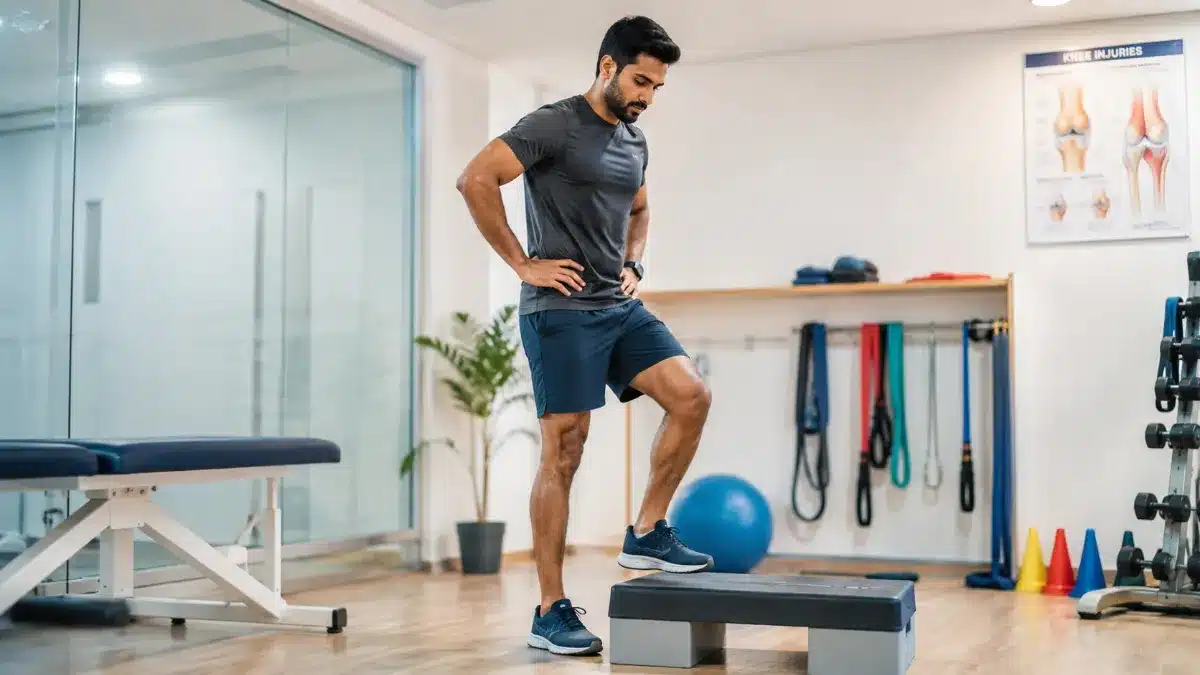
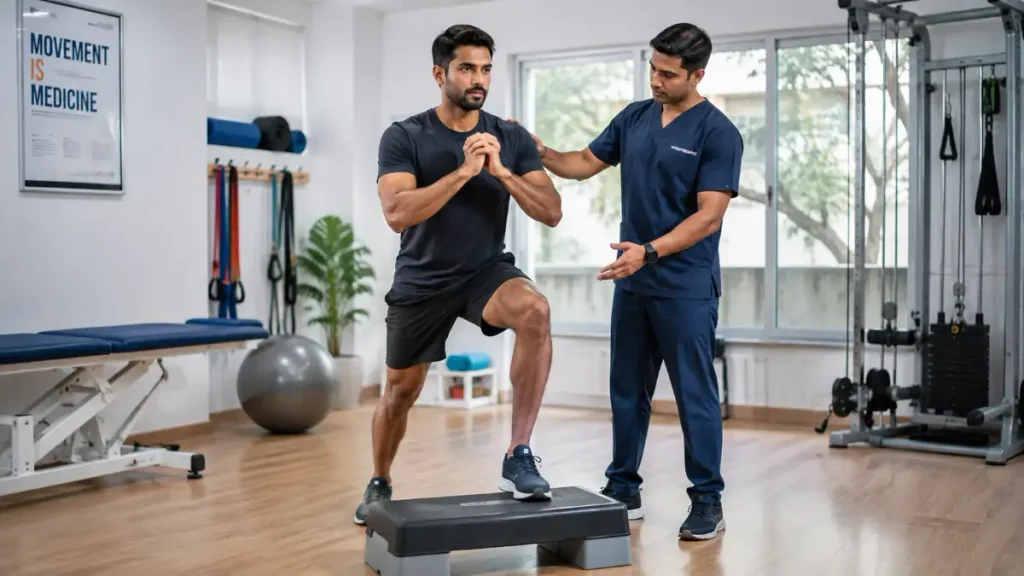
Functional strengthening may also involve appropriately selected exercises such as step-ups, squats, lunges, hip-focused movements and knee-strengthening exercises.
Mistake 4: “If my knee gives way, I should just strengthen it”
True mechanical instability, sudden repeated giving way, a major injury or a locked knee may require medical assessment.
Do not assume every episode of buckling is harmless muscle weakness.
Treatment: Why Hip and Knee Strength Often Work Better Together
If assessment suggests a strength or capacity deficit, rehabilitation may involve both hip and knee exercises.
Self-management principles
Depending on the condition:
- Avoid suddenly increasing painful activity volume
- Gradually build exercise tolerance
- Prioritize consistency over occasional intense workouts
- Allow adequate recovery
- Monitor whether symptoms are worsening over time
Professional rehabilitation
A physiotherapist may prescribe exercises based on:
- Pain location
- Diagnosis
- Strength deficits
- Functional goals
- Training demands
- Previous injury
- Tolerance to loading
For patellofemoral pain, combined hip- and knee-targeted exercise is supported by clinical guidelines.
Simple Exercises That May Be Used in Rehabilitation
| Exercise | Primary purpose | Stop/modify if |
|---|
| Side-lying hip abduction | Hip abductor strength | Sharp or worsening pain |
| Bridge | Hip extensor strength | Back/hip symptoms worsen |
| Step-up | Functional leg strength | Knee pain escalates significantly |
| Sit-to-stand | Progressive loading | Unable to control movement |
| Step-down | Eccentric control | Repeated buckling occurs |
Important precaution
Do not push through severe or rapidly worsening pain simply because an exercise is described as a “glute exercise” or “knee rehab exercise.”
Exercise selection and dosage matter.
Physiotherapy and Rehabilitation
Physiotherapy is relevant when knee symptoms involve reduced strength, impaired function, movement-related pain or recovery after injury.
Rehabilitation goals may include:
- Improving lower-limb strength
- Restoring confidence in movement
- Improving tolerance to stairs, walking or sport
- Progressively increasing load capacity
- Addressing meaningful side-to-side differences
- Returning safely to required daily or sporting activities
The best program is not necessarily the program with the largest number of exercises.
It is the one that targets relevant impairments and can be progressively advanced.
Myth vs Fact
| Myth | Fact |
|---|---|
| Every weak knee is caused by weak glutes | Knee weakness can have many causes |
| Clamshells fix all knee problems | Exercise should match the condition and functional deficit |
| Stronger glutes guarantee healthy knees | Strength is only one part of knee health |
| Knee exercises are enough for everyone | Some conditions benefit from combined hip and knee strengthening |
| Pain always means exercise is damaging | Pain response must be interpreted in clinical context |
Key Takeaways
- A weak-feeling knee is not automatically caused by weak glutes.
- Hip muscle strength can be relevant to some knee problems.
- The gluteus medius is only one part of a much larger lower-limb system.
- For patellofemoral pain, evidence supports combined hip- and knee-targeted exercise.
- Knee pain can itself reduce muscle performance and confidence.
- Sudden instability, major swelling, trauma or neurological symptoms require appropriate assessment.
Conclusion
Your knee does not function in isolation, and neither do your glutes.
If your knee repeatedly feels weak, painful or difficult to control, it may be worth looking beyond the knee—but not jumping to the conclusion that one weak muscle is responsible.
For many people, the most sensible approach is to assess the whole movement system, identify the actual cause of symptoms and progressively strengthen the areas that genuinely need attention.
The goal is not to find one muscle to blame. The goal is to restore comfortable, confident function safely.
FAQs
1. Can weak glutes cause knee pain?
Weak hip muscles may contribute to some forms of knee pain or impaired lower-limb control, but they are not the sole cause of knee pain. The underlying condition needs assessment.
2. Which glute muscle affects the knee the most?
The gluteus medius and other posterolateral hip muscles are commonly assessed in rehabilitation because they contribute to hip and pelvic control during weight-bearing activities.
3. Can strengthening glutes help knee pain?
It can help some people, particularly as part of a broader rehabilitation program. Evidence supports combined hip- and knee-targeted exercise for patellofemoral pain.
4. Why does my knee feel weak when going downstairs?
Pain, quadriceps weakness, reduced exercise tolerance, injury and some hip or movement-control deficits can all contribute. Persistent symptoms should be assessed.
5. Are clamshells enough to strengthen the glutes for knee pain?
Usually, no single exercise is enough for every person. A progressive program may need both hip- and knee-focused exercises.
Medical Disclaimer
This article is for general education and does not provide an individual diagnosis or replace an examination by a qualified healthcare professional. Knee pain, weakness or instability can have multiple causes. Seek appropriate medical assessment for severe symptoms, major injury, significant swelling, fever with a hot joint, inability to bear weight, sudden numbness or major weakness.
References
Clinical Guideline
- Willy RW, Hoglund LT, Barton CJ, et al. Patellofemoral Pain: Clinical Practice Guidelines Linked to the International Classification of Functioning, Disability and Health From the Academy of Orthopaedic Physical Therapy of the American Physical Therapy Association. Journal of Orthopaedic & Sports Physical Therapy. 2019;49(9):CPG1–CPG95. doi:10.2519/jospt.2019.0302
Clinical guideline:
JOSPT Patellofemoral Pain Clinical Practice Guideline

Dr. Shabbir Hussain, BPT
Licensed Physiotherapist | Clinical Rehabilitation Specialist
Maharashtra OTPT Council Reg. No.: PR-2021/08/PT/009532
Society of Onco Physiotherapists Reg. No.: SOP/00033/LM
Dr. Shabbir Hussain, BPT, Registered Physiotherapist with over 8 years of experience in physiotherapy, kidney rehabilitation, oncological rehabilitation, and lymphedema management. He specializes in balance disorders, pain management, musculoskeletal rehabilitation, strengthening programs, and VR-based rehabilitation.