
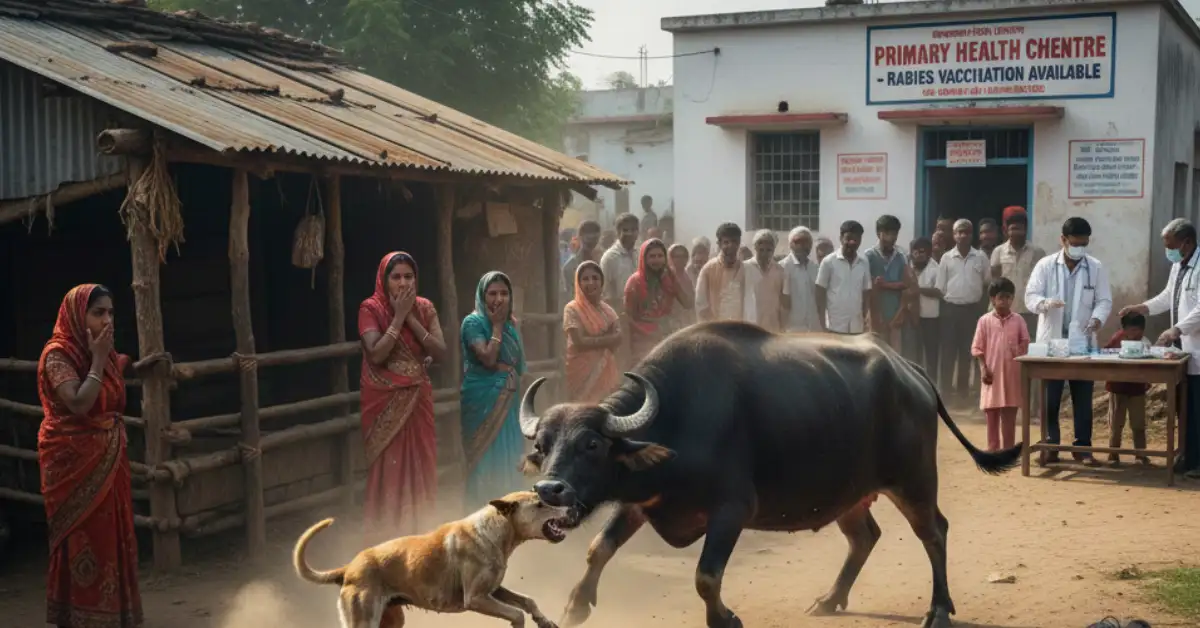
Buffalo Bitten by Rabid Dog Triggers Vaccination Drive – A recent incident in Budaun, India, has raised concerns about the spread of rabies, a deadly disease transmitted through the saliva of infected animals. A buffalo was bitten by a rabid dog, prompting local authorities to launch a massive vaccination drive.

The vaccination campaign aims to inoculate not only the livestock but also people who have come into contact with the infected buffalo. As the situation unfolds, concerns about the safety of unboiled milk have been raised, and the public is being advised to exercise caution.
Key Takeaways
- The incident in Budaun has triggered a massive vaccination drive to prevent the spread of rabies.
- Local authorities are working to inoculate livestock and people who have come into contact with the infected buffalo.
- The public is being advised to exercise caution regarding the consumption of unboiled milk.
- The vaccination campaign is a proactive measure to contain the spread of the disease.
- The incident highlights the importance of timely intervention in preventing the spread of rabies.
Buffalo Attack by Rabid Dog Sparks Health Alarm in Budaun
A health scare has erupted in Budaun after a rabid dog attacked a local buffalo. The incident has prompted immediate action from local health authorities, who are working to contain the spread of rabies.
Details of the Incident
The attack occurred when a dog, later confirmed to be infected with rabies, bit a buffalo. The buffalo was immediately quarantined, and a thorough investigation was launched to identify anyone who may have come into contact with the infected dog or buffalo.
Rabies transmission in animals is a significant concern, and the local veterinary team is working closely with health officials to monitor the situation closely. The dog was exhibiting symptoms of rabies in dogs, including aggression and foaming at the mouth, before it attacked the buffalo.
Identifying Rabid Dog Behavior
Understanding rabid dog behavior is crucial in preventing the spread of the disease. Rabid dogs often display unusual behavior, such as increased aggression, confusion, and a tendency to bite or attack animals or humans. Recognizing these signs early can help prevent further incidents.
| Behavior | Description |
|---|---|
| Aggression | Increased tendency to bite or attack |
| Foaming at the Mouth | A characteristic sign of rabies infection |
| Confusion | Disorientation and unusual behavior |
Initial Response from Local Authorities
The local authorities responded quickly to the incident, dispatching a team to investigate and contain the situation. Individuals who may have been exposed to the rabid dog or the buffalo are being identified and provided with post-exposure prophylaxis (PEP) as a precautionary measure.
The public is advised to be cautious and report any rabid dog danger signs to the authorities immediately. The situation is being closely monitored, and further actions are being taken to prevent the spread of rabies in the area.
For rabies testing in dogs, samples are being sent to a nearby laboratory for confirmation. The community is being educated on the risks and the necessary precautions to take.
Milk Contamination Fears and Public Health Response
As news spread of a buffalo being bitten by a rabid dog, local authorities quickly moved to address fears of rabies transmission through milk. The incident has raised significant concerns about the potential risks associated with consuming unboiled milk.
Can Rabies Transmit Through Unboiled Milk?
The risk of rabies transmission through unboiled milk is considered low, but not entirely negligible. Rabies virus is primarily spread through the saliva of infected animals, usually through bites. However, the possibility of transmission through contaminated milk cannot be ruled out entirely, especially if the milk is not boiled or pasteurized.
Boiling milk is a simple yet effective method to kill viruses, including rabies. The public has been advised to avoid consuming unboiled milk until the situation is fully under control.
Mass Vaccination Drive Implementation
In response to the incident, a mass vaccination drive has been implemented to protect against rabies. The drive aims to inoculate individuals who have come into contact with the infected buffalo or are at risk of exposure.
Post-Exposure Prophylaxis (PEP) Distribution
As part of the public health response, Post-Exposure Prophylaxis (PEP) is being distributed to individuals who have been exposed to the rabid dog or the infected buffalo. PEP includes immediate washing of the wound, administration of rabies immunoglobulin, and a series of vaccinations.
| Component | Description | Importance |
|---|---|---|
| Immediate Wound Washing | Washing the wound with soap and water | High |
| Rabies Immunoglobulin | Provides immediate antibodies against rabies | High |
| Vaccination Series | A series of vaccinations to build immunity | Critical |
WHO Guidelines on Rabies Management
The World Health Organization (WHO) provides guidelines on rabies management, emphasizing the importance of prompt medical attention in case of exposure. According to WHO guidelines, individuals exposed to rabies should receive PEP as soon as possible.

The public health response in this incident aligns with these guidelines, ensuring that those at risk receive appropriate care.
Preventing Future Rabies Outbreaks
To prevent future rabies outbreaks, local authorities in Budaun are strengthening their animal control measures. This includes implementing vaccination programs for dogs and other animals, ensuring they receive timely rabies treatment for dogs.
Pet owners are being advised on how to prevent rabies in pets by vaccinating their animals against rabies and taking precautions to prevent contact with potentially infected wildlife. The rabies vaccine for dogs is crucial in preventing the spread of the disease.
By educating the public on the risks associated with rabies and the measures being taken for rabies prevention, the community is coming together to protect both human and animal health. Effective rabies prevention strategies are being put in place to safeguard livestock from rabies in livestock, thereby reducing the risk of transmission.
The collaborative effort aims to create a safer environment by promoting awareness and proactive measures, ultimately preventing future rabies outbreaks.
FAQ
What are the symptoms of rabies in dogs?
Rabid dogs often exhibit unusual behavior, such as foaming at the mouth, aggression, and a loss of coordination. If you suspect a dog has rabies, it’s essential to contact local animal control or a healthcare professional immediately.
Can rabies be transmitted through unboiled milk?
While the risk is considered low, the authorities have taken precautions to advise against consuming unboiled milk due to the potential transmission of rabies. It’s always best to consume boiled or pasteurized milk to minimize the risk.
What is post-exposure prophylaxis (PEP), and how is it administered?
Post-exposure prophylaxis (PEP) is a treatment given to individuals who have been exposed to rabies to prevent the development of the disease. PEP typically consists of a series of injections with rabies immune globulin and a rabies vaccine, administered as soon as possible after exposure.
How can I prevent rabies in my pets?
To prevent rabies in your pets, ensure they are up-to-date on their rabies vaccinations. Additionally, take precautions to prevent your pets from coming into contact with potentially infected wildlife, such as keeping them indoors or on a leash.
What are the WHO guidelines on rabies management?
The World Health Organization (WHO) guidelines on rabies management emphasize the importance of prompt medical attention in case of exposure, including immediate washing of the wound, administration of PEP, and vaccination of animals to prevent the spread of the disease.
How effective is mass vaccination in preventing rabies outbreaks?
Mass vaccination drives are highly effective in preventing rabies outbreaks by vaccinating a large percentage of the animal population, thereby reducing the risk of transmission to humans and other animals.
What should I do if I’m bitten by a dog that may have rabies?
If you’re bitten by a dog that may have rabies, immediately wash the wound with soap and water, and seek medical attention. Report the incident to local animal control or a healthcare professional, who will assess the risk of rabies transmission and provide guidance on PEP if necessary.
References
- World Health Organization. (2024, June 5). Rabies — Key facts. World Health Organization. https://www.who.int/news-room/fact-sheets/detail/rabies. World Health Organization
- Centers for Disease Control and Prevention. (2025, July 15). Rabies: Post-Exposure Prophylaxis (PEP) — Clinical guidance. CDC. https://www.cdc.gov/rabies/hcp/clinical-care/post-exposure-prophylaxis.html. CDC
- Centers for Disease Control and Prevention. (1999). Mass treatment of persons who drank unpasteurized milk from rabid cows — Massachusetts, 1996–1998. MMWR. https://www.cdc.gov/mmwr/preview/mmwrhtml/00056759.htm. CDC
- Dutta, J. K. (1996). Oral transmission of rabies in cow: milk consumers protected by immunisation. Journal of the Association of Physicians of India, 44(8), 584. (PubMed). https://pubmed.ncbi.nlm.nih.gov/9251441/. PubMed
- National Centre for Disease Control (India). (2019; updated 2025). National guidelines for rabies prophylaxis (PDF). NCDC / Ministry of Health and Family Welfare. https://ncdc.mohfw.gov.in/wp-content/uploads/2025/06/Rabies-Guidelines.pdf. National Centre for Disease Control
- India Today. (2025, Dec 29). Rabid dog bites buffalo in UP, villagers who consumed milk rush for vaccination. India Today. https://www.indiatoday.in/india/story/rabid-dog-bites-buffalo-budaun-uttar-pradesh-rabies-vaccination-milk-raita-2843136-2025-12-29. India Today

Dr. Shabbir Hussain, BPT
Registered Physiotherapist | Clinical Rehabilitation Specialist
Maharashtra OTPT Council Reg. No.: PR-2021/08/PT/009532
Society of Onco Physiotherapists Reg. No.: SOP/00033/LM
Dr. Shabbir Hussain, BPT, Registered Physiotherapist with over 8 years of experience in physiotherapy, kidney rehabilitation, oncological rehabilitation, and lymphedema management. He specializes in balance disorders, pain management, musculoskeletal rehabilitation, strengthening programs, and VR-based rehabilitation.