
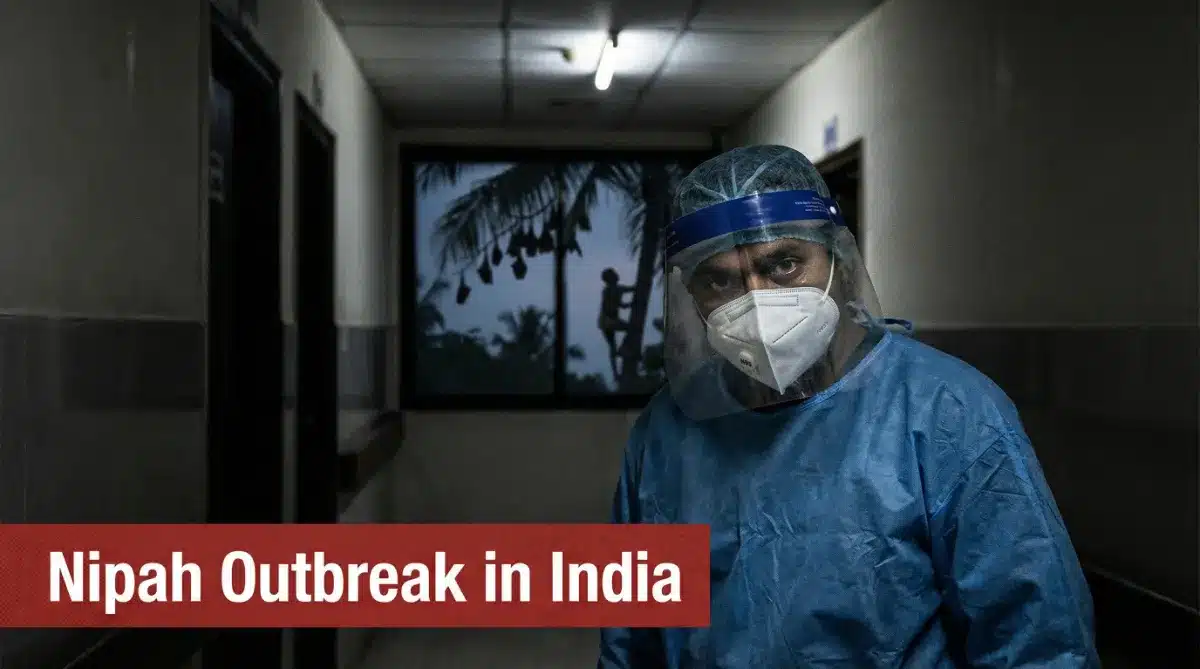
How Deadly Is Nipah in India? – Nipah virus (NiV) is not just another headline — it’s a high-fatality zoonotic virus that has repeatedly sparked deadly, fast-moving clusters in India.
Recent cases detected in West Bengal show how quickly hospitals and communities can be overwhelmed. If we fail to act now, small spillovers from bats could become a large, avoidable crisis.
What Nipah is ?
Nipah is a bat-borne paramyxovirus that can cause acute respiratory illness and fatal encephalitis.
Symptoms typically appear 3–14 days after exposure and can escalate rapidly to brain inflammation and coma.
Case-fatality rates in past Indian outbreaks have ranged very high (tens of percent to over 70% depending on the outbreak and clinical response). Early detection and strict infection control are essential.
Why this is worse than it looks
Two features make NiV especially dangerous:
- High fatality — many outbreaks show very high death rates when diagnosis or isolation is delayed.
- Nosocomial (hospital) spread — health-care associated transmission has amplified past outbreaks in India, turning single cases into dozens of infections. That means a single missed case in an emergency room can seed a deadly chain.
The proven prevention plan — seven immediate actions (strong solution)
These are practical, evidence-based steps public health authorities, hospitals and communities must implement now:
- Active surveillance & rapid testing — test suspected encephalitis/respiratory cases for NiV by RT-PCR and isolate until results return. (NIV / NCDC protocols recommended).
- Strict PPE & cohorting of patients — enforce airborne/droplet precautions for suspected cases and dedicate single-room isolation; retrain staff on don/doff. Hospital outbreaks in India were curtailed only after strict infection control.
- Ban raw date-palm sap and reduce bat–human contact — public advisories and physical sap-covering methods reduce bat contamination (proven in Bangladesh and India). Community education must start immediately.
- Protect health-workers — expedited vaccination trials aside, immediate measures are PPE, early reporting, and limiting staff exposure. Support healthcare workers with hazard pay and rest rosters to reduce errors.
- Contact tracing with 21-day monitoring — trace all contacts and monitor symptoms for 21 days (incubation typically 4–14 days; longer intervals reported). Rapid quarantine of symptomatic contacts is essential.
- Targeted bat surveillance and environmental controls — test bat roosts near case locations; restrict human access to bat roosting sites and educate on safe fruit handling.
- National coordination + public transparency — a single, public dashboard and daily briefings build trust and speed response (WHO guidance: technical support and coordinated response).
What clinicians must do
- Suspect NiV in acute encephalitis or severe respiratory illness with bat/date-palm exposure or contact with a known case.
- Isolate, use full PPE, notify public health, collect blood/CSF/nasal swabs for RT-PCR.
- Provide supportive intensive care; there is no widely-approved specific antiviral—clinical care is the mainstay.
What the public can do
- Don’t drink raw date-palm sap or eat fruit with bite marks.
- Avoid areas where fruit bats roost, cover stored food, wash hands frequently, and seek care early for fever + neurological or respiratory symptoms.
Conclusion – How Deadly Is Nipah in India?
Small, immediate actions save lives. With fast testing, strict infection control and community measures, we can stop Nipah from turning local cases into a national emergency. If you run a clinic or a community program, adopt the seven-step plan today and demand clear public reporting from health authorities.
This article is published for educational and informational purposes only and is not intended as a substitute for professional medical advice, diagnosis, or treatment.
The information provided is based on publicly available guidance from authoritative medical sources such as the World Health Organization (WHO), Centers for Disease Control and Prevention (CDC), and peer-reviewed medical literature.
Always seek the advice of a qualified physician or other licensed healthcare provider with any questions you may have regarding a medical condition. Never disregard professional medical advice or delay seeking it because of something you have read on this website.
If you suspect symptoms related to Nipah virus infection or any medical emergency, contact local health authorities or emergency medical services immediately.
FAQ
Q. What are the early symptoms of Nipah virus infection?
A. Early symptoms of Nipah virus infection may include fever, headache, muscle pain, sore throat, vomiting, and general weakness. In some cases, respiratory symptoms such as cough or shortness of breath may appear. Symptoms can progress rapidly and require urgent medical evaluation.
Q. What are the severe symptoms of Nipah virus?
A. Severe Nipah virus infection can lead to encephalitis (brain inflammation), drowsiness, confusion, seizures, coma, and acute respiratory distress. These complications can be life-threatening and require immediate hospital care.
Q. How does Nipah virus spread to humans?
A. Nipah virus can spread to humans through contact with infected fruit bats, consumption of food contaminated by bats (such as raw date palm sap), contact with infected animals, or close contact with an infected person, especially in healthcare settings.
Q. How can Nipah virus infection be prevented?
A. Prevention of Nipah virus infection includes avoiding consumption of raw date palm sap, washing fruits thoroughly, avoiding contact with fruit bats and sick animals, practicing good hand hygiene, and following infection-control measures in healthcare settings as recommended by health authorities.
References
World Health Organization. (2018, May 30). Nipah virus (Fact sheet). WHO. https://www.who.int/news-room/fact-sheets/detail/nipah-virus
Centers for Disease Control and Prevention. (2024, March 25). Nipah virus: Facts for clinicians (clinical overview). CDC. https://www.cdc.gov/nipah-virus/hcp/clinical-overview/index.html
National Centre for Disease Control (India). (2023). CD Alert — Nipah Virus Disease (PDF). NCDC, Ministry of Health and Family Welfare. https://ncdc.mohfw.gov.in/wp-content/uploads/2024/04/CD-Alert-Nipah-Virus-Disease.pdf
Veggalam, S. (2025). Nipah Virus Outbreaks in India: A Comprehensive Update. Journal / PMC. https://pmc.ncbi.nlm.nih.gov/articles/PMC12529219/
Hassan, M. Z., et al. (2025). Improving clinical care of patients in Nipah outbreaks. PMC. https://pmc.ncbi.nlm.nih.gov/articles/PMC11755010/
Economic Times (2026). Nipah virus outbreak: 100 people quarantined in West Bengal… (news report). https://m.economictimes.com/news/new-updates/nipah-virus-outbreak-100-people-quarantined-in-west-bengal-to-contain-deadly-zoonotic-virus-with-high-fatality-check-signs-symptoms-and-treatment/articleshow/127254288.cms

Dr. Shabbir Hussain, BPT
Registered Physiotherapist | Clinical Rehabilitation Specialist
Maharashtra OTPT Council Reg. No.: PR-2021/08/PT/009532
Society of Onco Physiotherapists Reg. No.: SOP/00033/LM
Dr. Shabbir Hussain, BPT, Registered Physiotherapist with over 8 years of experience in physiotherapy, kidney rehabilitation, oncological rehabilitation, and lymphedema management. He specializes in balance disorders, pain management, musculoskeletal rehabilitation, strengthening programs, and VR-based rehabilitation.