
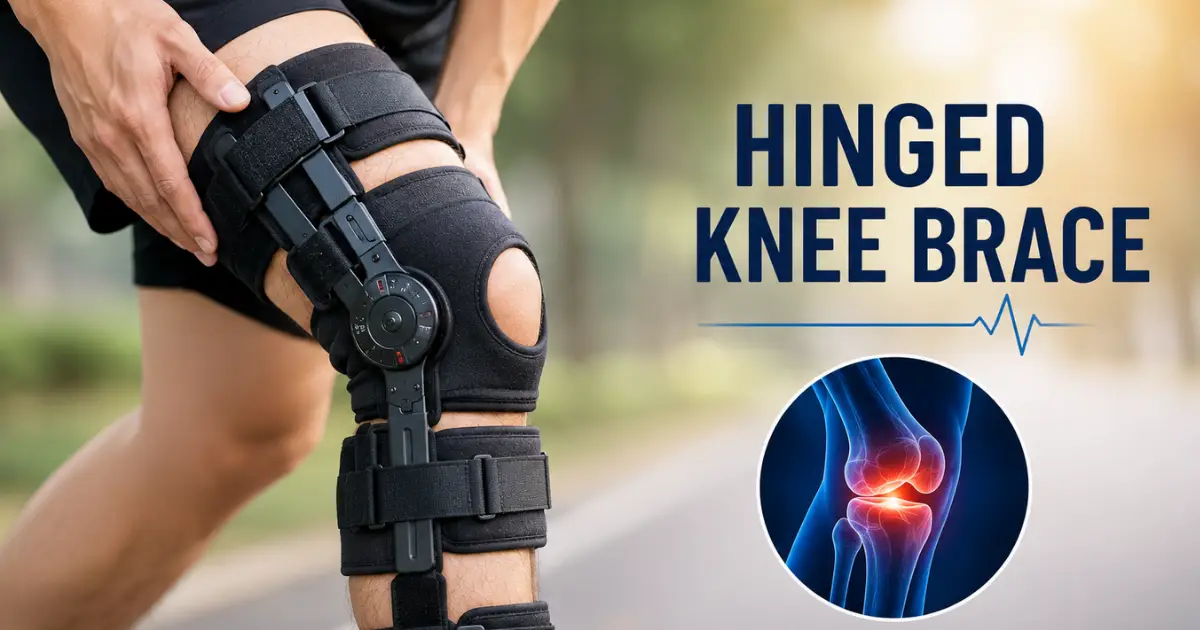

A hinged knee brace is a type of orthopedic device designed to provide support and stability to the knee joint.
It consists of a rigid frame with hinges that allow for controlled movement of the knee while limiting certain motions that may be harmful or painful.
A recent rise in sports-related ACL injuries has increased the use of hinged knee braces among athletes.
📌 Key Takeaways
- ✔ Hinged knee braces provide extra stability for knees affected by ligament injuries such as ACL and MCL tears.
- ✔ They are commonly recommended after knee surgery, during rehabilitation, or for people with chronic knee instability.
- ✔ Not every knee pain requires a hinged brace. Minor muscle strains or simple knee soreness often improve with appropriate exercise and physiotherapy.
- ✔ Long-term brace use without professional guidance may reduce muscle strength and delay natural knee stability.
- ✔ The best recovery usually comes from combining brace use with physiotherapy, strengthening exercises, and medical advice.
Should You Use a Hinged Knee Brace?
✔ ACL or MCL injury
✔ Knee feels unstable while walking
✔ Recovering after knee surgery
✔ Playing contact sports with doctor’s advice
❌ Not for every knee pain
Always consult a physiotherapist or orthopedic specialist before prolonged use.
How to Choose the Best Hinged Knee Brace
Amazing Key features and benefits of this Brace :
Support and stability:
The primary purpose of a hinged knee brace is to provide support and stability to the knee joint.
It helps stabilize the knee, preventing excessive side-to-side or forward-backward movements that can cause further injury or discomfort.
Post-injury recovery:
Hinged knee braces are commonly used during the rehabilitation process following knee injuries, such as ligament tears (e.g., ACL, MCL) or meniscus injuries.
The brace helps protect the injured structures and promotes healing by reducing stress on the knee joint.
Protection during physical activity:
Athletes or individuals involved in sports activities often use hinged knee braces to protect their knees from potential injuries.
The brace can help prevent excessive twisting or hyperextension of the knee during movements, reducing the risk of damage to the ligaments, cartilage or other structures.
Adjustable range of motion:
Hinged knee braces typically have adjustable hinges that allow for controlled and limited movement of the knee joint.
Depending on the specific needs of the wearer, the brace can be set to restrict certain motions while allowing for a desired range of motion, such as flexion and extension.
Pain relief:
For individuals with knee conditions, such as osteoarthritis or patellar instability, a knee brace can provide pain relief.
By providing support and distributing forces evenly across the knee joint, the brace can help alleviate pain and discomfort associated with these conditions.
It’s important to note that the use of a hinged knee brace should be based on the recommendation of a healthcare professional, such as a doctor or physical therapist.
They can evaluate your specific condition or injury and advise you on the appropriate type of brace and its usage.
When to use hinge knee Brace
A hinged knee brace is typically used in the following situations:
Knee injuries:
Hinged knee braces are commonly recommended for individuals who have sustained knee injuries
such as ligament tears (e.g., ACL, MCL), meniscus tears or patellar dislocations.
These braces provide support and stability to the injured knee, promoting healing and preventing further damage.
Post-surgical recovery: hinge knee Brace
After knee surgery, such as ACL reconstruction or meniscus repair
A hinged knee brace may be prescribed to protect the surgical site and assist in the rehabilitation process.
The brace helps control and limit the range of motion during the initial stages of recovery.
Ligament instability:
People with chronic or recurring knee ligament instability, such as chronic ACL laxity, may benefit from a hinged knee brace.
The brace provides additional support and stability to the knee joint, reducing the risk of further ligamentous injuries and improving overall joint function.
Osteoarthritis:
Individuals with knee osteoarthritis, a degenerative condition that causes joint pain and stiffness may find relief by using a hinged knee brace.
The brace can help offload the affected knee compartment, reduce joint compression and provide stability during weight-bearing activities.
Sports activities:
Athletes involved in high-impact or contact sports, such as football, basketball or skiing, may use hinged knee braces as a preventive measure.
The brace helps protect the knee joint from excessive forces and reduces the risk of ligamentous injuries or meniscal tears.
It is important to note that the decision to use a hinged knee brace should be made in consultation with a healthcare professional.
They can evaluate your specific condition, assess your needs and determine
whether a hinged knee brace is appropriate for your situation.
They can also provide guidance on the proper fit, usage, and duration of brace wear.
Seek Medical Care Immediately If:
- Unable to bear weight
- Severe swelling within hours
- Knee locks completely
- Visible deformity
- Fever with knee pain
My Experience Using Hinged Knee Braces in Physiotherapy Practice
Over the years, I have recommended hinged knee braces for patients recovering from ACL injuries, MCL sprains, meniscus injuries, and knee instability. In properly selected cases, these braces help improve confidence during walking, rehabilitation exercises, and return-to-sport activities.
What to Look for in a Hinged Knee Brace
Agaro is primarily known as an Indian brand that offers a range of healthcare and personal care products, including knee braces.
However, it’s worth mentioning that the best hinged knee brace brand can vary depending on individual preferences, needs and factors such as budget and availability.
When choosing a hinged knee brace, it’s important to consider factors
such as quality, durability, comfort, fit and any specific features or requirements you may have.
It’s often beneficial to consult with a healthcare professional, such as a doctor or physical therapist
who can guide you in selecting the most suitable brace for your specific condition or injury.
Additionally, conducting independent research and reading customer reviews can provide insights into the performance and reputation of different brands.
It is recommended to explore multiple brands and compare their offerings before making a purchase decision.
Recovery Timeline
Week 1–2 → Pain & swelling control
Week 3–6 → Strengthening exercises
Week 6–12 → Return to daily activities
3–9 Months → Return to sports (depending on injury)
The latest evidence on post-surgical bracing — a 2025 meta-analysis
A systematic review and meta-analysis published in Knee Surgery, Sports Traumatology, Arthroscopy (September 2025) examined the effect of post-operative bracing on function, pain, strength, and stability after ACL reconstruction across multiple randomised controlled trials.
The findings were significant: routine bracing after ACL reconstruction did not produce measurable improvements in any of those outcomes compared to no brace. Notably, mid-to-long-term follow-up data (two to five years post-surgery) slightly favoured the non-bracing group.
What this means for you: post-operative bracing remains appropriate in specific protocols (for example, where the surgeon needs to control range of motion in the first few weeks), but wearing a brace routinely for months after ACL reconstruction is not supported by current evidence.
Always follow your surgeon’s personalised discharge instructions rather than assuming a brace is required long-term.
📊 Research Highlights
- 2025 Meta-analysis reviewed multiple randomized trials.
- Routine long-term bracing after ACL surgery showed no significant improvement.
- Short-term bracing may still be useful when prescribed by surgeons.
- Evidence supports individualized rehabilitation rather than routine brace use.
A hinged knee brace can provide valuable support after ligament injuries, knee surgery, or chronic instability. However, it works best when combined with an accurate diagnosis, strengthening exercises, and a structured physiotherapy program. Long-term use without professional guidance is generally not recommended.
Frequently asked questions
What is a hinged knee brace and how does it work?
A hinged knee brace is an orthopedic support device with rigid side bars and metal or polycentric hinges on either side of the knee joint. The hinges mirror the natural movement of the knee — allowing controlled flexion and extension — while limiting side-to-side and rotational forces that can damage ligaments or cartilage.
The frame distributes load away from injured structures, reduces pain, and protects the joint during activity or recovery.
Who should wear a hinged knee brace?
A hinged knee brace is suitable for people who have sustained ligament injuries (ACL, MCL, PCL, or LCL tears), undergone knee surgery such as ACL reconstruction or meniscus repair, experience chronic ligament instability, have moderate-to-severe knee osteoarthritis, or play high-contact sports that put repeated stress on the knee.
What is the difference between a hinged knee brace and a regular knee support?
A regular (sleeve-type) knee support is soft and compressive — it reduces swelling and provides mild proprioceptive feedback, but offers little structural protection. A hinged knee brace has rigid hinges and frame bars that physically limit harmful movement ranges. It is prescribed for structural injuries where passive compression is insufficient — for example, after an ACL tear or knee surgery.
How long should I wear a hinged knee brace each day?
Duration depends on your condition and the rehabilitation phase. During early post-surgical recovery, a brace may need to be worn almost continuously (including at night, in some protocols).
For sports or activity-based use, it is typically worn only during the activity. Most physiotherapists progressively wean patients off bracing as strength and stability return — usually over 6–12 weeks post-surgery. Wearing a brace longer than prescribed can weaken the surrounding muscles.
Can I sleep with a hinged knee brace on?
In certain post-operative protocols — particularly after ACL reconstruction — a surgeon may instruct you to wear the brace at night in the early weeks to prevent accidental hyperextension.
Outside of this specific scenario, sleeping with the brace is generally not recommended as it can cause skin irritation, restrict circulation, and disrupt sleep quality. Follow your surgeon’s or physiotherapist’s specific guidance.
How We Reviewed This Article
At Physio Talk, we follow an evidence-based review process to ensure our medical content is accurate, balanced, and helpful.
- ✔ Reviewed by a licensed physiotherapist with over 8 years of clinical rehabilitation experience.
- ✔ Updated using peer-reviewed research, including recent evidence published through 2025.
- ✔ Compared with recommendations from recognized orthopedic and musculoskeletal health organizations, where applicable.
- ✔ Reviewed for medical accuracy, clarity, and patient safety before publication and during content updates.
Our Editorial Commitment: We regularly review and update our health articles to reflect the latest scientific evidence and current physiotherapy best practices.
Evidence-Based References
This article is based on current physiotherapy practice and supported by guidance from internationally recognized medical organizations.
-
PubMed – National Library of Medicine
Peer-reviewed research on ACL injuries, knee braces, rehabilitation, and sports medicine. -
American Academy of Orthopaedic Surgeons (AAOS)
Evidence-based information on knee ligament injuries, ACL tears, meniscus injuries, and rehabilitation. -
National Institute of Arthritis and Musculoskeletal and Skin Diseases (NIAMS)
Trusted patient education covering knee anatomy, osteoarthritis, ligament injuries, and musculoskeletal health.
Our Commitment: All medical content published on Physio Talk is reviewed by a licensed physiotherapist and updated regularly using the latest available scientific evidence.
Dr. Shabbir Hussain, BPT
Licensed Physiotherapist | Clinical Rehabilitation Specialist
Maharashtra OTPT Council Reg. No.: PR-2021/08/PT/009532
Society of Onco Physiotherapists Reg. No.: SOP/00033/LM
Dr. Shabbir Hussain, BPT, Registered Physiotherapist with over 8 years of experience in physiotherapy, kidney rehabilitation, oncological rehabilitation, and lymphedema management. He specializes in balance disorders, pain management, musculoskeletal rehabilitation, strengthening programs, and VR-based rehabilitation.