Medically Reviewed By:
Dr. Shabbir Hussain Bohra, BPT
Last Updated: 19, May 2026
Your skull does much more than protect your brain.
It helps you breathe, chew, speak and even protects delicate nerves and blood vessels every second of your life.
In this guide, we’ll break down skull anatomy in a simple way — including skull bones, functions, structure, and surprising medical facts most people never learn.
Skull Anatomy: Structure and Function – The human skull, a complex and remarkable structure, serves as both a protective casing for the brain and a defining characteristic of our species.
Comprising a harmonious blend of strength and elegance, the skull’s anatomy offers a fascinating glimpse into the intricate interplay of bones, sutures, and various features that define its form and function.
🧠 Skull Anatomy Quick Facts
- The adult human skull contains 22 bones.
- The skull protects the brain and sensory organs.
- It supports facial structure and jaw movement.
- The cranium and facial bones form the skull.
- Some skull bones are connected by sutures.
Cranial Bones and Sutures
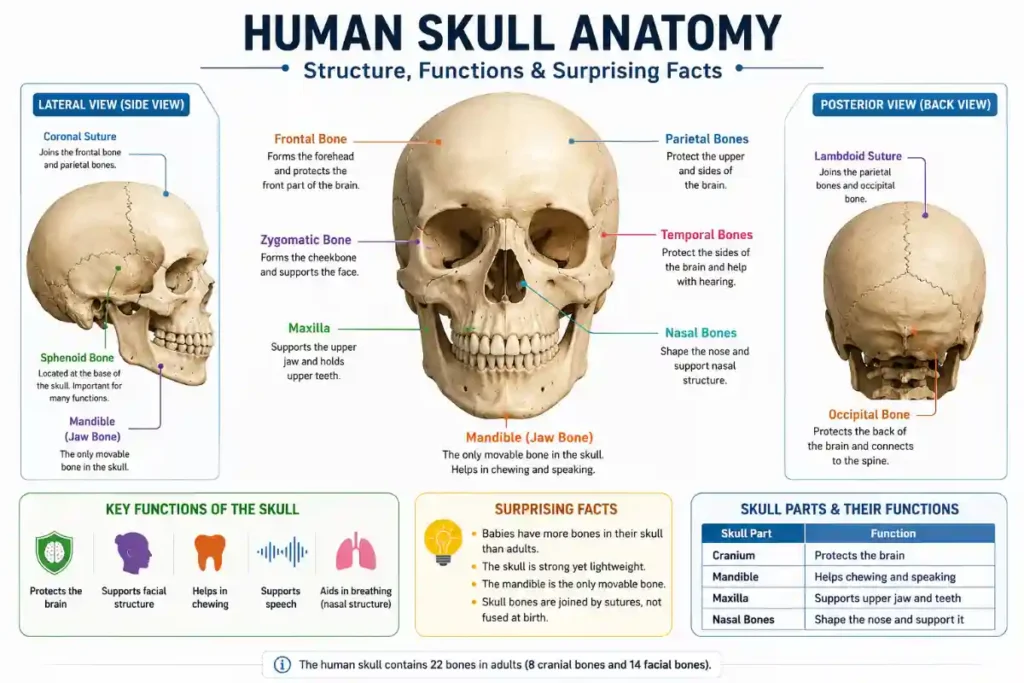
The skull is composed of two main parts: the cranium, which encloses the brain, and the facial skeleton.
The cranium is further divided into several bones that are connected by sutures – immovable fibrous joints.
The frontal bone forms the forehead, while the parietal bones comprise much of the cranium’s upper sides.
The temporal bones house the ears and are situated on the sides of the skull. Lastly, the occipital bone forms the rear of the skull.
These bones are intricately connected by sutures that provide stability and protection to the brain.
The coronal suture joins the frontal and parietal bones at the front of the skull, while the sagittal suture connects the parietal bones along the midline.
The lambdoid suture joins the parietal bones with the occipital bone at the back.
These sutures play a vital role during infancy and early childhood, allowing for the expansion of the skull as the brain grows.
Facial Skeleton and Foramina
The facial skeleton is a composite of bones that give shape and support to the face.
These include the nasal bones, which form the bridge of the nose, and the maxilla, the upper jawbone that houses the upper teeth.
The mandible, or lower jawbone, is the only moveable bone in the skull and facilitates essential functions such as eating and speaking.
An intriguing aspect of the skull’s anatomy is the presence of foramina – openings in the bones that allow passage for nerves, blood vessels, and other structures.
The foramen magnum, located in the occipital bone, serves as the gateway for the spinal cord to connect with the brain.
Another notable foramen is the optic foramen, through which the optic nerve travels from the eye to the brain.
Brain Protection and Evolutionary Significance
The primary function of the skull is to safeguard the delicate brain from injury.
Its rigid structure and layered composition provide exceptional protection against external forces.
The curved shape of the skull helps distribute impact forces, reducing the risk of injury to the brain during accidental falls or collisions.
From an evolutionary perspective, the skull has undergone significant changes over millions of years.
The transformation of the skull in different species reflects adaptations to diverse ecological niches and functional demands.
In humans, the enlargement of the brain over time has led to alterations in skull shape and structure, showcasing the intricate relationship between brain development and skull anatomy.
Clinical Importance of Skull Anatomy: Structure and Function
Beyond its evolutionary and anatomical significance, the study of skull anatomy has crucial clinical implications.
Medical professionals rely on their understanding of skull structures to diagnose and treat various conditions.
Radiologists, for example, use detailed knowledge of the skull’s anatomy to interpret medical imaging such as X-rays, CT scans, and MRIs.
These images help identify fractures, tumors, and other abnormalities that may affect the brain or surrounding structures.
Neurosurgeons and maxillofacial surgeons also benefit from a comprehensive understanding of skull anatomy.
When performing procedures that involve the brain, face, or jaw
These specialists must navigate the intricate network of bones, sutures, and foramina to minimize risks and optimize patient outcomes.
Modern Techniques and Ongoing Research on Skull Anatomy: Structure and Function
Advancements in medical imaging and technology have revolutionized the way we study skull anatomy. High
-resolution imaging techniques allow researchers to visualize intricate details of the skull’s internal and external structures without invasive procedures.
This has enabled a deeper exploration of skull development, biomechanics, and variations in different populations.
Furthermore, ongoing research continues to unveil previously unknown aspects of skull anatomy.
Genetic studies provide insights into the genetic basis of cranial development.
shedding light on the molecular processes that shape our skulls during embryonic growth.
Additionally, comparative studies across species and populations contribute to our understanding of the factors driving cranial diversity and adaptation.
😲 Surprising Facts About the Human Skull
🧠 Babies Have More Skull Bones Than Adults
Newborn babies actually have around 270 bones, which later fuse together to form the adult skull.
💀 Your Skull Is Extremely Strong
The human skull is designed to absorb impact and protect the brain from serious injuries.
🦷 The Jaw Bone Can Move
The mandible (jaw bone) is the only movable bone in the skull and helps in chewing and speaking.
⚡ The Skull Protects Important Nerves
Tiny openings in the skull allow major nerves and blood vessels to safely pass through.
🔍 Skull Shape Is Unique
Every human skull has slight structural differences, making each skull unique.
Conclusion
The study of skull anatomy is a multidisciplinary endeavor that spans fields from anthropology to medicine and genetics.
From its evolutionary history to its clinical applications, the skull’s intricate anatomy offers a wealth of knowledge and insight.
Whether exploring the adaptations that allowed our species to thrive or diagnosing and treating medical conditions.
The study of the skull continues to be a source of fascination and innovation, enriching our understanding of both our past and our present.
Frequently Asked Questions
How many bones are in the human skull?
An adult human skull contains 22 bones.
What is the main function of the skull?
The skull protects the brain and supports the face and sensory organs.
Can skull bones move?
Most skull bones are fixed, except the mandible (jaw bone).
About the Reviewer
Dr. Shabbir Hussain Bohra, BPT is a physiotherapy professional focused on anatomy, rehabilitation, posture correction and musculoskeletal health education.

Dr. Shabbir Hussain, BPT Licensed Physiotherapist | Clinical Rehabilitation SpecialistMaharashtra OTPT Council Reg. No. PR-2021/08/PT/009532Society of Onco Physiotherapists Reg. No. SOP/00033/LM
He is a licensed physiotherapist with over 8 years of experience in physiotherapy, kidney rehabilitation, oncological rehabilitation, and lymphedema management. He specializes in balance disorders, pain management, musculoskeletal rehabilitation, strengthening programs, and VR-based rehabilitation.
Dr. Shabbir Hussain (BPT)