Updated November 3, 2026 — Written by Dr. Shabbir Hussain, BPT, Registered Physiotherapist | Clinical Rehabilitation Specialist
CAN AI Improve Hospital Discharge Summaries?
Artificial intelligence (AI) could help clinicians prepare clearer and more complete hospital discharge summaries. A study published in npj Digital Medicine on October 2, 2026, evaluated AI-generated summaries across 60 hospitalizations lasting 7 to 21 days. Physician reviewers preferred the AI-generated summaries in 95% of the evaluated hospitalizations.
However, this finding does not mean that AI achieved 95% accuracy or reduced medical errors by 95%. Both AI-generated and human-authored summaries contained errors, highlighting why physician verification remains essential before discharge documentation is finalized.
How AI Is Changing Hospital Discharge Summaries
Leaving the hospital does not mean that a patient’s treatment journey is over. Medication adjustments, follow-up appointments, unresolved medical problems and rehabilitation instructions must all be communicated clearly to the healthcare professionals providing ongoing care.
This is where AI-generated hospital discharge summaries could make a difference.
A study from Stony Brook University, published in npj Digital Medicine on October 2, 2026, suggests that large language models (LLMs) could help physicians prepare discharge documentation more efficiently. The researchers evaluated AI-generated summaries for longer hospital stays, focusing on documentation quality, readability, completeness and communication between healthcare professionals.
What Is a Hospital Discharge Summary?
A hospital discharge summary is a clinical document prepared when a patient leaves the hospital. It communicates important information about the patient’s hospitalization to the patient, caregivers and healthcare professionals involved in subsequent care.
It generally includes:
- Reason for hospital admission and final diagnosis.
- Important investigations and clinical findings.
- Treatments and procedures performed.
- Medications started, stopped or modified.
- Medical problems that remain unresolved.
- Follow-up appointments and recommended investigations.
- Rehabilitation and ongoing care instructions.
An incomplete discharge summary can make it harder for the next healthcare professional to understand what happened during hospitalization.
How Can Artificial Intelligence Improve Discharge Summaries?
Large language models can process extensive electronic health records and organize relevant clinical information into a structured summary.
In the Stony Brook University study, researchers developed an LLM-based approach with input from clinicians. The system analyzed medical records and generated the core information needed for discharge documentation within minutes.
This approach could reduce the time physicians spend reviewing lengthy patient records and preparing discharge documents.
However, generating a summary is not the same as independently making clinical decisions. The treating physician must confirm that the information is accurate.
What Did the 2026 Stony Brook University Study Find?
The researchers evaluated 60 Internal Medicine hospitalizations at Stony Brook University Hospital.
The hospital stays lasted between 7 and 21 days, making them particularly relevant to complex discharge documentation.
AI-generated and physician-written discharge summaries were assessed by hospitalists and primary care physicians.
The major findings included:
- 95% preference: Physician reviewers preferred the AI-generated summaries in 95% of evaluated hospitalizations.
- Better overall quality: AI-generated summaries received higher overall quality ratings.
- Improved readability: Reviewers found the AI-generated documents easier to understand.
- Greater completeness: They identified fewer missing clinical details.
- Better follow-up communication: Primary care physicians found the summaries easier to explain to patients and caregivers.
Importantly, both AI-generated and human-written summaries contained errors. Reviewers did not find a statistically significant difference in the estimated severity or likelihood of harm associated with those errors.
These findings suggest potential benefits, but they do not establish that AI documentation is completely safe or ready to replace physician-written summaries.
Can AI Replace Doctors in Preparing Discharge Summaries?
No. AI should currently be considered a documentation assistant rather than a replacement for clinical judgment.
There are several important limitations:
- Incorrect information: AI may misinterpret clinical notes or patient history.
- Missing details: Important medication changes, complications or follow-up instructions may be overlooked.
- Hallucinations: An LLM can generate information that is not supported by the medical record.
- Patient safety: Incorrect documentation could affect treatment decisions after discharge.
- Data privacy: Hospitals must ensure that patient information is processed through secure, appropriately governed systems.
Other research has also reported mixed results. A 2025 study published in JAMA Internal Medicine found comparable overall quality between physician-written and AI-generated discharge narratives, but AI summaries contained more unique errors and were less comprehensive. A 2026 Dutch hospital study involving 292 paired summaries also found lower completeness in AI-generated documents.
This means that AI performance can vary depending on the model, hospital workflow, patient population and evaluation method.
How Could AI Help Patients After Hospital Discharge?
The potential benefits extend beyond hospital documentation.
Better-organized discharge information could help:
- Primary care physicians understand the patient’s hospital treatment.
- Patients and caregivers follow medication instructions.
- Rehabilitation professionals understand restrictions and precautions.
- Healthcare teams coordinate follow-up appointments.
- Clinicians identify unresolved problems requiring further attention.
However, these benefits depend on the accuracy of the final document and effective communication between healthcare professionals.
How AI Can Support Physiotherapy and Rehabilitation
Discharge summaries are particularly important for patients recovering from stroke, orthopaedic surgery, prolonged hospitalization, neurological conditions and critical illness.
Physiotherapists use discharge information to understand:
- Functional status and mobility limitations.
- Weight-bearing restrictions and movement precautions.
- Muscle weakness and balance impairments.
- Respiratory rehabilitation requirements.
- Assistive device recommendations.
- Follow-up rehabilitation plans.
AI could help organize this information into a more readable clinical handover. However, physiotherapists must independently assess the patient’s functional capacity before developing an individualized rehabilitation programme.
What Should Doctors Check Before Approving an AI-Generated Discharge Summary?
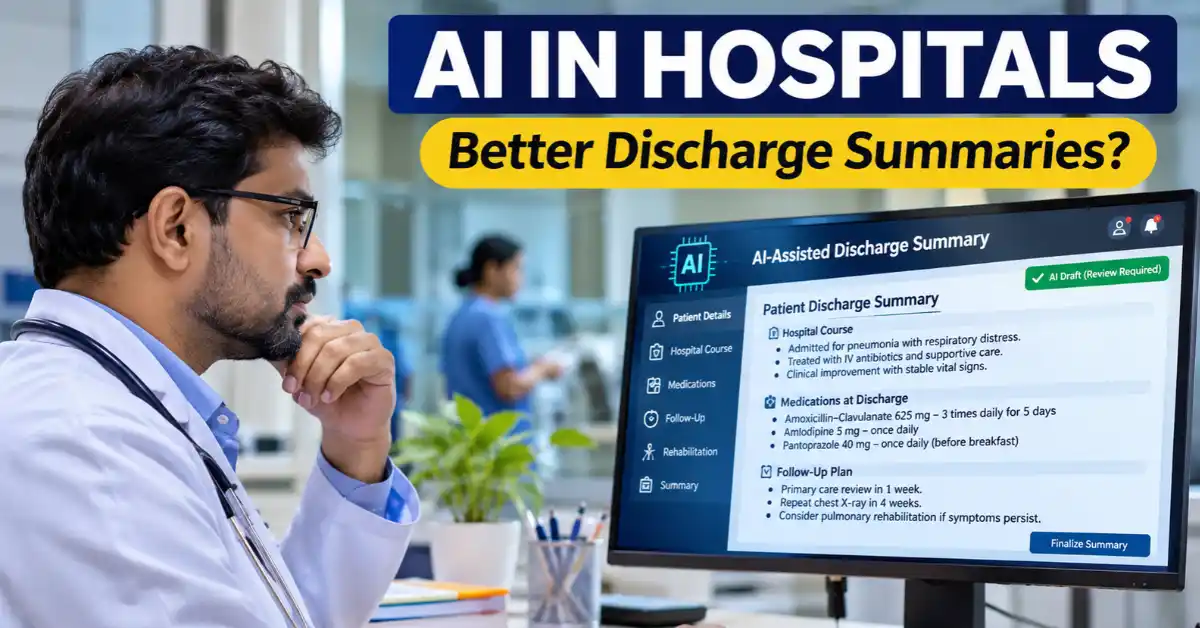
AI-generated documentation should be treated as a draft that requires clinical review. Before approving a discharge summary, the treating physician should verify:
- Final diagnosis: Does the summary accurately reflect the patient’s confirmed diagnoses?
- Medication reconciliation: Are medication changes, doses and discontinuations correct?
- Clinical investigations: Are important test results and unresolved findings documented?
- Follow-up instructions: Are appointments, referrals and pending investigations clearly mentioned?
- Rehabilitation precautions: Are weight-bearing restrictions, mobility limitations and postoperative precautions accurately recorded?
- Clinical consistency: Does every statement match the patient’s actual medical record?
A readable discharge summary is not necessarily an accurate one. Human clinical verification remains essential for safe transitions of care.
What Is the Future of AI in Hospital Discharge Documentation?
The Stony Brook research team plans to investigate accuracy, patient safety, actual physician time savings and integration into everyday clinical workflows.
A clinical pilot study is also being considered at Stony Brook Medicine.
The important distinction is that promising research results do not automatically establish real-world clinical effectiveness. Larger studies, practical implementation and continuous safety monitoring will be necessary.
Key takeaway: AI-generated hospital discharge summaries could improve documentation quality and reduce administrative workload, particularly for complex hospital stays. Nevertheless, physician verification must remain an essential part of the discharge process.
Important Research Limitation
Other studies have reported different results.
A 2025 study published in JAMA Internal Medicine evaluated 100 hospital encounters. AI-generated discharge narratives were rated similarly to physician-written narratives for overall quality, but they were less comprehensive and contained more unique errors.
A 2026 study published in eBioMedicine evaluated 292 paired discharge summaries at a Dutch academic hospital. AI-generated summaries scored lower for completeness, showed similar correctness, and were more concise than physician-written summaries.
These findings suggest that AI performance depends on the model, clinical workflow, hospital setting and evaluation criteria. Results from one institution should not automatically be generalized to all hospitals.
MEDICAL SOURCES
1. npj Digital Medicine — Clinician-centered evaluation of large language model-generated discharge summaries for longer hospitalizations (2026).
Read the original research paper
2. JAMA Internal Medicine — Physician- and Large Language Model-Generated Hospital Discharge Summaries (2025).
3. eBioMedicine — Assessing the quality of AI-generated and physician-written discharge summaries (2026).
MEDICAL DISCLAIMER
This article is for general educational and informational purposes only. It is not a substitute for professional medical diagnosis, treatment, or individualized medical advice. If you have persistent, severe, worsening, or concerning symptoms, consult a qualified healthcare professional. Seek urgent medical care for emergency symptoms.

Dr. Shabbir Hussain, BPT
Registered Physiotherapist | Clinical Rehabilitation Specialist
Maharashtra OTPT Council Reg. No.: PR-2021/08/PT/009532
Society of Onco Physiotherapists Reg. No.: SOP/00033/LM
Dr. Shabbir Hussain, BPT, Registered Physiotherapist with over 8 years of experience in physiotherapy, kidney rehabilitation, oncological rehabilitation, and lymphedema management. He specializes in balance disorders, pain management, musculoskeletal rehabilitation, strengthening programs, and VR-based rehabilitation.