Medically reviewed and updated September 3, 2026 — treatment recommendations and safety information reviewed against current clinical sources.
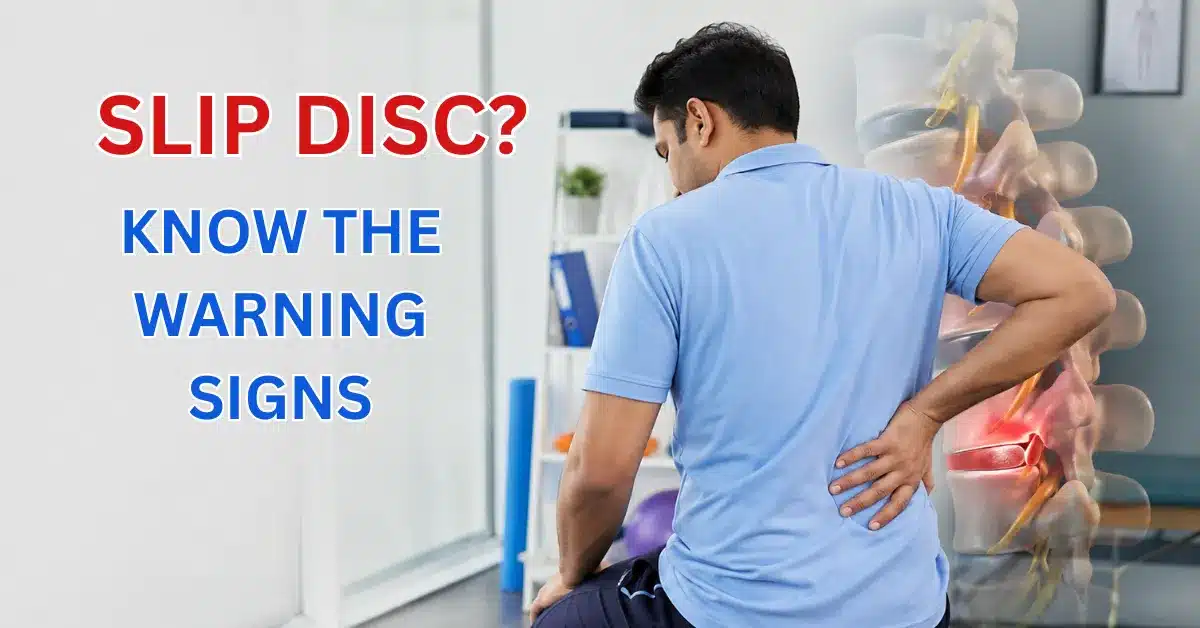
Slip disc symptoms can range from localized lower-back or neck pain to sciatica, numbness, tingling or muscle weakness. A slip disc, more accurately called a herniated disc, occurs when disc material pushes through a weakened or torn outer layer. Most cases are managed without surgery, but certain neurological symptoms require urgent medical assessment. This guide explains slip disc symptoms, treatment options, exercises, L4-L5 disc problems, medicines and slip disc treatment costs in India.
Quick Answer: A slip disc, medically called a herniated disc, occurs when material from a spinal disc pushes through a weakened or torn outer layer. It may cause back or neck pain, sciatica, tingling, numbness or weakness. Most people do not need surgery, but progressive weakness or bladder/bowel problems require urgent medical assessment.
What Are the Slip Disc Symptoms?
Symptoms depend on the disc’s location and whether a nearby nerve is irritated. A lower-back herniated disc may cause low-back pain and sciatica, with pain travelling from the buttock into the leg. Tingling, numbness or muscle weakness can also occur. Cervical disc problems may produce neck pain with symptoms extending into the shoulder, arm or hand.
Is slip disc dangerous?
Usually, a slip disc is not an emergency, and many people improve without surgery. However, urgent assessment is needed if there is worsening or significant weakness, difficulty walking, new bladder or bowel problems, or numbness around the inner thighs, buttocks or genital region. These symptoms can indicate serious nerve compression, including cauda equina syndrome.
Seek urgent medical assessment if you develop:
- new difficulty starting urination or inability to urinate
- loss of bladder or bowel control
- numbness around the genitals, anus, buttocks or inner thighs
- rapidly worsening leg weakness
- new foot drop
- significant difficulty walking
These symptoms can indicate serious nerve compression, including cauda equina syndrome, and require urgent medical assessment.
NICE specifically recommends immediate assessment when severe low-back pain radiating into the leg occurs with new bladder, bowel or sexual dysfunction or new-onset perineal numbness.
What is the slip disc problem at L4-L5?
L4-L5 is a common lumbar level where disc problems can irritate a nerve root and produce lower-back pain or leg symptoms. The exact symptoms depend on which nerve structures are affected, so an MRI report should be interpreted alongside the clinical examination rather than in isolation.
| L4-L5 disc problem | Possible symptoms |
|---|---|
| Low-back pain | Pain around lumbar region |
| Nerve irritation | Pain radiating into buttock/leg |
| Sensory changes | Tingling or numbness |
| Motor involvement | Weakness in muscles supplied by the affected nerve |
| Severe compression | Possible foot weakness/foot drop |
What causes a slip disc?
A herniated disc can develop when the outer portion of a spinal disc becomes weakened or damaged and the inner disc material pushes through it. Age-related disc changes can increase susceptibility. Repetitive lifting, awkward loading, physically demanding work and some forms of trauma may also contribute, although a specific triggering event is not always identifiable.
Do you always need an MRI for a slip disc?
An MRI is not automatically required for every episode of back pain or sciatica. Imaging is generally considered when the result is likely to change management, when symptoms are persistent or disabling, or when there are concerning neurological or other clinical features.
An MRI finding does not automatically mean that the disc herniation is causing the person’s symptoms. Disc abnormalities can occur in people without significant pain, so imaging should be interpreted alongside the history and physical examination.
What medicines are used for slip disc?
Pain medicines may be used for symptom relief depending on the individual’s age, medical history, other medicines and type of pain. A clinician should determine which medicine is appropriate. Medicines intended for neuropathic pain or muscle spasm are not suitable for everyone and should not be started without professional advice.
What is the treatment for a slip disc?
Treatment usually begins conservatively. Depending on the person’s symptoms, this may include activity modification, appropriate pain medicines and physiotherapy. Prolonged bed rest is generally not recommended; gentle movement and gradually returning to activity can support recovery. An epidural steroid injection may be considered for some people with acute and severe sciatica after clinical assessment.
Conservative treatment
- staying reasonably active rather than prolonged bed rest
- symptom-guided activity modification
- appropriate analgesia when medically suitable
- physiotherapy/exercise
- gradual return to normal activity
- selected epidural steroid injection for acute severe sciatica
- surgery in selected patients
What exercises are good for slip disc?
Exercises may include:
Depending on the clinical presentation:
- gentle walking
- repeated movement exercises when appropriate
- lumbar mobility exercises
- trunk stabilization
- progressive abdominal and back strengthening
- hip strengthening
- graded functional movements
The appropriate exercise depends on how symptoms respond to movement, whether leg pain or other nerve symptoms are present, and whether strength or sensation is affected.
A physiotherapist may use movement-based assessment to identify which positions or exercises are better tolerated.
During an acute flare, temporarily modifying activities that clearly increase leg pain, numbness or weakness may be appropriate. However, long-term avoidance of normal movement is not generally the goal. Activity should usually be progressed according to symptoms, function and clinical assessment.
What is the slip disc treatment cost in India?
Published Indian hospital and healthcare sources show that discectomy costs can vary substantially, from around ₹75,000 to several lakh rupees depending on the procedure, hospital, city, room category and individual clinical requirements. These figures are indicative rather than a fixed national price.
Cost information: Indicative published estimates; actual charges vary.
When is surgery needed for a slip disc?
Surgery may be considered when:
- symptoms remain severe or disabling despite appropriate non-surgical treatment
- neurological deficits are significant or progressive
- symptoms and clinical findings correspond with imaging evidence of nerve compression
- urgent neurological compression, such as cauda equina syndrome, is suspected
NICE recommends considering spinal decompression for sciatica when non-surgical treatment has not improved pain or function and the radiological findings are consistent with the symptoms. Urgent neurological assessment is required when cauda equina symptoms appear.
How can physiotherapy help with a slip disc?
Physiotherapy can form an important part of non-surgical management. A physiotherapist may use an individualised programme to reduce functional limitations, restore movement, improve trunk and lower-limb strength and progressively rebuild activity tolerance. The programme should be based on the patient’s examination rather than a generic “slip disc exercise” list.
Physiotherapist’s clinical note: An MRI report should not be interpreted in isolation. In clinical practice, the distribution of pain, neurological findings, movement behaviour and functional limitations all help determine whether a disc finding is clinically relevant.
Medical Disclaimer
This article is for general education and does not replace an examination or personalised medical advice. Severe or worsening weakness, loss of bladder or bowel control, difficulty urinating, or saddle-area numbness requires urgent medical evaluation.
Sources
- NICE — Low back pain and sciatica in over 16s: assessment and management — Clinical guidance covering exercise, activity, imaging, epidural injections and surgical management.
- Mayo Clinic — Herniated Disk: Symptoms & Causes — Symptoms, causes and common clinical features of herniated discs.
- Mayo Clinic — Herniated Disk: Diagnosis & Treatment — Diagnosis, treatment options and when surgery may be considered.
- Mayo Clinic — Sciatica: Symptoms & Causes — Information about sciatic nerve symptoms and causes.
- ManipalCigna — Slip Disc Treatment Cost in India — Published Indian treatment-cost estimates; actual costs vary by hospital, city and treatment.
- Yashoda Hospitals — Discectomy Surgery Cost in India — Published Indian cost information for discectomy procedures.

Dr. Shabbir Hussain, BPT Licensed Physiotherapist | Clinical Rehabilitation SpecialistMaharashtra OTPT Council Reg. No. PR-2021/08/PT/009532Society of Onco Physiotherapists Reg. No. SOP/00033/LM
He is a licensed physiotherapist with over 8 years of experience in physiotherapy, kidney rehabilitation, oncological rehabilitation, and lymphedema management. He specializes in balance disorders, pain management, musculoskeletal rehabilitation, strengthening programs, and VR-based rehabilitation.
Dr. Shabbir Hussain (BPT)