
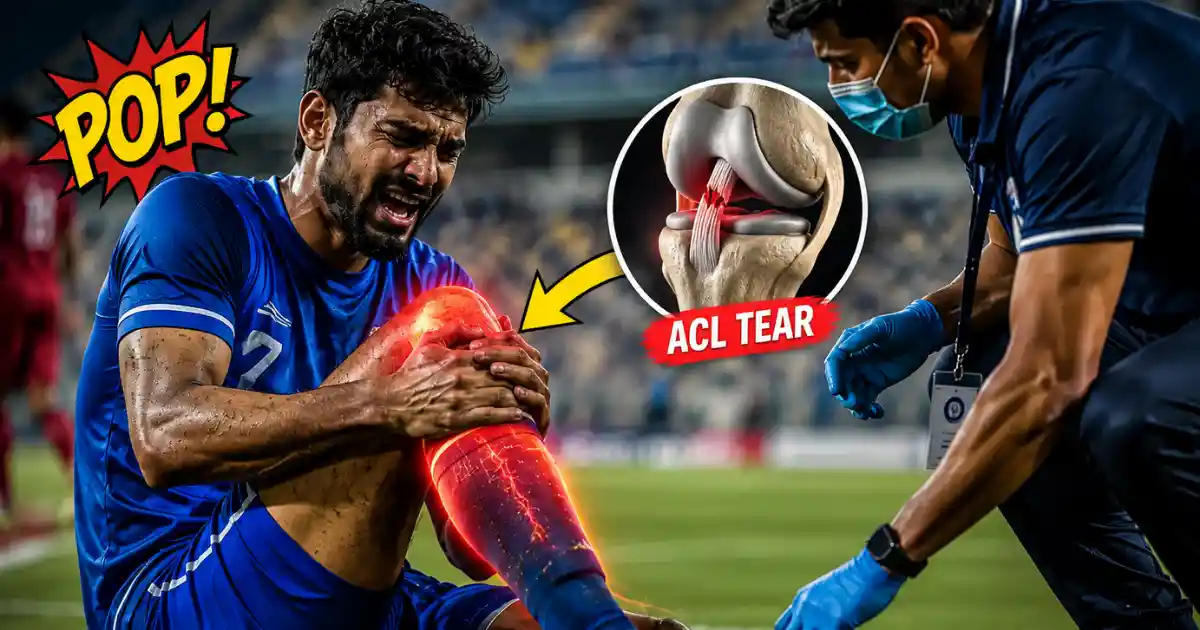
Can You Walk With an ACL Tear?
Many people ignore the first signs of an ACL tear thinking it’s just a minor knee twist — until walking becomes painful or the knee suddenly gives way.
Published Date: May 20, 2026
Last Updated: May 20, 2026
👨⚕️ Author & Medical Review
Written By: Senior Physiotherapy & Rehabilitation Team
Reviewed By: Dr. SHABBIR HUSSAIN (BPT)
Clinical Experience: Orthopedic Rehabilitation & Sports Injury Management
Evidence-Based Review: Yes
This article has been reviewed by a qualified physiotherapist for medical accuracy and public health awareness.
⚡ Quick Summary
Main Risk: Knee instability and long-term cartilage damage
Key Symptom: Sudden popping sensation with swelling
Best Solution: Early diagnosis + structured physiotherapy rehabilitation
Prevention Tip: Improve knee strength, balance, and landing mechanics
The moment usually feels small.
A quick twist while getting off a bike. A sudden turn during cricket. Missing one step while rushing downstairs. Many patients initially think, “It’s probably just a minor sprain.”
But clinically, ACL injuries rarely stay “minor.”
In my physiotherapy practice, one common pattern observed is that people continue walking despite the injury, only to notice weeks later that the knee feels unstable, weak, or “untrustworthy.” Some even describe the sensation as if the knee may suddenly give way while climbing stairs.
That delay can quietly worsen the damage.
An untreated ACL tear may affect not only sports activities but also normal daily movement, confidence, balance, and long-term joint health.
What Is an ACL Tear?
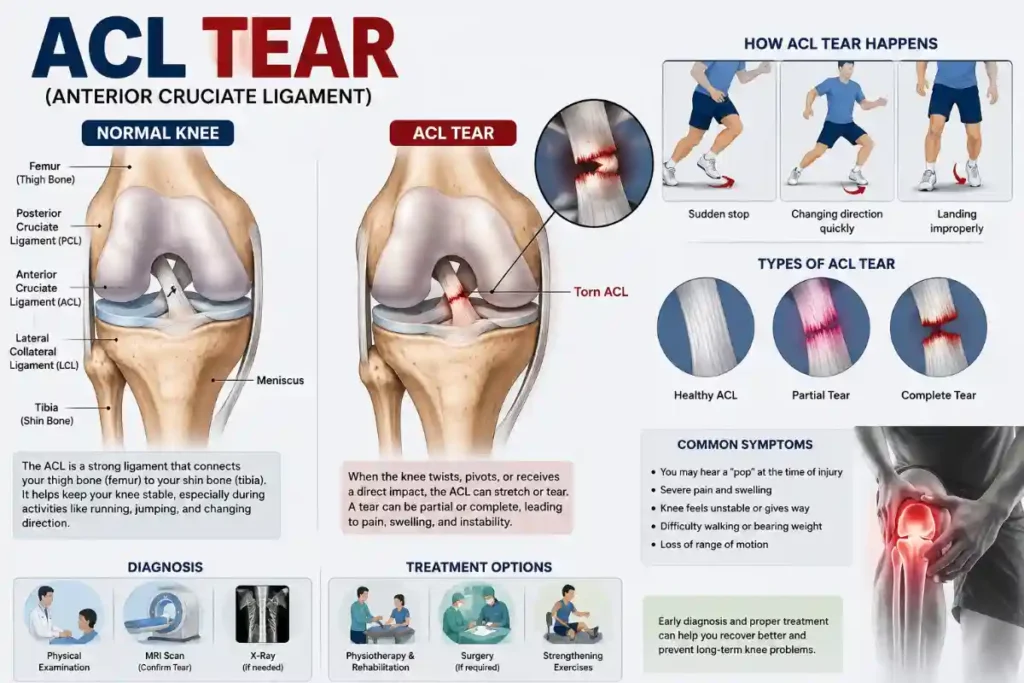
The ACL, or Anterior Cruciate Ligament, is one of the major ligaments inside the knee joint. Its primary role is to stabilize the knee during twisting, turning, jumping, and sudden directional movements.
f(x)=Knee Stability During Rotational Movement
The ACL acts like a strong internal support structure that prevents the shin bone from moving excessively forward relative to the thigh bone.
When this ligament tears partially or completely, knee stability reduces significantly.
In simple terms, the knee may still move, but it no longer feels secure.
Many ACL tears happen during sports like football, badminton, basketball, kabaddi, or gym training. However, in modern rehabilitation settings, ACL injuries are increasingly seen in non-athletes too. Sudden slips in bathrooms, bike accidents, awkward landings, and even aggressive stair climbing can trigger injury.
In my clinical experience, younger adults often ignore early symptoms because swelling reduces after a few days. Unfortunately, internal instability may continue silently.
Hidden Dangers of an ACL Tear
The biggest danger is not always the initial pain.
It is what happens afterward.
An unstable knee changes the way a person walks, squats, climbs stairs, and distributes body weight. Over time, this abnormal movement pattern may increase pressure on cartilage and menisci inside the knee.
Clinically, many patients who delay rehabilitation later develop recurring swelling, locking sensations, reduced confidence while walking, and early degenerative knee changes.
One common pattern observed in Indian office workers is reduced physical activity after injury. People become fearful of movement, gain weight gradually, and unknowingly weaken surrounding muscles further.
This creates a vicious cycle:
pain → inactivity → weakness → instability → more pain.
In severe cases, repeated knee instability episodes may damage other structures inside the joint.
Causes & Risk Factors
ACL tears are often linked to sports, but modern lifestyle habits are contributing too.
Sudden twisting movement remains one of the biggest triggers. Athletes commonly injure the ACL while pivoting or landing awkwardly after a jump.
However, sedentary urban lifestyles also play a role.
Long sitting hours weaken gluteal and thigh muscles. Smartphone overuse reduces posture awareness and movement quality. Many Indian professionals commute for long hours and exercise irregularly, which affects balance, flexibility, and lower limb coordination.
Personally, I’ve observed that gym beginners sometimes perform jumping exercises or deep squats without proper knee control. This increases strain on the ligament.
Other risk factors include obesity, poor footwear, weak hamstrings, previous knee injuries, muscle imbalance, slippery surfaces, and fatigue during sports.
Women may also have a slightly higher risk because of anatomical and hormonal factors affecting knee alignment and ligament laxity.
Warning Signs You Should Never Ignore
Many ACL tears produce a distinct “pop” sound at the moment of injury.
Patients often describe hearing or feeling something snap inside the knee.
Swelling may appear within a few hours. Walking becomes difficult, especially during turning movements.
One important symptom is instability.
People frequently say:
“It feels like my knee is slipping.”
“It suddenly gives way.”
“I don’t trust my leg anymore.”
In real rehabilitation settings, instability is often more concerning than pain itself.
Early signs may include mild swelling, stiffness, discomfort while descending stairs, or difficulty squatting.
Advanced symptoms may include:
persistent instability, repeated swelling episodes, reduced range of motion, locking sensations, and muscle wasting around the thigh.
⚠️ Ignoring these signs may increase the risk of long-term knee degeneration.
Diagnosis
ACL injuries require proper clinical assessment.
A physiotherapist or orthopedic specialist usually begins with history taking and movement evaluation. The mechanism of injury provides major clues.
Specific physical tests help assess ligament stability.
Common clinical tests include:
Lachman test, anterior drawer test, and pivot shift test.
MRI is considered the gold-standard imaging method because it clearly visualizes ligament damage and associated injuries.
X-rays may also be used to rule out fractures.
In physiotherapy practice, movement quality assessment is equally important. Many patients compensate unconsciously by shifting weight away from the injured side.
This altered movement pattern can affect the hip, ankle, and lower back too.
Treatment & Physiotherapy Management
Treatment depends on several factors:
age, activity level, instability severity, associated injuries, and functional goals.
Not every ACL tear automatically requires surgery.
Some individuals recover successfully through structured physiotherapy rehabilitation, especially when instability is manageable and lifestyle demands are lower.
However, athletes and highly active individuals may require ACL reconstruction surgery for optimal stability.
In real rehabilitation settings, physiotherapy plays a critical role both before and after surgery.
Early rehabilitation focuses on:
reducing swelling, restoring range of motion, improving muscle activation, and controlling pain.
Later stages focus heavily on strength, balance, neuromuscular control, and movement retraining.
One common mistake observed clinically is rushing back to sports too early.
Many patients feel “normal” within a few weeks, but ligament healing and neuromuscular recovery take much longer.
Recovery timelines vary significantly.
Mild injuries may improve within weeks, while post-surgical rehabilitation often requires 6–9 months or longer depending on the individual.
Many patients improve faster when they follow consistent rehabilitation instead of depending only on rest or painkillers.
Myth vs Fact
A common myth is that walking normally means the ACL has healed.
That is not always true.
Some patients can walk despite significant ligament damage because surrounding muscles temporarily compensate.
Another myth is that complete bed rest is best.
Excessive inactivity may actually worsen muscle weakness and stiffness.
Evidence-based rehabilitation focuses on controlled movement, progressive strengthening, and functional recovery.
Prevention Strategy
ACL injury prevention is possible in many cases.
Strong thigh, hip, and core muscles help reduce stress on the knee joint. Balance training and landing mechanics are equally important.
Indian lifestyle adjustments matter too.
People who sit for long hours should avoid remaining inactive throughout the day. Small movement breaks improve muscle activation and circulation.
In my clinical experience, patients who combine strength training with flexibility and movement control exercises usually maintain better long-term knee health.
Proper warm-up before sports is essential.
Supportive footwear also matters, especially on slippery surfaces during monsoon seasons.
Young athletes should learn safe jumping and landing techniques early.
Real Patient Story
A 27-year-old software engineer visited the clinic after slipping during a weekend football match.
Initially, he ignored the injury because he could still walk.
After two weeks, he noticed his knee repeatedly giving way while climbing stairs in his office building. Swelling kept returning after long working hours.
Clinical examination suggested ACL instability, later confirmed through MRI.
What stood out was not severe pain — it was fear.
He stopped exercising completely and became anxious about movement.
Through structured physiotherapy rehabilitation focusing on quadriceps strength, balance retraining, and gradual functional exercises, his confidence improved significantly over the next few months.
This pattern is extremely common in urban Indian professionals today.
🩺 Doctor Insight
⚠️ Many patients ignore early ACL symptoms until daily movement becomes painful or unstable. Early rehabilitation often improves long-term outcomes significantly.
When to See a Doctor
Seek medical evaluation immediately if:
the knee swells rapidly after injury, you hear a popping sound, the knee feels unstable, or walking becomes difficult.
Repeated episodes of the knee giving way should never be ignored.
Early assessment may help prevent further joint damage.
Who Should Avoid Certain Exercises or Treatments?
People with severe swelling, suspected fractures, acute instability, or uncontrolled pain should avoid aggressive strengthening exercises initially.
Deep squats, jumping drills, twisting activities, and high-impact sports should be avoided until proper assessment is completed.
Post-surgical patients must also avoid unsupervised rehabilitation.
In physiotherapy practice, individualized progression is extremely important because recovery speed differs from person to person.
✅ Key Takeaways
ACL tears may initially feel minor but can lead to serious instability.
Swelling, popping sounds, and knee “giving way” are major warning signs.
Physiotherapy plays a critical role in recovery and long-term knee protection.
Ignoring rehabilitation may increase future joint damage risk.
Early diagnosis often improves recovery outcomes significantly.
Modern sedentary lifestyles may indirectly increase injury risk.
⚠️ Medical Disclaimer
This article is for educational and public awareness purposes only. It does not replace professional medical evaluation, diagnosis, or treatment. Always consult a qualified healthcare professional for personalized advice.
FAQs
Can you walk with a torn ACL?
Yes, many people can still walk after an ACL tear, especially initially. However, instability may persist internally.
Does every ACL tear need surgery?
No. Some individuals recover well with structured physiotherapy, while others may require surgery depending on activity demands and instability severity.
How long does ACL recovery take?
Recovery varies widely. Conservative rehabilitation may take weeks to months, while post-surgical recovery often takes 6–9 months or longer.
What does an ACL tear feel like?
Patients commonly describe a popping sensation followed by swelling, instability, and difficulty with twisting movements.
Can gym workouts cause ACL injuries?
Yes, improper landing mechanics, poor supervision, fatigue, or uncontrolled twisting movements may increase risk.
Is cycling safe after ACL injury?
In many cases, controlled cycling is introduced during rehabilitation, but timing depends on injury severity and recovery stage.

References
- National Institutes of Health (NIH). ACL Injuries Overview.
https://www.ncbi.nlm.nih.gov/books/NBK499848/ - PubMed. Anterior Cruciate Ligament Rehabilitation Research.
https://pubmed.ncbi.nlm.nih.gov/35381974/ - World Health Organization (WHO). Physical Activity and Musculoskeletal Health.
https://www.who.int/news-room/fact-sheets/detail/physical-activity - American Academy of Orthopaedic Surgeons (AAOS). ACL Injury Guidelines.
https://www.aaos.org/globalassets/quality-and-practice-resources/anterior-cruciate-ligament-injuries/aclcpg.pdf - British Journal of Sports Medicine. ACL Rehabilitation Evidence.
https://bjsm.bmj.com/content/57/9/500
Dr. Shabbir Hussain, BPT
Licensed Physiotherapist | Clinical Rehabilitation Specialist
Maharashtra OTPT Council Reg. No.: PR-2021/08/PT/009532
Society of Onco Physiotherapists Reg. No.: SOP/00033/LM
Dr. Shabbir Hussain, BPT, Registered Physiotherapist with over 8 years of experience in physiotherapy, kidney rehabilitation, oncological rehabilitation, and lymphedema management. He specializes in balance disorders, pain management, musculoskeletal rehabilitation, strengthening programs, and VR-based rehabilitation.